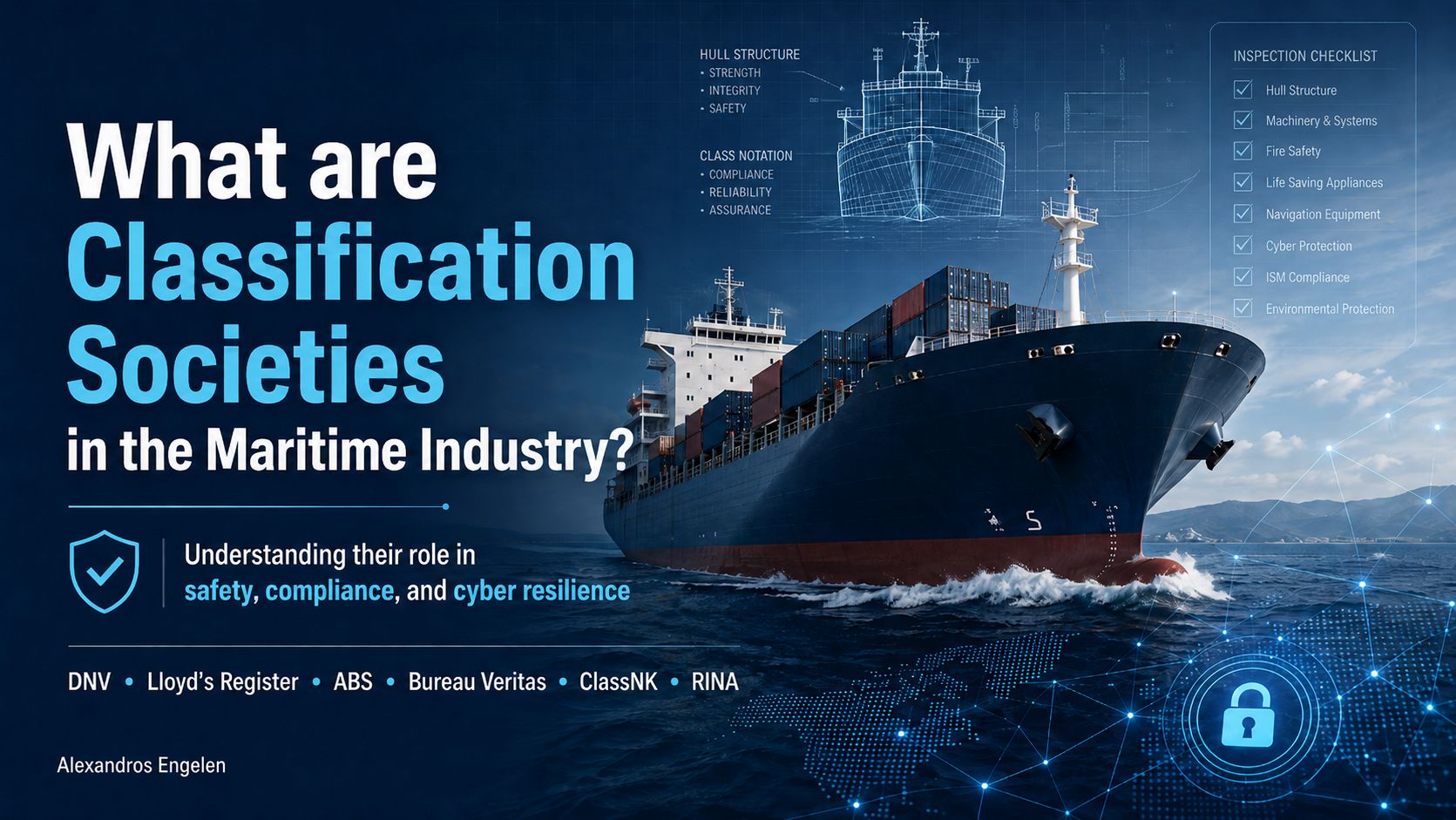
If you work in shipping, you encounter their names constantly:
– DNV
– Lloyd’s Register
– ABS Group
– Bureau Veritas
– ClassNK – Nippon Kaiji Kyokai
– RINA
But outside technical circles, their actual role is often misunderstood.
Classification societies are independent technical organizations that establish and apply rules for the design, construction, and operation of ships and offshore structures.
When a vessel is built and maintained in accordance with a society’s rules, it is said to be “in class.”
This is not just a formality.
Class status supports a vessel’s technical credibility, insurability, chartering acceptance, and the confidence that owners, operators, charterers, insurers, financiers, port states, and flag states place in its condition.
Their role spans the full lifecycle of a vessel:
– Design approval before construction begins.
– Surveys during construction.
– Periodic surveys during operation.
Verification that the vessel continues to comply with applicable class requirements throughout its service life.
It is also important to distinguish between classification and statutory certification.
Classification societies apply their own technical rules. However, when authorized by a flag State, they may also act as Recognized Organizations, carrying out statutory surveys and certification on behalf of that flag administration.
This is where their influence becomes even more important.
The twelve IACS member societies coordinate through the International Association of Classification Societies, which develops unified requirements and interpretations adopted across member fleets.
And this is where the cyber dimension becomes unavoidable.
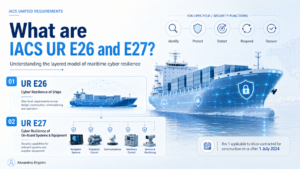
IACS Unified Requirements E26 and E27, applicable to new ships contracted for construction on or after 1 July 2024, extend classification thinking into cyber resilience.
1. UR E26 focuses on the cyber resilience of the ship as a whole.
2. UR E27 focuses on the cyber resilience of onboard systems and equipment.
In other words, the same institutional framework that has governed hull, machinery, and safety-related technical assurance for more than a century is now shaping the baseline for cyber integrity at sea.
Understanding what classification societies do is the first step to understanding who sets many of the technical rules maritime cyber security must now answer to.