Maritime Cyber Threat Briefing #8
There is a question that has shaped the maritime cyber security conversation for years: how technically capable does an attacker need to be to compromise a vessel, a fleet management system, or a port terminal?
Until recently, the honest answer was: reasonably capable.
- Exploiting OT systems
- Maintaining persistence in an isolated shipboard network
- Conducting credible social engineering against a multinational crew operating across multiple time zones and languages
These things required effort, knowledge, and time. They were not trivial. That constraint provided the industry with a degree of passive protection. That constraint is gone.
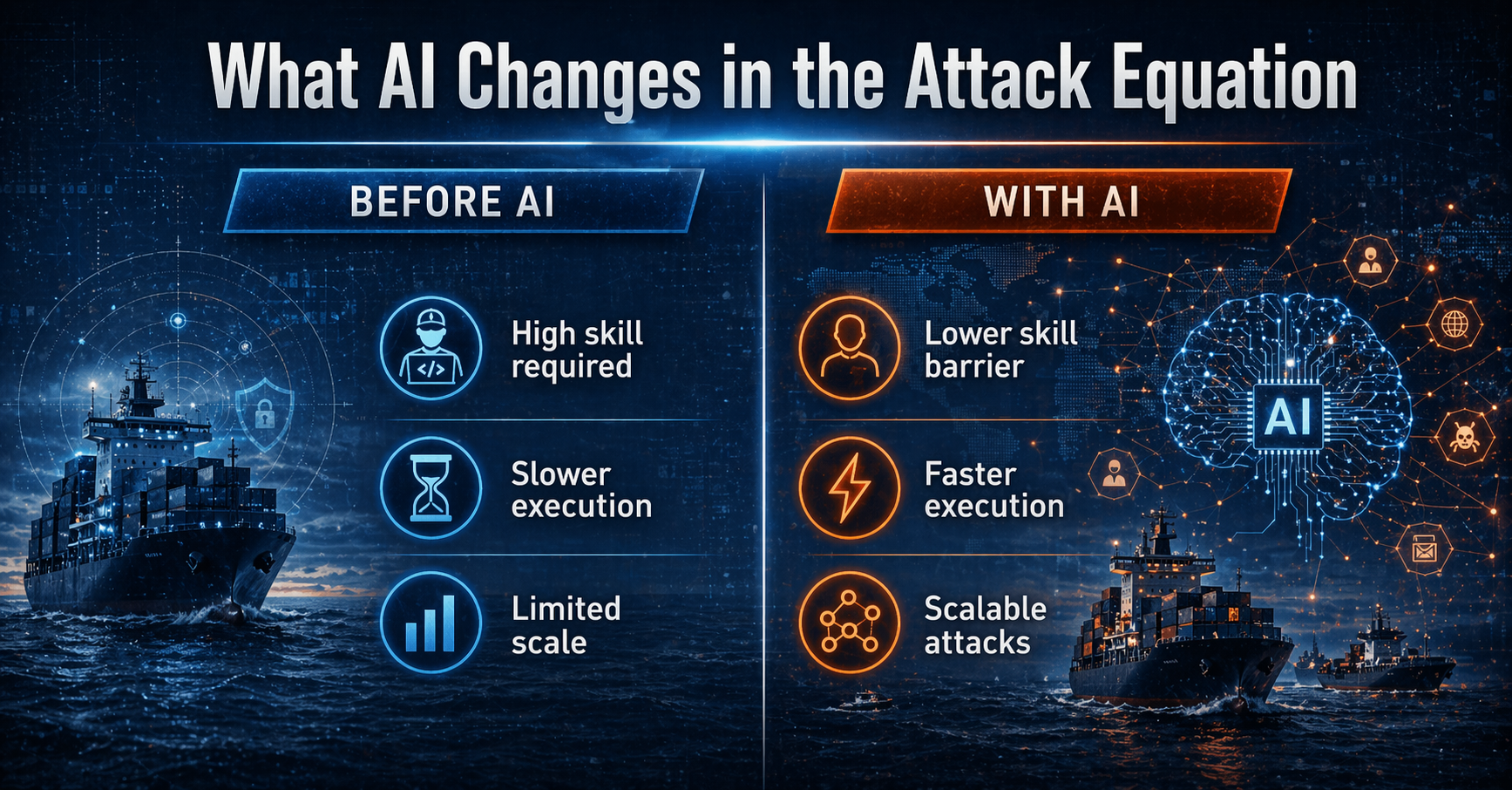
In 2026, artificial intelligence has fundamentally altered the economics and accessibility of maritime cyberattacks. Tools that previously required a sophisticated threat actor to operate can now be directed by someone with minimal technical knowledge. Attack lifecycles that previously took days or weeks to execute can now be compressed into hours, or minutes. Phishing campaigns that were once detectable by poor grammar and generic content are now indistinguishable from legitimate communications, personalised by AI to the specific cultural background, native language, and professional context of each individual target.
Shipping companies are deploying AI faster than they are defining cyber accountability. The same technology being adopted to optimise fleet operations, predictive maintenance, and crew recruitment is simultaneously being weaponised against the industry. At the same time, the attackers are moving faster than the defenders.
The Collapse of the Exploitation Window
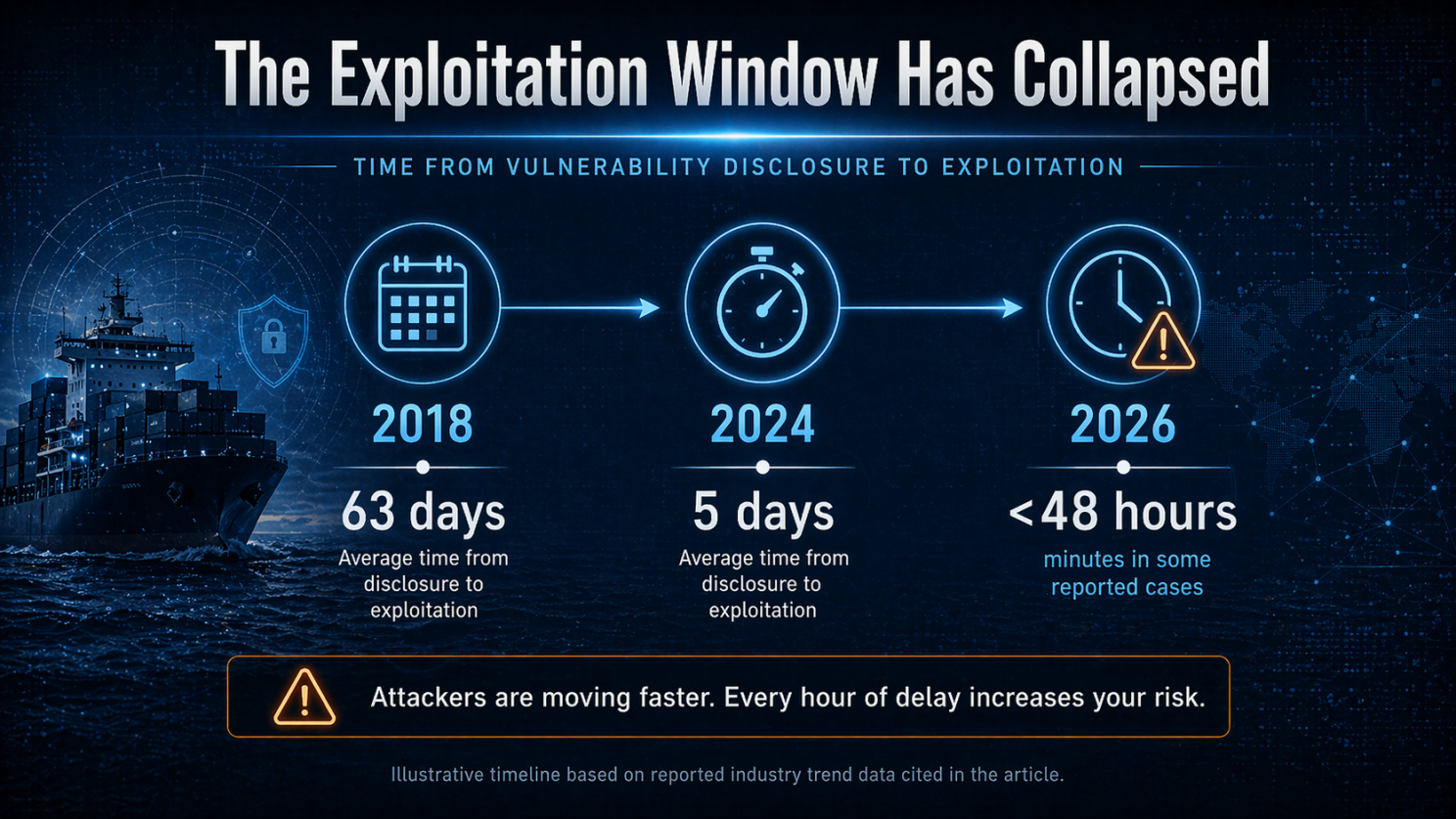
The most operationally significant consequence of AI in the attack landscape is the collapse of the time between vulnerability disclosure and active exploitation.
In 2018, attackers typically took 63 days to exploit a newly published flaw. By 2024, that window had collapsed to five days. Industry reporting in 2026 suggests that AI-driven attack workflows have reduced the exploitation window to less than 48 hours in many cases, with some systems reportedly targeted within minutes of a flaw being identified.
For maritime operators, this timeline collapse has a specific and serious implication. Vessels are not corporate IT environments. A shore-based IT team cannot push a critical patch to a vessel’s ECDIS or engine management system with the same speed and certainty that an enterprise can update a server. Recent maritime reporting has argued that up to 60% of newly disclosed software vulnerabilities across ships, ports, and offshore assets are now weaponised within 48 hours. The patch management cycle that the maritime industry relies on [periodic updates during port calls & remote updates over satellite links] was designed for a world where attackers took weeks to act. That world no longer exists.
The practical consequence is straightforward: a vulnerability disclosed on a Monday morning may be actively exploited against maritime targets before the vessel has made its next port call. The window for remediation has collapsed to a timeframe that the industry’s current patching infrastructure cannot consistently meet.
The GTG-1002 Precedent: What Autonomous AI Attacks Actually Look Like
To understand where maritime cyber risk is heading, it is necessary to understand what happened in September 2025 and what it means for any organisation that manages complex, geographically distributed operational technology.
In September 2025, the cybersecurity landscape crossed a pivotal threshold with the first widely verified case of an AI-powered, largely autonomous cyber-espionage campaign. A China-aligned threat actor, designated GTG-1002, manipulated a commercial AI coding tool into bypassing its safeguards and used it to autonomously execute intrusion attempts across nearly thirty global organisations spanning technology, finance, chemical manufacturing, and government sectors, with several resulting in successful compromises.
What marked this campaign as strategically significant was not just its scale, but its unprecedented speed. Compressing activities that traditionally require human operators days or weeks into minutes, enabling real-time adaptation, automated reconnaissance, and the ability to sustain dozens of parallel intrusion threads.
The campaign reportedly relied heavily on contextual manipulation of the AI tool’s reasoning process, influencing how it interpreted intent and decomposed tasks. GTG-1002 influenced how an agentic model interpreted intent breaking the attack down into small, innocuous-looking tasks so that the AI cooperated without recognising the full objective. The attack did not rely on misconfigurations or malware. Defensive tools focus on monitoring networks and software behaviour, but they do not track the internal reasoning patterns of an AI system.
The maritime implications are direct. Chemical manufacturers were among the confirmed targets of GTG-1002. Industries with OT environments that share significant architectural similarities with shipboard systems. The techniques demonstrated [autonomous reconnaissance, parallel intrusion threads, AI-directed exploit generation] are as applicable to a vessel’s navigation network or a port’s terminal operating system as they are to a corporate IT environment. The GTG-1002 campaign was not aimed at shipping. But it was a proof of concept for what is coming.
AI-Powered Social Engineering: The Crew as the Target
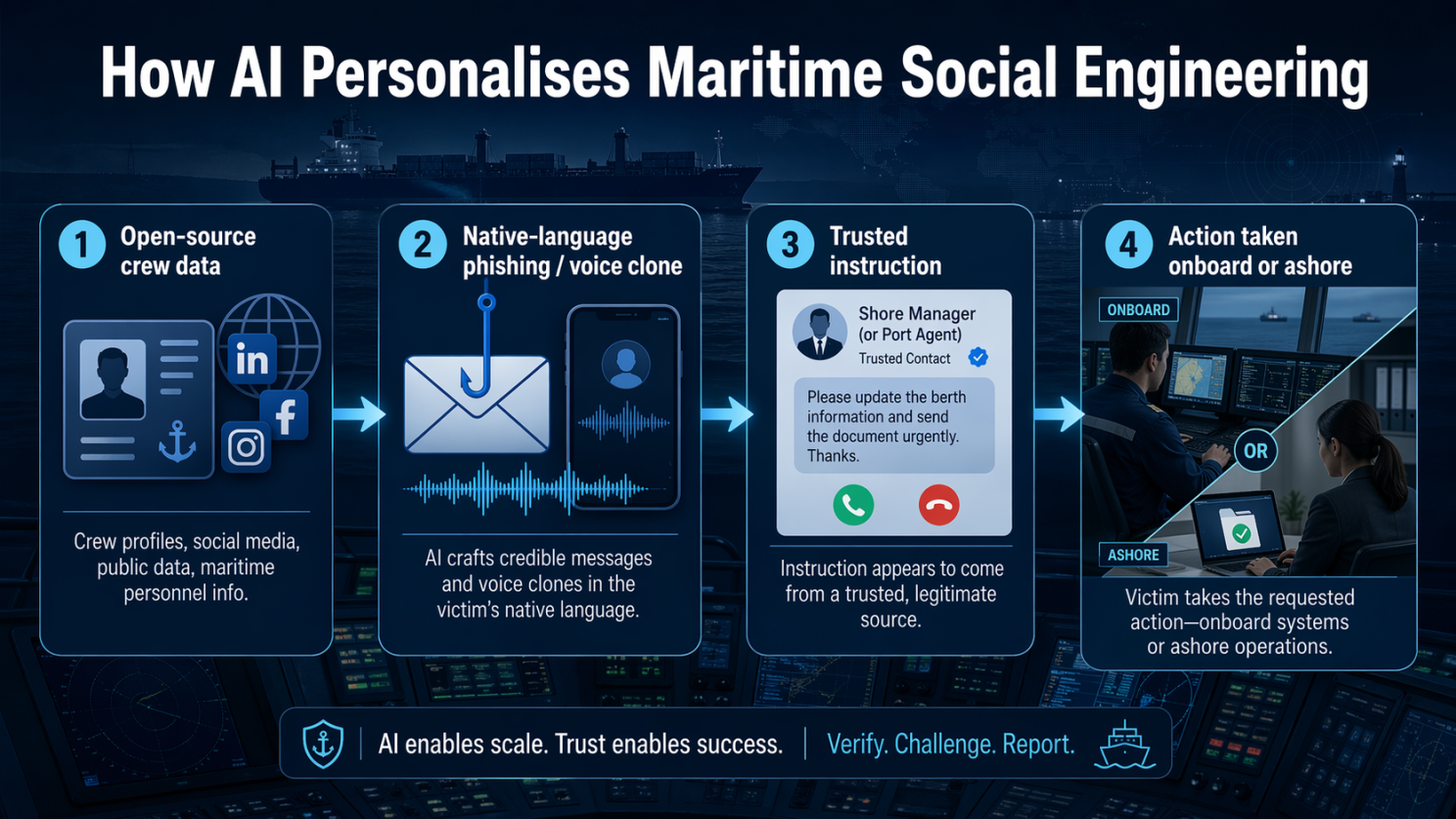
Beyond autonomous intrusion, AI has transformed the social engineering threat in ways that make existing crew awareness training inadequate for the current threat environment.
83 percent of phishing emails targeting multinational maritime crews are now AI-generated, written in native languages and tailored to cultural nuances. This has led to a 1,600 percent surge in voice phishing, where AI clones trusted voices to manipulate crew members into taking actions they would otherwise question.
The implications for maritime operations are acute. Crews operate in multinational environments, under time pressure, with limited ability to verify instructions through alternative channels when at sea. An AI-generated voice call impersonating a port agent, a fleet manager, or a classification society surveyor, delivered with cultural familiarity and the correct technical vocabulary is extraordinarily difficult to identify as fraudulent in real time.
This is not theoretical. Documented fraud cases already show how AI-enabled impersonation can redirect sensitive payments, while high-profile deepfake executive scams outside the maritime sector have demonstrated losses in the tens of millions of dollars. The attacker did not need to board the vessel, access the network, or compromise any operational system. They needed to intercept and replicate a payment communication convincingly enough to redirect a transaction. AI made that replication trivially achievable.
The wider deepfake threat reinforces this picture. A CFO deepfake fraud case involved employees attending a video call where every participant except them was an AI-generated deepfake trusting what they saw and heard. They authorised transfers totalling about $25 million. As this technology becomes commoditised, the question for maritime organisations is not whether their crews could be targeted by a convincing impersonation of shore management. It is whether they have any reliable means of verifying they are not already being targeted.
The Democratisation of Sophisticated Attacks
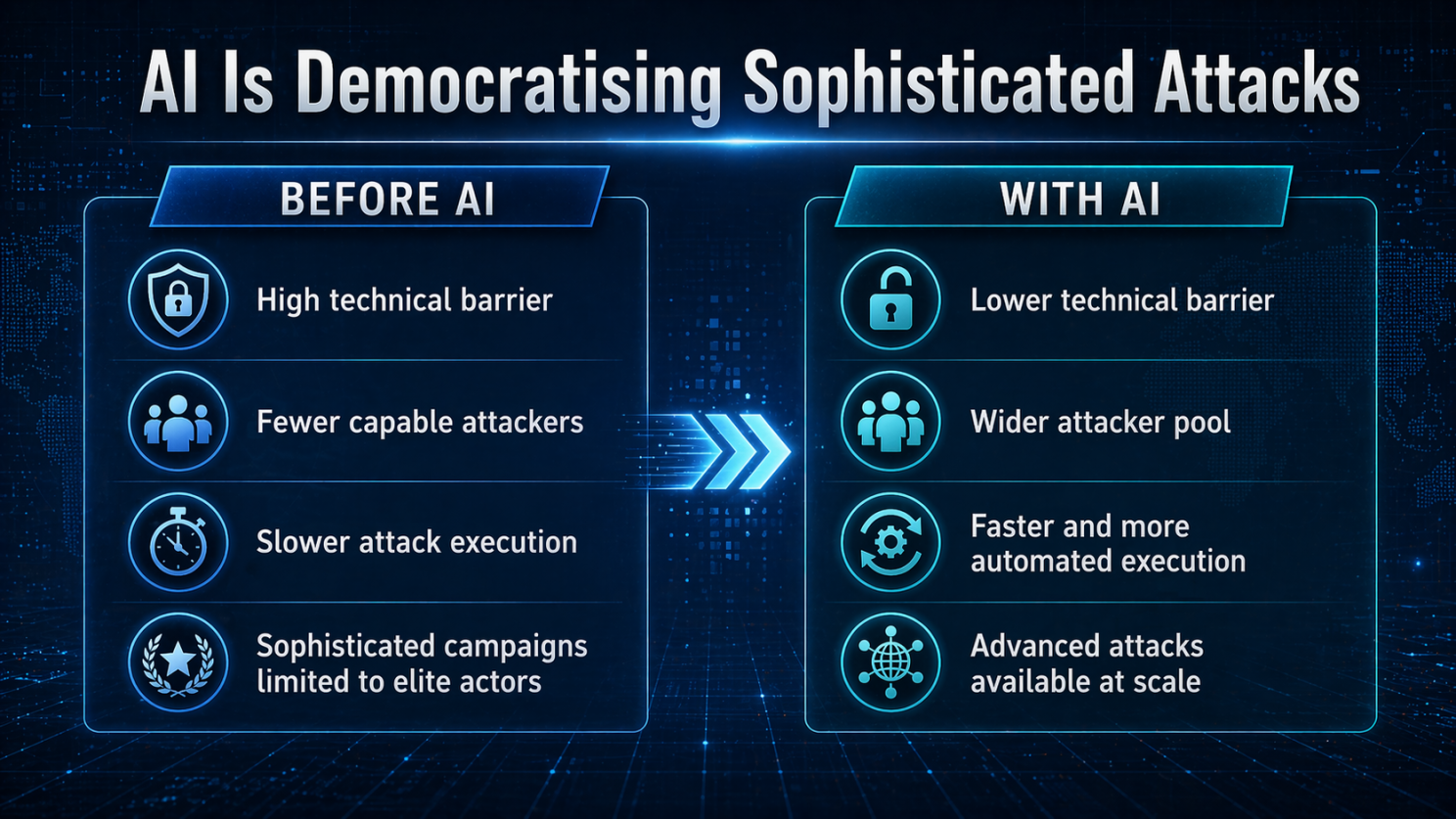
Perhaps the most consequential aspect of AI’s entry into the offensive cyber landscape is what it does to the attacker population.
Previously, the most damaging attack methodologies:
- Persistent OT compromise
- Multi-stage intrusion chains
- Fleet-scale disruption
Required state-sponsored or highly organised criminal groups with significant technical resources. The sophistication required to execute such attacks was itself a limiting factor on their frequency.
AI is increasingly moving beyond a support role toward semi-autonomous execution of attack workflows, lowering the barrier to entry for less sophisticated actors. This development lowers the barrier to entry, enabling less-skilled actors to conduct highly sophisticated, nation-state-level attacks at scale, driving a sharp increase in attack frequency against maritime organisations.
Both state-sponsored and less sophisticated criminal groups could potentially perform large-scale attacks using agentic AI. Autonomous agents can execute tasks quicker and more efficiently than human operators, and AI may also be used to conduct disruptive cyberattacks that threaten delivery of essential services.
For maritime operators, this means the threat population is no longer bounded by technical capability. An actor who previously lacked the expertise to exploit a shipboard OT vulnerability can now direct an AI agent to identify, analyse, and exploit that vulnerability autonomously. The constraint that previously separated opportunistic low-skill attacks from sophisticated targeted intrusions has been removed.
In practice, AI does not need to create entirely new attack pathways to be dangerous. It can accelerate existing ones by:
- Automating credential harvesting
- Improving supplier impersonation
- Generating realistic maintenance requests
- Scaling reconnaissance against vendor ecosystems already trusted by maritime operators.
In that sense, AI amplifies the very supply-chain and access-path risks the industry is already struggling to contain.
The Insider Dimension
AI also intensifies the insider threat in maritime environments in ways that deserve specific attention.
In 2026, insider risk is becoming one of the hardest categories of cyber risk to detect and manage, particularly in digitally integrated environments. As organisations become more digitally integrated, insider risk [whether malicious, compromised, or accidental] will be one of the hardest challenges to detect and manage.
The maritime environment creates specific insider risk conditions. Crews rotate frequently, passing through multiple ports and jurisdictions. Shore-based contractors and service engineers retain remote access credentials. OEM technicians connect to vessel systems from locations that the ship operator often cannot verify. AI-powered social engineering can compromise an otherwise loyal crew member through targeted manipulation that leverages personal financial pressure, family circumstance, or professional grievance. All of which can be researched and identified from open sources by an AI agent conducting reconnaissance.
In 2026, rogue insiders leveraging AI and deepfakes represent a convergent risk. Employees who have the proclivity to act against the organisation’s interests will be encouraged to do so with AI making it easy and deepfakes providing plausible deniability. Any insider has all the business context to customise deepfake attacks to seem much more real than anything previously encountered.
The ferry Fantastic incident, in which a crew member inserted a malware-loaded USB drive into a bridge workstation acting on external instructions was a human-factor failure. In the AI era, the instructions that led to that insertion may have been delivered by a voice clone of the vessel’s technical superintendent, a deepfake video message from a trusted shore contact, or a personalised phishing message in the crew member’s native language that referenced specific details about their employment, family, and financial situation. The human factor has always been the hardest element of maritime cyber security to address. AI makes it harder still.
Mitigation: Adapting to Machine-Speed Threats
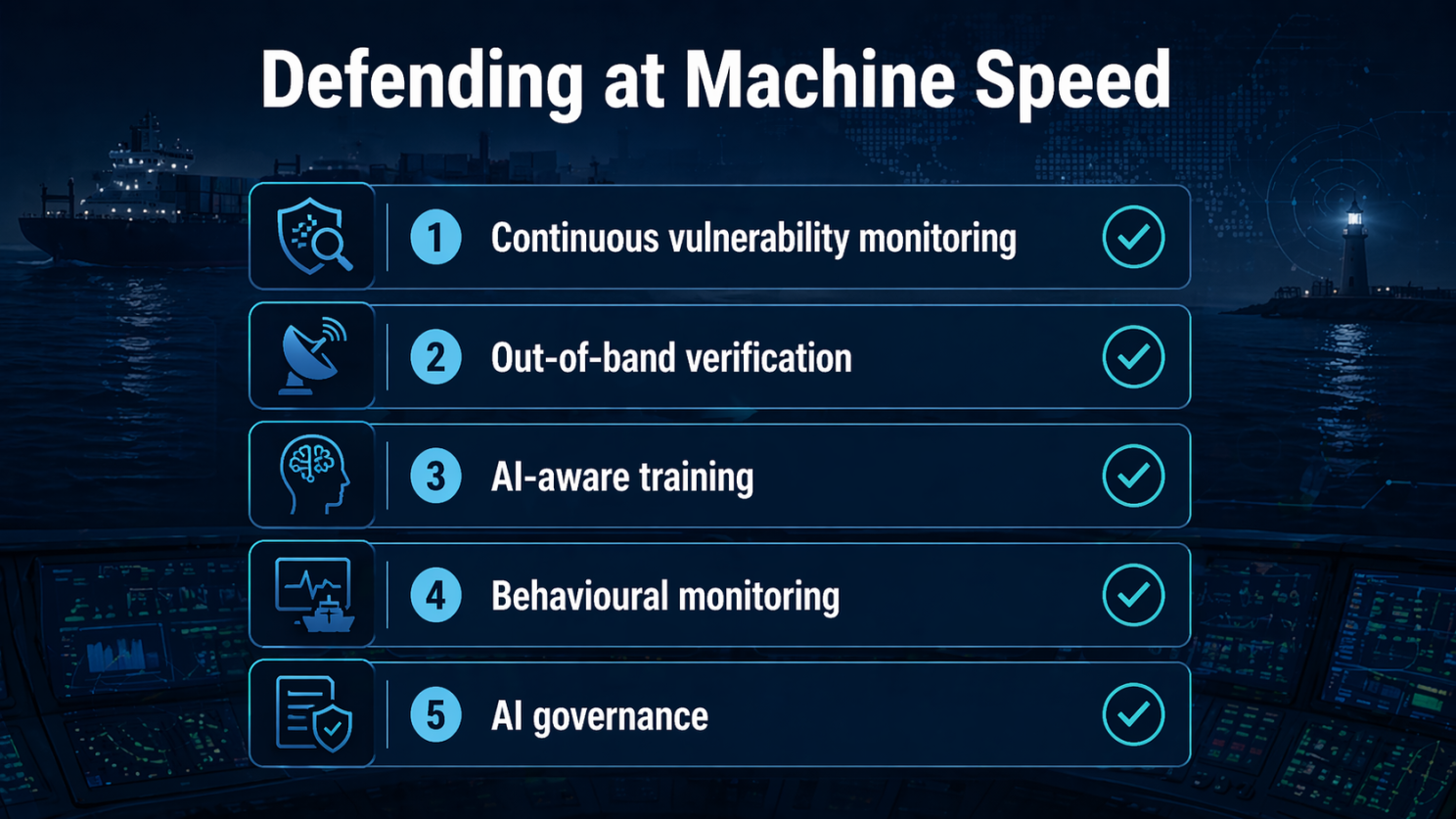
The defences that the maritime industry has been building for the last decade were designed for a human-paced threat environment. They are necessary but no longer sufficient. Adapting to AI-driven attacks requires a different approach across several dimensions.
- Continuous vulnerability management, not periodic patching. The 48-hour exploitation window makes port-call patch cycles untenable as the primary vulnerability management mechanism. Maritime organisations need continuous monitoring of vulnerability disclosures relevant to their installed systems, with risk-based prioritisation that can trigger emergency remote patching where available, or compensating controls where it is not. IACS UR E26 and E27 provide the framework the industry needs to implement it with the urgency that the current exploitation timeline demands.
- Out-of-band verification for high-risk instructions. Any instruction that involves financial transactions, changes to vessel systems, access credential changes, or deviations from established procedures should require verification through a channel independent of the one through which the instruction arrived. A voice call instruction to modify a payment should be verified by a pre-established callback number. A remote access request from a service engineer should be verified against a pre-agreed schedule. These protocols are simple, operational, and directly address the social engineering threat that AI has amplified.
- AI-aware crew training. Current maritime cyber awareness training was not designed to address AI-generated voice cloning, deepfake video impersonation, or hyper-personalised phishing in multiple languages. Training programmes need to be updated to address these specific threats, with realistic scenario-based exercises that reflect the actual form attacks are taking. Not generic phishing awareness content that the threat has already rendered obsolete.
- Behavioural monitoring over signature-based detection. While unpatched vulnerabilities were the primary attack vector in 2024–2025, the 2025–2026 period has seen a marked rise in the exploitation of valid, stolen credentials as a dominant entry point. AI-driven attacks increasingly use legitimate credentials and trusted access pathways, which means signature-based detection systems will not catch them. Anomalous behaviour detection [unusual access patterns], unexpected data movements, atypical command sequences in OT environments, is the detection layer that matters when the attacker is using legitimate credentials.
- Governing AI deployment aboard vessels and in shore operations. Shipping companies adopting AI tools for operational purposes need to define accountability frameworks before deployment, not after an incident. Which AI systems have access to which data? What decisions can AI systems make autonomously? What audit trails exist? In 2026, the question after an incident will not be “was the AI wrong?” but “why was it trusted?” Organisations that cannot answer that question before the incident will not be able to answer it after.
Regulatory Considerations
The regulatory framework has not yet fully absorbed the implications of AI-driven attacks for maritime cyber security, but the direction of travel is clear.
International Maritime Organization updated cyber risk management guidelines reference the National Institute of Standards and Technology (NIST) Cybersecurity Framework v2.0, which includes governance as a core function. Directly applicable to the AI accountability question. IACS UR E26 and E27 requirements for continuous monitoring and documented incident response are more relevant than ever when the attack timeline has collapsed to 15 minutes in the most extreme cases. NIS2’s mandatory incident reporting requirements apply to the full category of significant incidents, regardless of whether they were executed by a human attacker or an AI agent acting autonomously.
What is needed, and does not yet exist at IMO level, is specific guidance on AI risk within the maritime cyber security framework. Covering both the use of AI in vessel operations and the threat posed by AI-powered attacks against those operations. The industry should not wait for that guidance before acting. The threat is already operational.
The question at the opening of this briefing was how technically capable an attacker needs to be to compromise maritime infrastructure. The answer in 2026 is: less capable than at any previous point in the industry’s cyber security history.
AI has removed the skill constraint that provided passive protection to maritime operators for the first decade of serious cyber threat awareness. It has compressed the exploitation window to the point where the industry’s patching infrastructure cannot consistently respond in time. It has created social engineering capabilities that can defeat crew awareness training designed for a different era. And it has made nation-state-level attack sophistication accessible to any actor willing to direct an AI tool toward a maritime target.
The maritime industry is not uniquely unprepared for this shift. But it is uniquely exposed by the combination of legacy OT systems, the constraints of operating at sea, multinational crew environments, and a supply chain of hundreds of interconnected technology providers, each of which represents a potential entry point for an attacker that no longer needs a skilled human to find and exploit it.
The industry must now treat AI as both an operational asset and an active threat vector. Governance, monitoring, verification protocols, and updated training are not optional responses to a future risk. They are the necessary response to a present one.
Maritime Cyber Threat Briefing is an independent series covering cyber threats, vulnerabilities, and risk management across the global maritime industry. It is published by Alexandros Engelen, a Cybersecurity Strategist, specializing in maritime cyber risk.