Home Blog Page 2

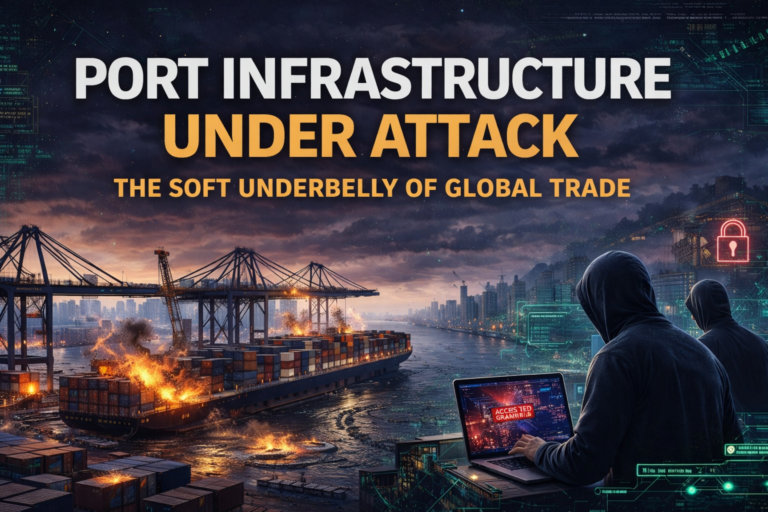
Port Infrastructure Under Attack: When the Terminal Goes Dark

Maritime Cyber Threat Briefing #10
Article content
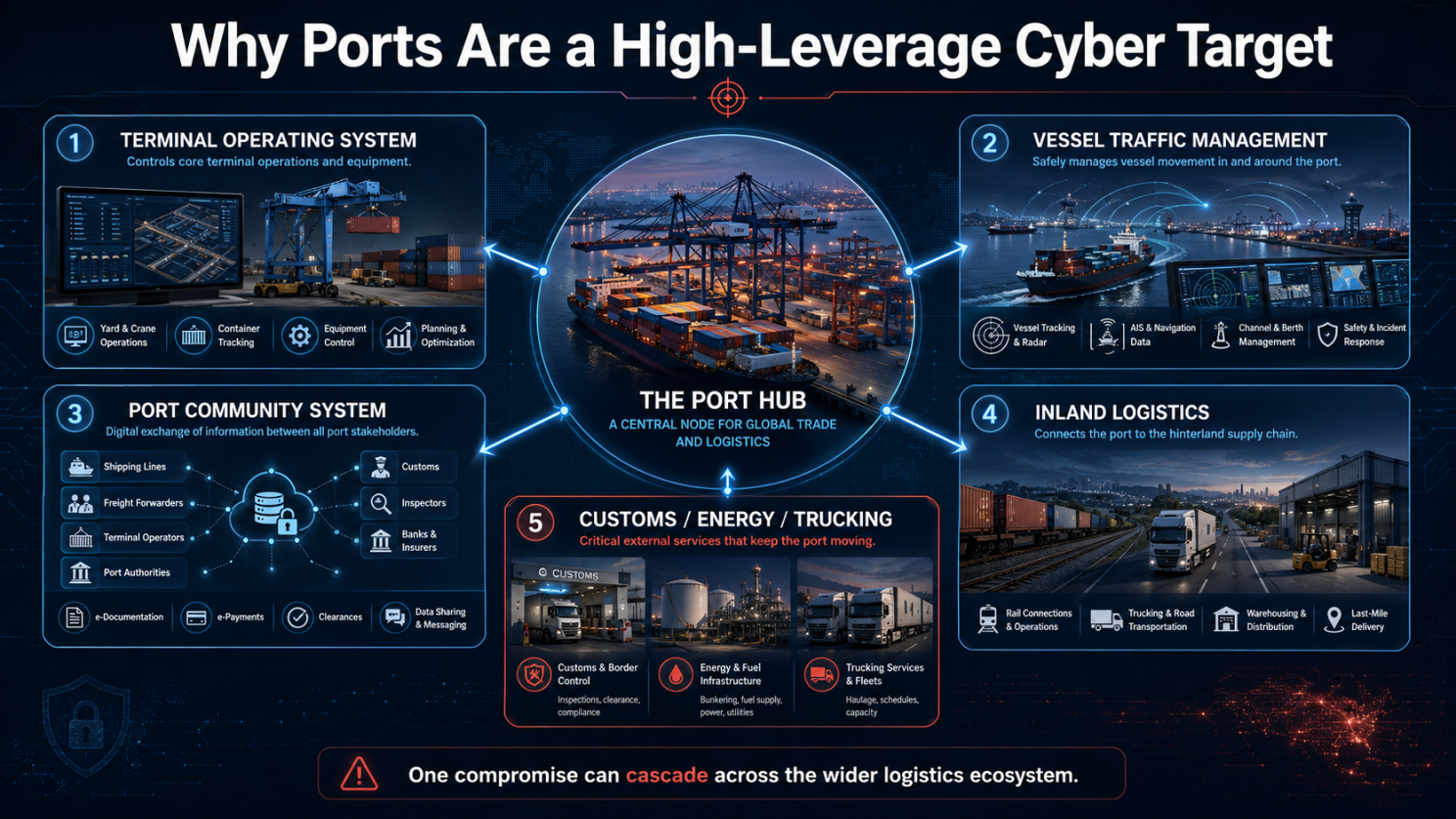
One Port Compromise Can Cascade Across the Supply Chain

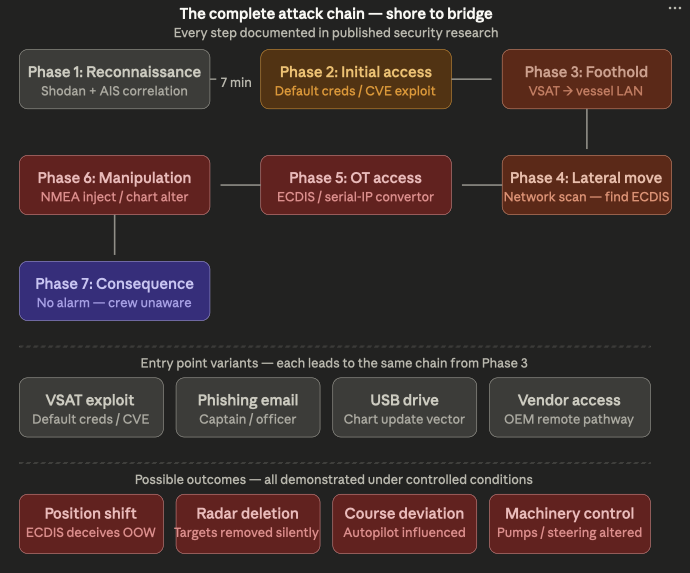
A port is not simply a place where ships berth and cargo changes hands. It is a node in a global logistics network through which approximately 80 percent of world trade flows. It is an energy distribution hub, a customs clearance gateway, a military logistics chokepoint, and an economic multiplier for the region it serves. When a port stops working, the consequences do not stay inside the perimeter fence.

A disruption in one system can quickly cascade across port operations, industrial partners, and inland transport networks. Threats are becoming more targeted and sophisticated, often with geopolitical drivers. The evidence for this is no longer theoretical. It is documented across more than a decade of escalating incidents. From the “NotPetya attack” that brought APM Terminals to a standstill across 76 ports in 2017, to the coordinated ransomware campaign that paralyzed 17 European oil terminals in January 2022, to the cyberattack on DP World Australia in November 2023 that stranded 30,000 shipping containers and triggered a nationally significant incident response. Navatom

Large-scale port terminals are now prime targets for ransomware. Attackers encrypt Terminal Operating Systems to completely halt container loading and unloading operations, subsequently demanding exorbitant ransoms. When hacktivists or criminal organisations paralyse cargo handling systems and logistics data, container operations grind to a halt, forcing vessels in nearby waters to wait indefinitely. Such attacks transcend the damage of a single port, triggering bottlenecks in the global supply chain and causing immediate chaos in the global economy, including spikes in oil prices and inflation. Staunch Technologies

This briefing examines the evolving threat to global port infrastructure, the documented incident record, the specific threat actors now targeting maritime logistics, and the mitigation and governance frameworks the industry needs to apply.


The Digital Port: A Complex and Expanding Attack Surface
Article content
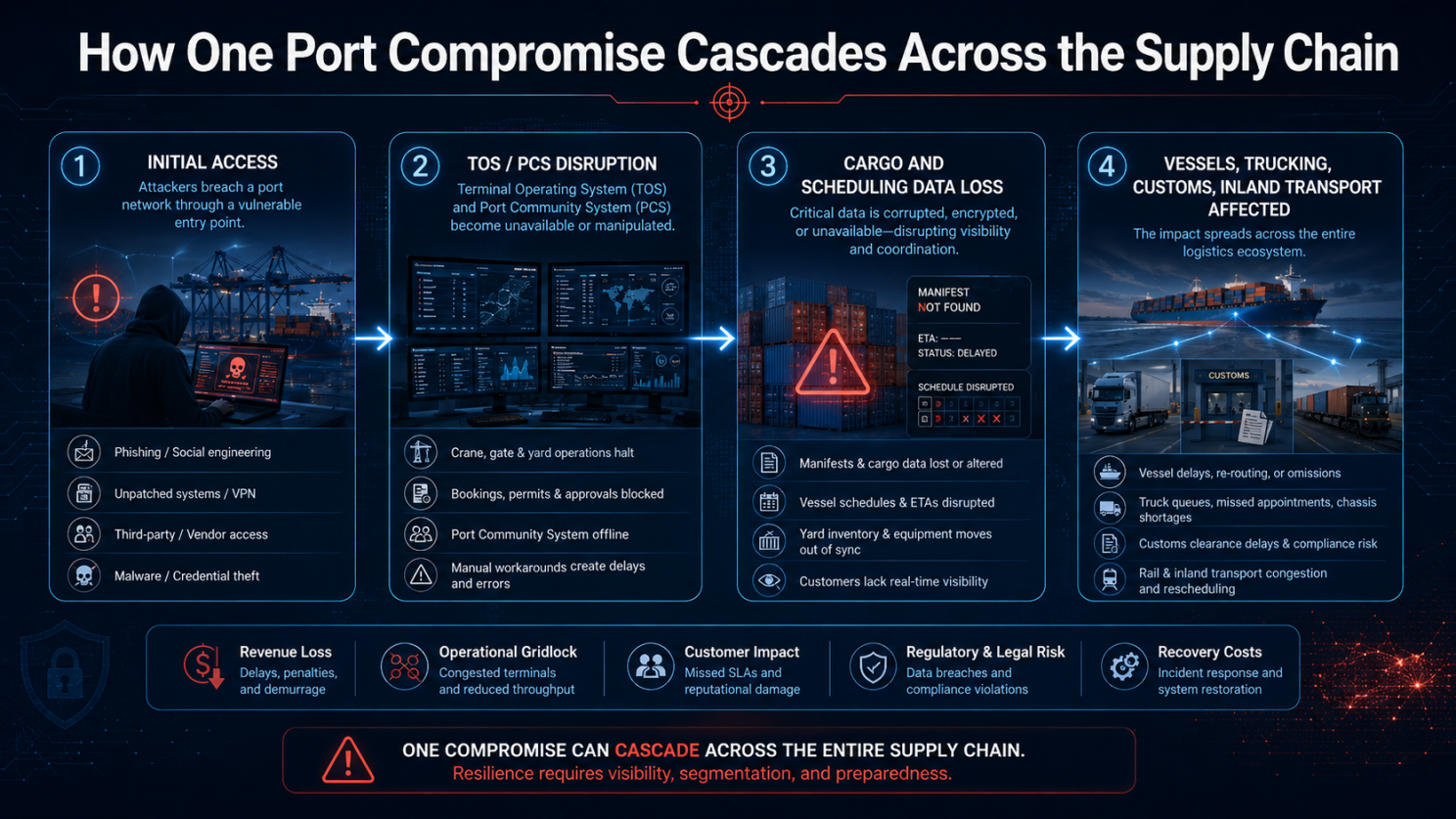
From Breach to Bottleneck Across the Supply Chain

The modern port is one of the most digitally complex environments in any critical infrastructure sector. Vessel traffic management systems coordinate movements across the approach channels. Terminal operating systems direct crane sequencing, berth allocation, yard planning, and gate operations. Cargo management platforms process customs declarations, dangerous goods manifests, and logistics documentation. Industrial control systems manage fuel storage, pipeline operations, refrigerated container power, and electrical distribution. Port community systems connect all of these to shipping agents, freight forwarders, trucking companies, customs authorities, and financial institutions.

Escalating digitisation across global seaports has transformed cyber risk from a siloed operational concern into a systemic, ecosystem-wide vulnerability. Attackers exploit the lateral movement potential between terminals, logistics partners, and inland transport networks. Shipping Telegraph

This connectivity [the very feature that makes modern ports efficient] is precisely what makes them strategically attractive to attackers. A single point of entry into a well-connected port environment can provide access to dozens of downstream organisations. As documented in Briefing #7, the supply-chain attack model targets shared infrastructure nodes because one compromise can cascade across many dependent organizations simultaneously. The same logic that made OEM and communications-provider targeting so effective against vessel fleets applies with equal force to the shared port community systems on which terminals, agents, customs authorities, and logistics operators all depend. A ransomware payload deployed against a terminal operating system does not only disable crane scheduling. It removes the data layer on which every subsequent logistics decision in the port ecosystem depends: vessel scheduling, truck slot allocation, customs release, cargo positioning, dangerous goods segregation. The terminal goes dark, and everything connected to it goes dark with it.

Using 112 incidents from the Maritime Cyber Attack Database covering 2020 to 2025, researchers identified a 150 percent rise in incidents, with OT compromise identified as the paramount threat at a risk score of 98 out of 100. State-sponsored actors linked to Russia, China, and Iran are associated with many of the highest-impact attacks in the current incident record. SAFETY4SEA


The Incident Record: Three Case Studies in Port Disruption

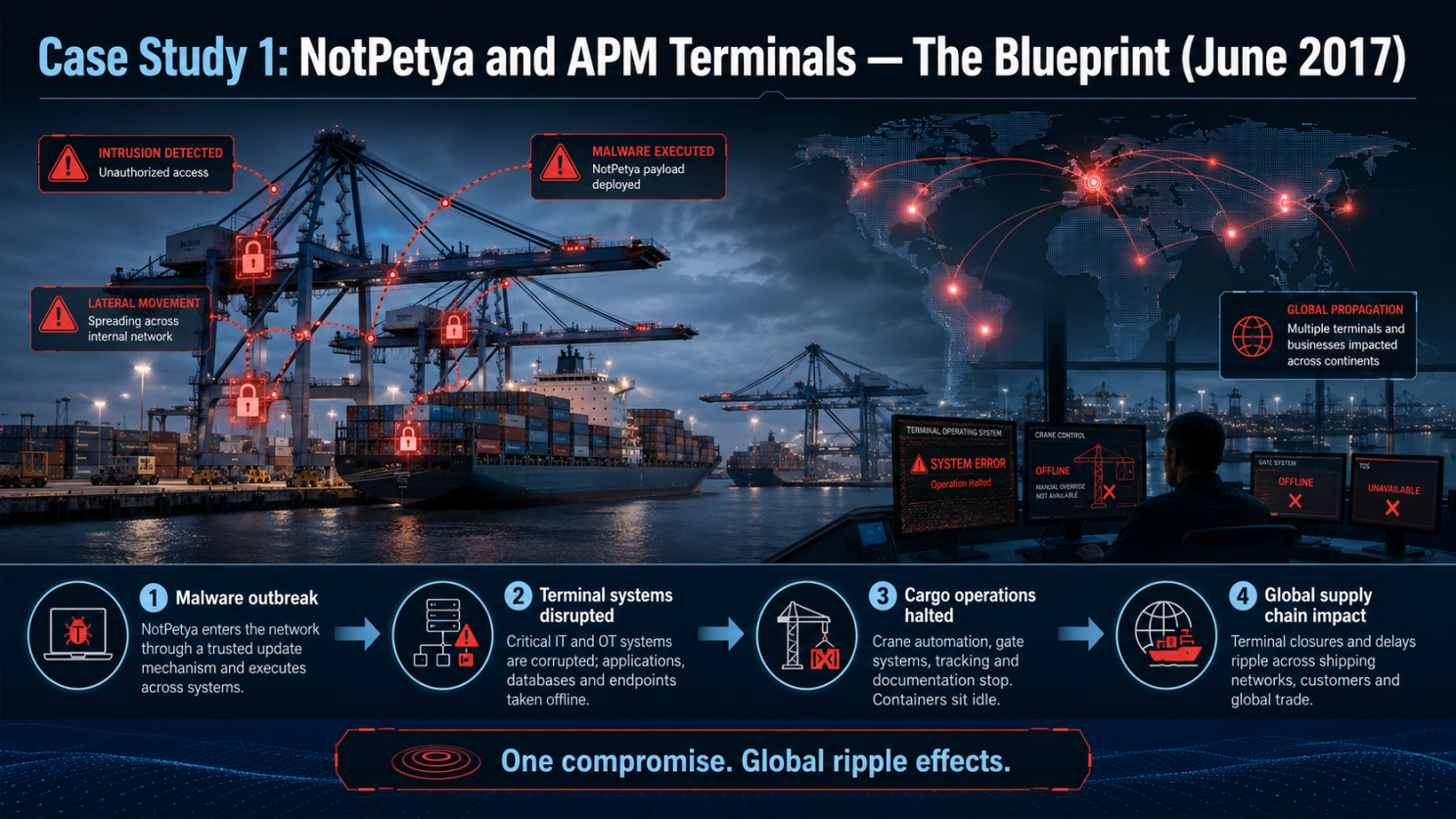
Case Study 1: NotPetya and APM Terminals – The Blueprint (June 2017)
Article content
One Malware Strain. Terminal Operations Worldwide.

The NotPetya attack of June 2017 remains the defining reference point for port infrastructure cyber risk. Not because it was specifically aimed at ports, but because of what it revealed about the consequences when an interconnected global maritime operator loses its IT infrastructure simultaneously across all jurisdictions.

It took ten days for A.P. Moller – Maersk to rebuild its network. The company replaced 4,000 servers and 45,000 computers. The biggest cost, as Maersk’s chairman stated at the World Economic Forum, came in lost business. All told, the NotPetya attack cost Maersk an estimated USD 300 million. NotPetya crippled Maersk’s operations across 130 countries, shutting down ports and terminals simultaneously. Maersk’s interconnected IT infrastructure meant one compromised system could spread the malware across the entire global network. Business Upturn NPR

The APM Terminal at the Port of Los Angeles [the port’s largest cargo terminal] was shut down for three days before reopening. The White House subsequently attributed NotPetya to Russian state-sponsored actors. The Hacker News

The operational mechanism that made NotPetya so devastating was not its sophistication in targeting ports. It was the absence of network segmentation between Maersk’s administrative IT and its operational terminal infrastructure. The malware entered through an accounting software update in Ukraine and found no meaningful barrier between the point of infection and the systems controlling terminal operations globally. One compromised node. One hundred and thirty countries. Ten days of recovery.

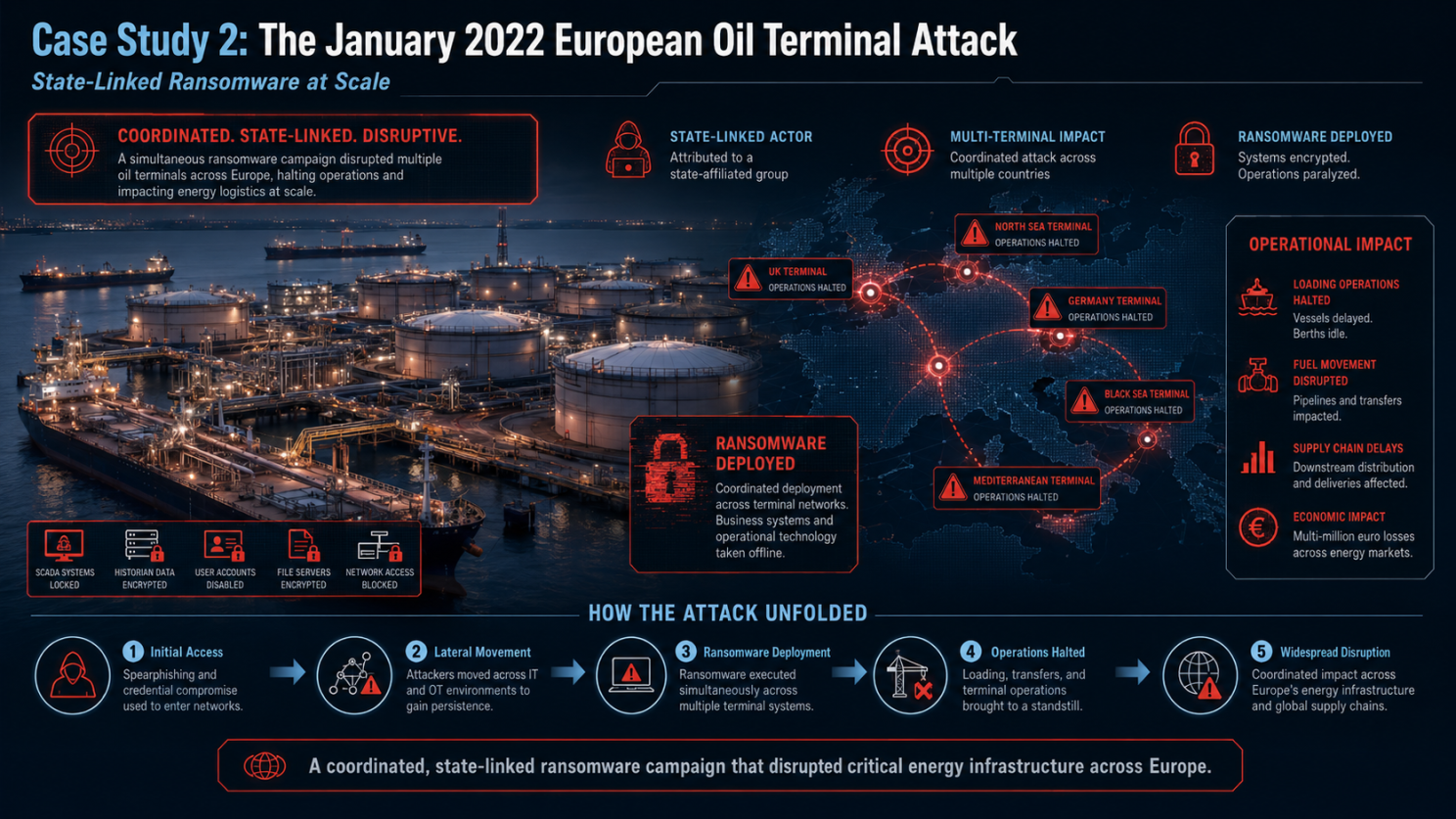
Case Study 2: The January 2022 European Oil Terminal Attack: State-Linked Ransomware at Scale
Article content
State-Linked Ransomware Can Paralyse Energy Logistics at Scale

In January 2022, a coordinated ransomware campaign struck oil storage and terminal operations across Belgium, the Netherlands, and Germany with a precision and scale that had not previously been documented against European port infrastructure.

The attack affected a total of 17 terminals, 11 in Germany and six across the Amsterdam-Rotterdam-Antwerp hub. Sources described the attack as causing “massive issues” in Antwerp, where loading operations were affected across all products. Many tankers were unable to load, as loading and unloading at tank farms is largely an automated process dependent on the compromised systems. A significant amount of rerouting occurred as barges were diverted to other terminals across the region. IBM

Ghent-based SEA-invest, which operates terminals in 24 ports across eight countries and handles more than 150 million tonnes of goods annually, confirmed that attackers crippled its networks on the night of 30 January with ransomware. Loading and unloading activities at the Belgian New Fruit Wharf in Antwerp had been difficult since the previous Sunday, with activities on the dock practically paralysed. Gopher

Investigations by the Antwerp public prosecutors’ office confirmed the criminal dimension of the attacks. Germany’s Federal Office for Information Security (BSI) attributed the attacks on German terminals to the state-linked BlackCat ransomware group. The Conti ransomware group, subsequently disbanded but identified by investigators at the time as state-linked, was attributed responsibility for the attack on Sea-Invest. CISA

The geopolitical timing is significant. The attacks occurred in late January 2022, weeks before Russia’s full-scale invasion of Ukraine on 24 February. The targeting of European energy logistics infrastructure, attributed to groups assessed as state-linked to Russia, has been interpreted by European security services as part of the hybrid warfare preparation that preceded the conventional military campaign.

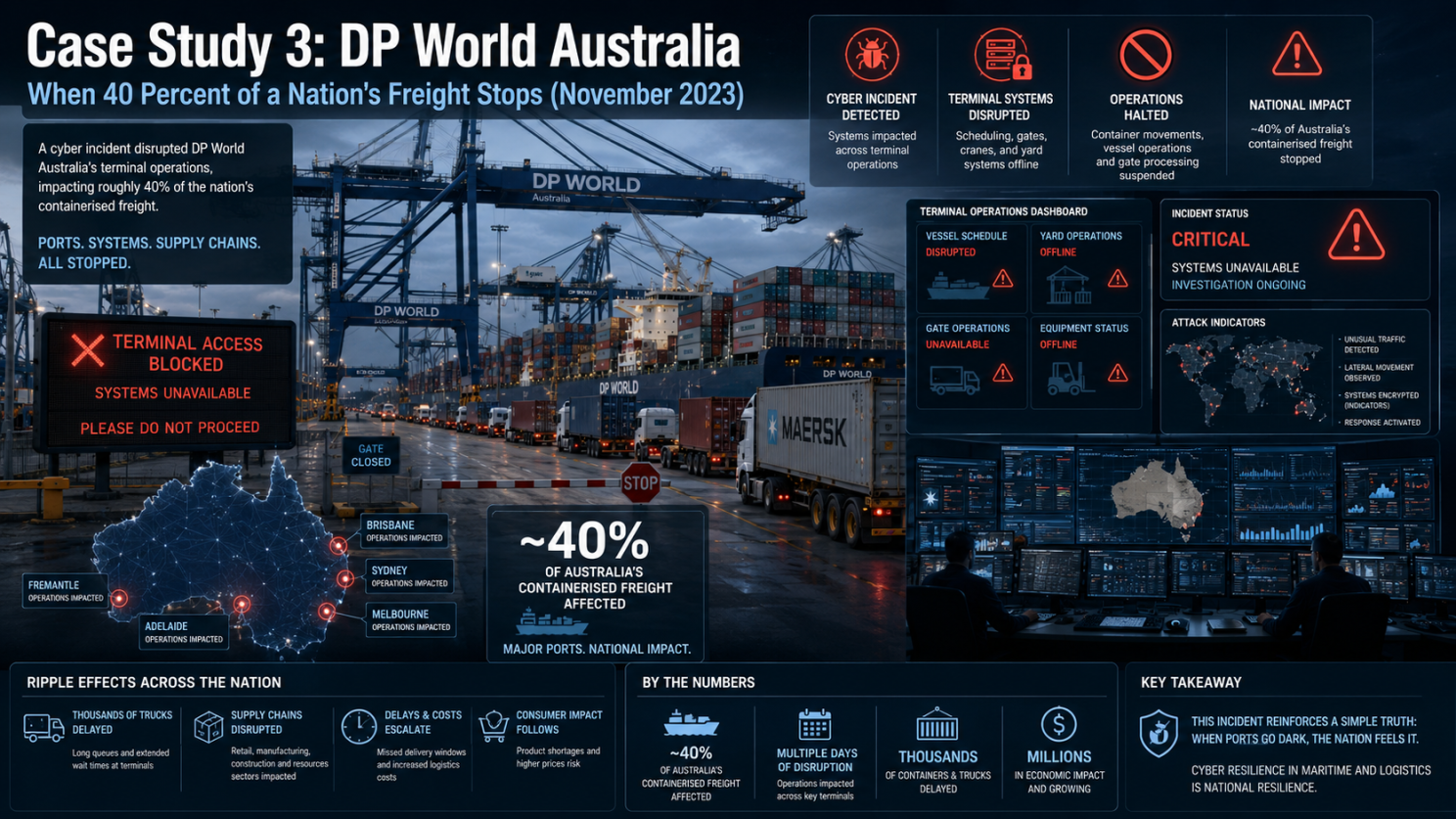
Case Study 3: DP World Australia: When 40 Percent of a Nation’s Freight Stops (November 2023)
Article content
When a Terminal Goes Dark, National Freight Feels It

On the evening of 10 November 2023, DP World Australia’s technology team detected unauthorised access to the company’s corporate network. The decision to disconnect the network from the internet [the correct incident containment response] simultaneously halted land-side port operations at four of Australia’s largest container terminals.

Key ports in Sydney, Melbourne, Brisbane, and Fremantle, responsible for about 40 percent of Australia’s import-export traffic, were severely affected for three days. Approximately 30,000 containers, including refrigerated ones containing perishable goods such as blood plasma, were stranded at these ports. The disruption led to a near-capacity pile-up of containers on docks, severely limiting storage space. The delays in container movement impacted a variety of industries, from retail to critical industrial operations. SAFETY4SEA

Australia’s federal cybersecurity coordinator described the event as a “nationally significant incident impacting a number of maritime port facilities”. Home Affairs Minister Clare O’Neil confirmed that the government was coordinating a national response. Dryadglobal

By 20 November, seven days after port operations recommenced and ten days after first detecting the incident, DP World Australia had cleared 100 percent of the backlog, comprising some 30,137 containers. The investigation confirmed no ransomware was found or deployed within the DP World Australia network; no encrypted files and no ransom demand were identified, though data had been accessed and exfiltrated. Maritime Executive

Two elements of the DP World Australia incident are particularly instructive for the broader industry. First, the correct containment action “network disconnection”, itself caused the operational disruption. The security response and the operational impact were the same event. This is a characteristic of port cyber incidents that distinguishes them from most corporate data breaches: there is no option to investigate quietly while operations continue. Second, the attacker did not need to deploy ransomware. The data exfiltration alone [the contents of which have not been fully disclosed] represented a significant intelligence and potential commercial liability exposure for the company and its counterparties.


The Threat Actor Landscape: Criminal, Hacktivist, and State

The port infrastructure threat does not come from a single category of attacker. Three distinct actor types are now documented as targeting maritime port environments, each with different objectives and different implications for port operators.

State-sponsored actors: intelligence collection and pre-positioning

In May 2025, a joint cybersecurity advisory co-issued by 11 allied nations and 21 intelligence agencies including CISA, the UK NCSC, and counterparts from Germany, France, and Canada. Confirmed that APT28 (Fancy Bear), Russia’s GRU Unit 26165, had targeted “dozens of entities, including government organizations and private and commercial entities across virtually all transportation modes: air, sea, and rail” within NATO member states, Ukraine, and international organizations. Industrial Cyber

According to the NORMA Cyber [Nordic Maritime Cyber Resilience Centre], APT28 has specifically targeted maritime operators, logistics companies, and air traffic control networks in at least 11 countries. In January 2026, APT28 orchestrated a concentrated 72-hour spear-phishing campaign across nine Eastern European nations, primarily targeting defence ministries at 40 percent of recipients, transportation and logistics operators at 35 percent, and diplomatic entities at 25 percent. Smartmaritimenetwork SAFETY4SEA

The Polish ports of Gdansk and Gdynia, and the Taiwan ports of Kaohsiung and Keelung, have been assessed with a critical composite cyber risk score of 95 out of 100. The Polish ports primarily threatened by APT28 due to their role as key transit hubs for military and humanitarian aid to Ukraine, the Taiwan ports facing Chinese threats from Volt Typhoon, APT41, and ArcaneDoor amid escalating geopolitical tensions over the semiconductor supply chain. SAFETY4SEA

The Iranian cyber retaliation campaign examined in Briefing #9 exposed a state playbook that is now becoming unmistakable across the maritime domain. Following Operation Epic Fury, Ministry of Intelligence and Security-affiliated groups shifted from espionage to disruptive and destructive operations against energy, logistics, and critical infrastructure. The significance lies not only in the attacks themselves, but in the methodology behind them: infrastructure mapped in advance, access established quietly, and capability held in reserve until strategic conditions justified activation. That is the same pre-positioning logic now being documented by CISA and allied intelligence agencies against European port infrastructure. The Hormuz crisis made visible what had been building for years: state actors no longer treating maritime logistics as a target of opportunity, but as a strategic battlespace to be surveilled, penetrated, and, when required, disrupted at scale.

The objective of state-sponsored actors in port environments is not always immediate disruption. Pre-positioning, establishing persistent access that can be activated at a strategically chosen moment, is a documented methodology that requires years of patient infiltration before producing visible effects. The value of access to a major port’s vessel traffic management system, cargo manifests, or dangerous goods databases is significant for intelligence collection long before any destructive action is considered.

Criminal ransomware operators: financial extraction through operational leverage

According to NORMA Cyber, at least 45 maritime organisations were attacked with ransomware in 2024, with the actual number likely to be significantly higher. The state-linked BlackCat ransomware group was responsible for the German terminal attacks of January 2022, and the Conti group for the Sea-Invest attack. Maritime Administration

The criminal ransomware model applied to port infrastructure follows a straightforward logic: the operational dependency of the broader logistics chain on terminal continuity creates extraordinary pressure to pay. A port operator whose terminal operating system has been encrypted is not simply facing a data recovery problem. They are facing vessel queuing costs, cargo demurrage claims, perishable goods losses, contractual penalties, and the commercial reputational consequences of being the operational bottleneck in a global supply chain. The leverage available to a ransomware operator targeting a major terminal is qualitatively different from the leverage available when targeting a corporate data environment.

Hacktivists: geopolitical disruption as operational objective

Pro-Palestinian hacktivists have targeted Israeli-linked vessels using AIS data. Russian groups have targeted European ports supporting Ukraine. Chinese state actors have compromised classification societies that certify the world’s fleets. Insurance Edge

Hacktivist targeting of port infrastructure has escalated alongside geopolitical conflict. The same collectives documented in Briefing #9 as targeting Gulf energy infrastructure [Handala, Cyber Islamic Resistance, NoName057(16)] have also conducted DDoS campaigns against European port authority websites and logistics platforms, primarily as psychological and political messaging operations. While the operational impact of DDoS against public-facing websites is limited compared to ransomware against terminal operating systems, these campaigns serve as demonstrators of capability and intent. In some cases as cover for more targeted intrusion activity occurring simultaneously.


Operational Impact: What Port Disruption Actually Costs

The financial quantification of port cyberattacks has historically been constrained by the reluctance of operators to disclose the full operational and commercial consequences. The available data is nonetheless significant.

The NotPetya impact on Maersk and APM Terminals produced documented losses of USD 250–300 million from a single malware strain that was not specifically designed to target the company. The total costs of the NotPetya outage across all affected companies amounted to an estimated USD 10 billion globally. United Against Nuclear Iran

Cyberattacks aimed at logistics firms are projected to double in 2026, having risen 61 percent in 2025 from 132 to 213 incidents, up nearly 1,000 percent since 2021. Hackers are moving away from hitting individual companies and instead targeting shared transportation networks, where a single breach can ripple across thousands of businesses. SMI DIgital

Beyond direct financial loss, port cyberattacks produce a category of impact that does not appear in incident cost estimates: the erosion of trust in the port as a reliable logistics node. Shipping lines that divert bookings away from a cyber-attacked port [as happened with Maersk during NotPetya recovery] may not return immediately even after operations are restored. The reputational and commercial consequences of being perceived as an unreliable logistics gateway compound the direct operational losses.

For ports that serve NATO logistics functions [as the Polish ports of Gdansk and Gdynia do in the context of Ukraine support] a successful cyberattack carries national security implications that extend far beyond the commercial port operations. The targeting of these ports by APT28 reflects a deliberate strategic assessment of their value as logistics chokepoints.


The incident record is clear: ports do not fail as isolated systems. They fail as connected ecosystems.

Mitigation: Building Resilience Into Port Operations
Article content
Resilience Determines How Long the Terminal Stays Dark

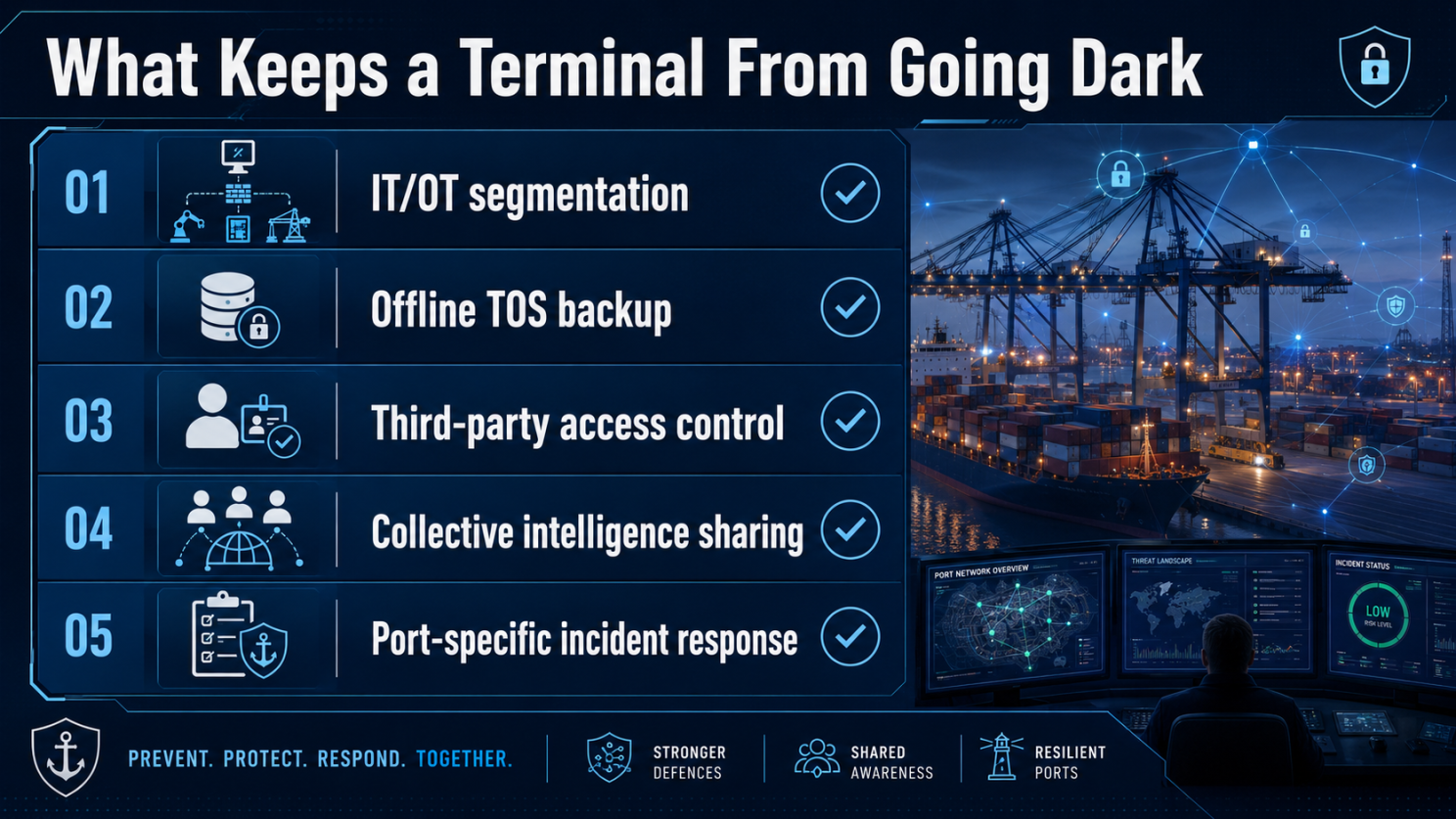
IT/OT network segmentation as a non-negotiable baseline

The NotPetya incident demonstrated with devastating clarity what happens when there is no meaningful barrier between administrative IT networks and operational terminal systems. Implementing robust network segmentation with clearly defined, monitored, and enforced boundaries between corporate IT, terminal operating systems, vessel traffic management, and industrial control systems, is the foundational control that prevents a malware infection from becoming a terminal shutdown. This is not a new recommendation. It is the recommendation that the industry documented in 2017 and has still not universally implemented in 2026.

Briefing #8 of this series documented how AI has compressed the vulnerability exploitation window to under 48 hours and in some cases to under 15 minutes from public disclosure to active exploitation. That timeline makes the periodic patch cycles common in port OT environments typically aligned to maintenance windows and vendor service schedules, functionally inadequate as a primary vulnerability management mechanism. Continuous monitoring of OT network behaviour, combined with risk-based prioritisation of critical patches, is the only credible response to a threat that moves faster than scheduled maintenance can track.

Terminal Operating System resilience and offline backup capability

Attacking the lateral movement potential between terminals, logistics partners, and inland transport networks is now an established attacker methodology. Terminal operators need tested offline backup and recovery capabilities for TOS environments that allow partial operations to continue during a cyber incident. Not full capability, but sufficient to manage safety-critical functions such as dangerous goods segregation, vessel berthing, and emergency cargo movements. This requires investment in backup infrastructure and regular testing, not simply the existence of a backup policy. Shipping Telegraph

Third-party and supply chain access governance

Port environments are characterised by large numbers of third-party connections: shipping agents with cargo system access, customs authorities with manifest data access, trucking companies with gate and yard system connections, and service contractors with engineering system access. Each of these represents a potential entry point that bypasses the port operator’s own perimeter controls. Governance of third-party access through formal assessments, contractual security requirements, session-based access controls, and access revocation procedures, is as important in port environments as network segmentation.

Collective intelligence and information sharing

The Dutch Ferm Seaports initiative, which unites over a thousand companies across five major ports under a shared intelligence and response framework, is cited by the World Economic Forum as a proven blueprint. Ferm identifies roughly fifteen vulnerable systems and issues two urgent advisories weekly. While ports compete commercially, the model demonstrates that cyber threat intelligence sharing across a port community is both operationally feasible and strategically necessary. CYTUR

The Ferm model addresses a structural problem in port cyber security: individual port operators, particularly smaller terminal operators and port service companies, lack the resources and intelligence access to maintain current awareness of the threat landscape targeting their environment. A collective model that aggregates intelligence from national cyber security centers, maritime sector signals, and participating operators [and translates it into actionable operational guidance] is the appropriate institutional response to a threat that operates at ecosystem scale.

Incident response planning for port-specific scenarios

Port incident response plans must address scenarios that have no direct parallel in generic IT incident response frameworks.

  • What is the procedure when the TOS must be taken offline to contain an incident, and vessels are scheduled to berth in six hours?
  • What is the fallback when the dangerous goods management system is unavailable and a vessel carrying hazardous cargo is approaching the berth?
  • Who has authority to declare a force majeure on cargo commitments?

These questions need answers before an incident occurs, not during one.


Regulatory Considerations
Article content
Governance Must Catch Up With Cascading Port Risk

The regulatory framework governing port cyber security is evolving, but enforcement and implementation remain uneven across jurisdictions.

Maritime ports handle 80 percent of global trade and serve as critical nodes in NATO’s defence logistics network, yet they face unprecedented cybersecurity threats from state-linked actors. Nearly all surveyed countries have experienced cyberattacks within the past five years, with access control systems and vessel traffic management systems among the primary targets. The blurring of responsibilities between national and international, public and private entities particularly challenges coordinated response. Anglo-Eastern

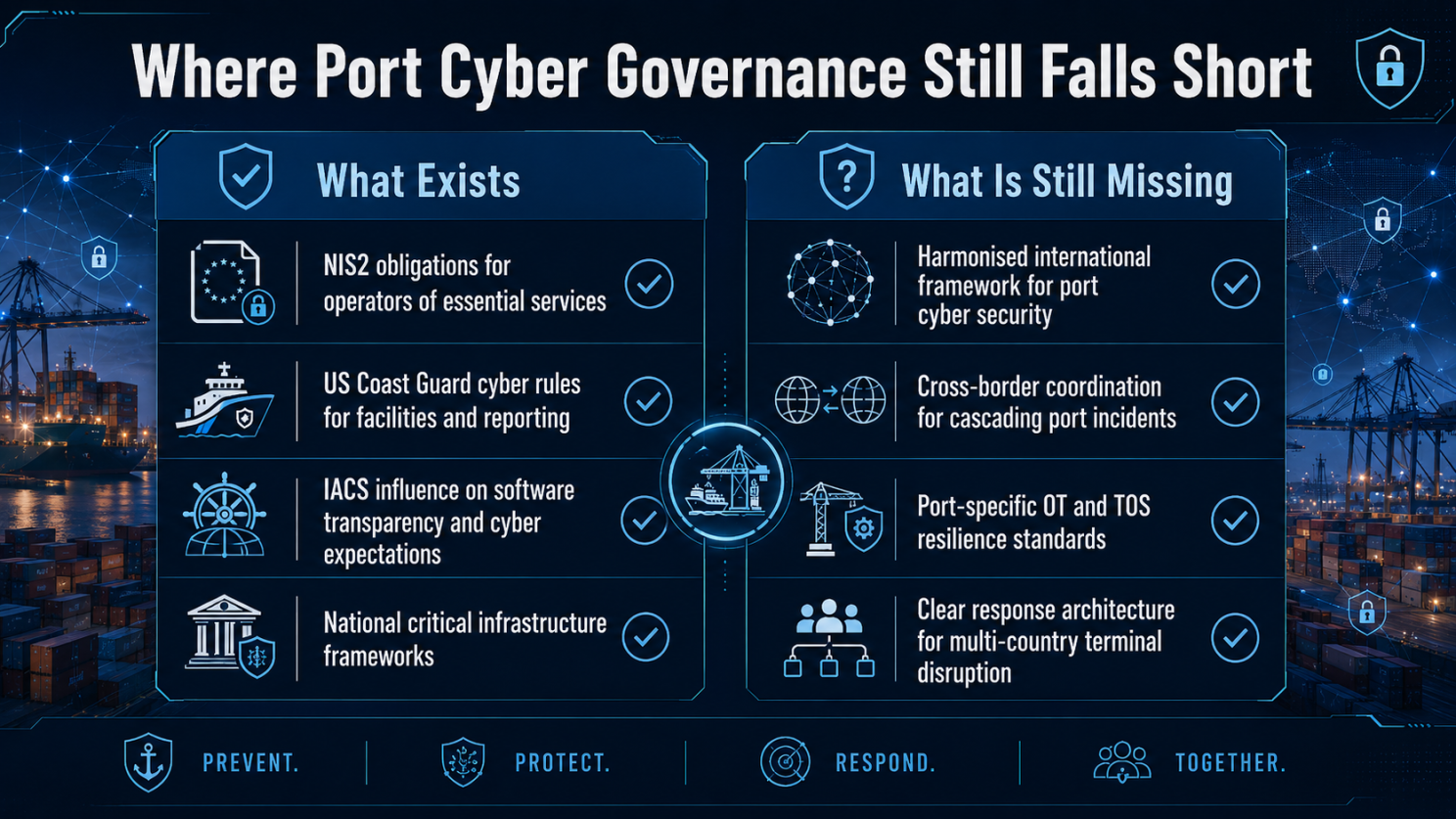
In Europe, NIS2 classifies port authorities as operators of essential services, imposing mandatory security measures, supply chain risk governance, and incident reporting requirements with a 24-hour initial notification obligation. The January 2022 European oil terminal attacks which affected operators across multiple member states simultaneously, illustrated precisely the kind of cross-border incident that NIS2’s reporting framework was designed to address.

The US Coast Guard cyber security rules, which impose incident reporting obligations and security planning requirements on vessels and facilities operating in US waters, provide a parallel framework at the facility level. The US Department of Homeland Security’s designation of maritime transportation as critical infrastructure creates an additional layer of federal interest in port cyber resilience that is increasingly reflected in port security planning requirements.

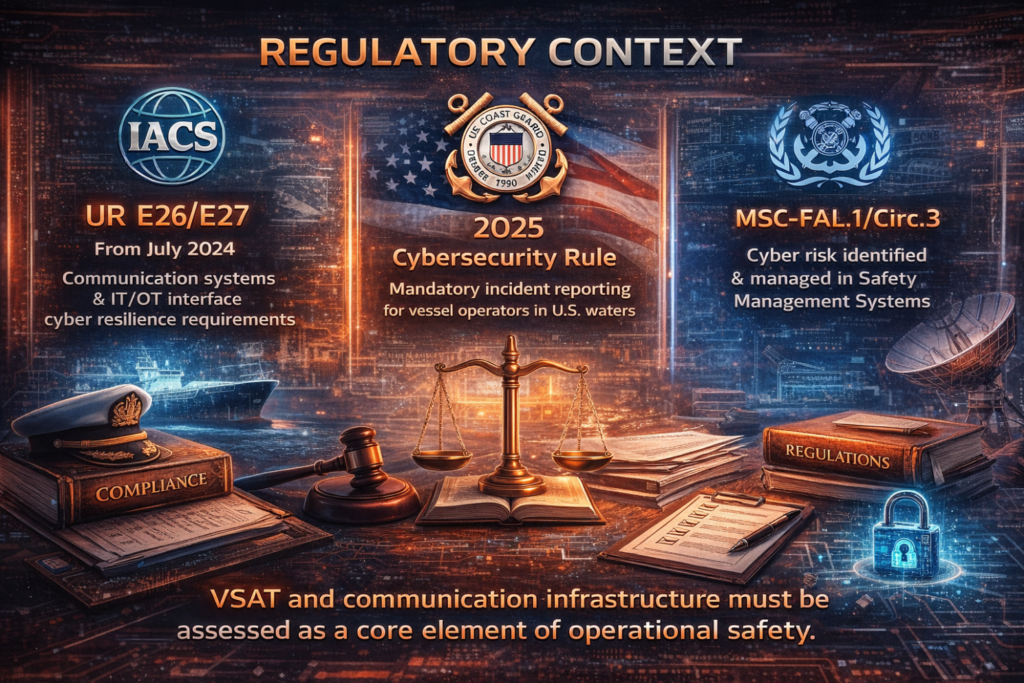
IACS UR E26 and E27, while primarily applicable to vessel systems, have begun to influence shore-side cyber security expectations as classification societies and port state control authorities develop more integrated approaches to maritime cyber governance. The concept of a Software Bill of Materials which is now required under E27 for onboard systems, is directly applicable to the complex software environments operating within major terminal facilities.

What is still absent is a harmonised international framework specifically governing port infrastructure cyber security and the cross-border cascade risk the incident record has already demonstrated. The 2022 European oil terminal attacks affected operators across three countries. The DP World Australia incident prompted a nationally significant response from a government that had no prior framework for coordinating a cyber incident affecting 40 percent of national freight capacity. The industry cannot wait for the next incident to define the response architecture.

Article content

Port infrastructure is not a passive target waiting to be discovered by attackers. It is an active, documented, and escalating target being pursued by state-sponsored threat actors conducting strategic pre-positioning, criminal ransomware operators applying maximum operational leverage, and hacktivist collectives using disruption as political messaging. The incident record from 2017 through to 2026 demonstrates consistent patterns: the cascade effect of port disruption extends far beyond the terminal perimeter; the financial and operational consequences are severe and compound over time; and the security controls that would have prevented or contained the worst incidents were known, affordable, and not implemented.

Traditional isolated security postures are obsolete against threats that cascade rapidly across interconnected supply chains. The necessary response is a collective cyber defence model. One that treats port cyber security as an ecosystem responsibility rather than an individual operator obligation. Shipping Telegraph

The World Economic Forum’s framing of this as a collective defence problem is correct. Individual port operators, terminal companies, and logistics providers cannot independently achieve the intelligence access, monitoring capability, and incident response capacity that the current threat environment requires. The Dutch Ferm model shared:

  • Intelligence
  • Response planning
  • Accountability

It clearly represents the direction the industry must move.

The question for port operators, terminal companies, and maritime logistics providers is not whether their infrastructure will be targeted. The incident record has settled that question. The question is whether, when the terminal goes dark, they will have the segmentation, the backup capability, the response plan, and the collective intelligence framework to limit the darkness to hours rather than days. And to prevent it from spreading to every organization connected to them.


Maritime Cyber Threat Briefing is an independent series covering cyber threats, vulnerabilities, and risk management across the global maritime industry. It is published by Alexandros Engelen, a Cybersecurity Strategist, specializing in maritime cyber risk.

Sources: CYTUR 2026 Maritime Cyber Threat White Paper, SAFETY4SEA, Industrial Cyber, World Economic Forum / Port of Rotterdam, SC Media, CCDCOE Policy Brief, Recorded Future News, S&P Global Platts, The Stack Technology, BankInfoSecurity, ASIS Online, DP World Australia official statements, MSSP Alert, Waterstons, SOCRadar® Extended Threat Intelligence, Security Boulevard, Reveal Security, The Record / Recorded Future News, CISA Advisory AA25-141A, NORMA Cyber, MDPI Maritime Risk Journal, Computer Weekly, CNBC, Supply Chain Dive, Euromaidan Press.

No commercial relationship exists with any cited organization.
The Hormuz Playbook: Cyber, Electronic Warfare, and the Live Anatomy of Maritime Hybrid Conflict

Maritime Cyber Threat Briefing #9

Article content
Hybrid Warfare Has Reached the Waterway

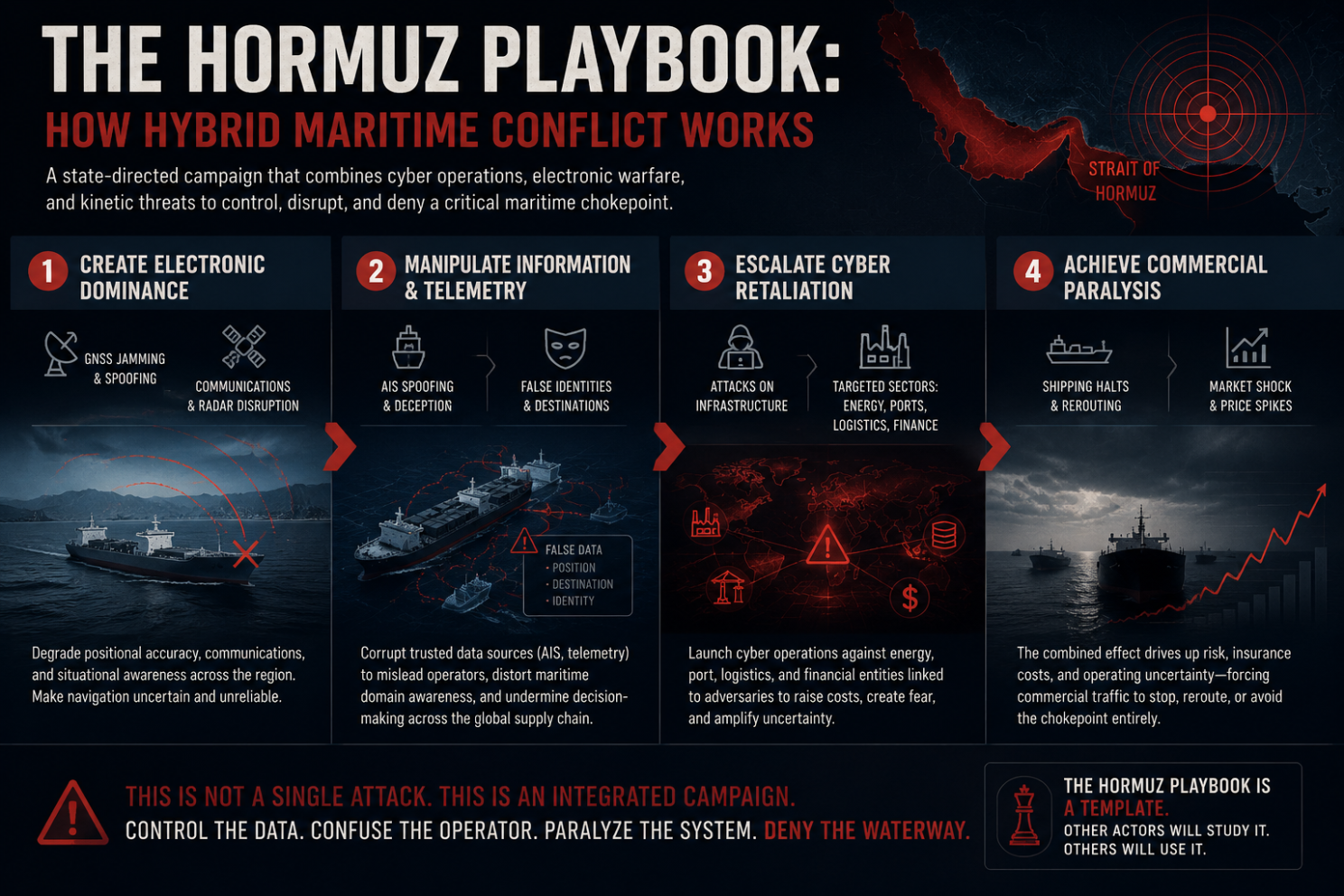
Since 28 February 2026, commercial transit through the Strait of Hormuz has been severely disrupted, with operators suspending or sharply reducing movements under a rapidly escalating threat environment.

The International Maritime Organization Secretary-General has confirmed 21 attacks on commercial ships since 28 February 2026, resulting in 10 seafarer fatalities. Approximately 20,000 civilian seafarers remain stranded aboard vessels in the Persian Gulf facing dwindling supplies, fatigue, and severe psychological stress. The World Bank has characterised the disruption as the largest oil supply shock on record, with an initial reduction in global oil supply of approximately 10 million barrels per day. Brent crude prices remained more than 50 percent higher in mid-April than at the start of the year. Brent crude reached an intraday high of USD 126.41 per barrel on 30 April 2026. A four-year price peak, according to Argus Media. Small Wars Journal + 2

The maritime industry has discussed hybrid warfare largely in theoretical terms. The Hormuz crisis has turned that theory into operational reality. The Hormuz crisis has turned theory into operational reality, and the cyber and electronic warfare dimensions of what is unfolding provide the most consequential live case study in maritime hybrid conflict that the industry has ever had to analyze in real time.

This briefing examines what is actually happening in the cyber and electronic warfare domains, what it means for commercial shipping, and what the lasting implications are for how maritime operators must think about their exposure to conflict-adjacent threats. The series has documented Iranian cyber-to-kinetic targeting since Briefing #1. This is where that arc lands.


The Electronic Battlefield: What Is Happening to Navigation in the Gulf

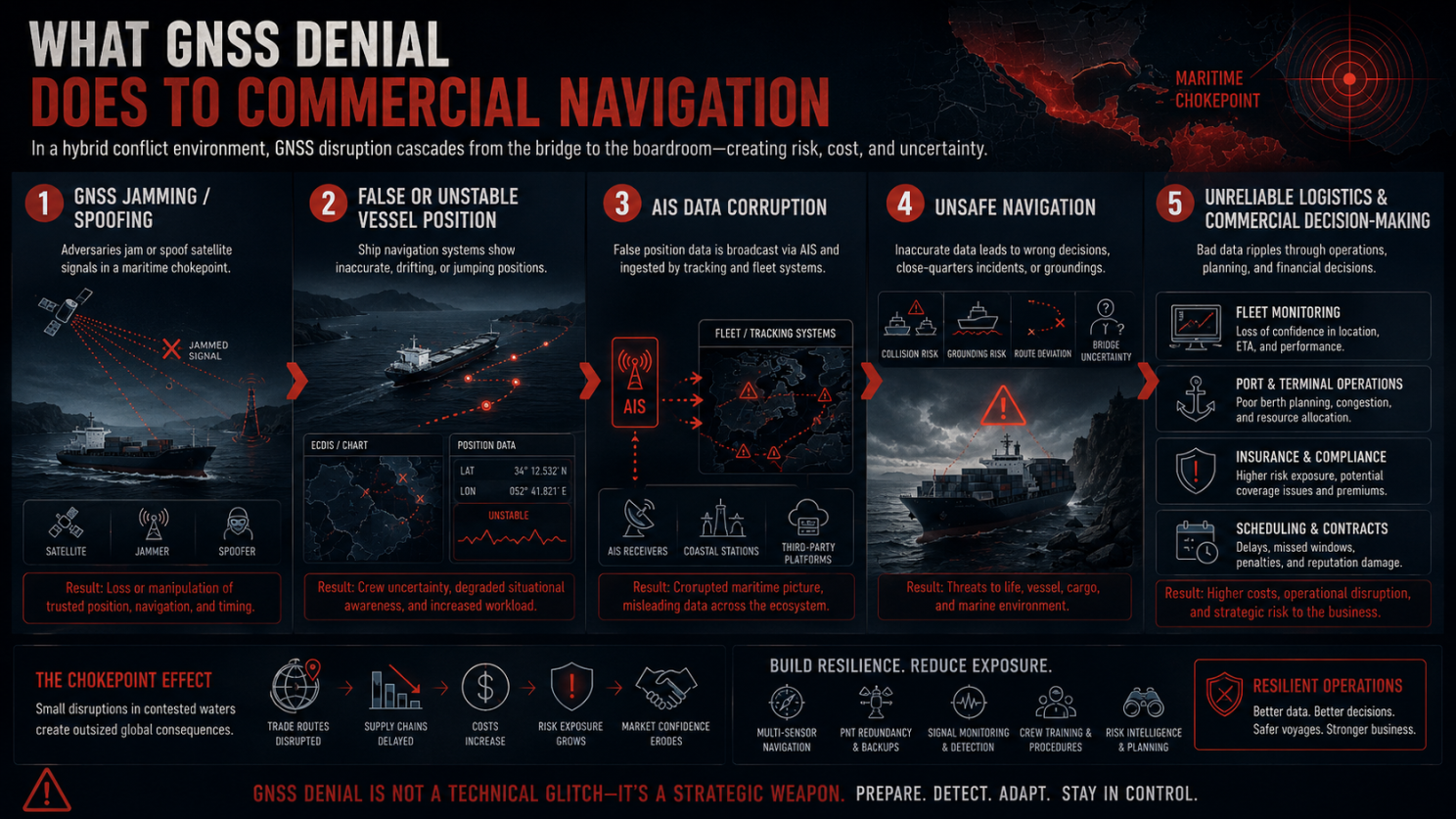
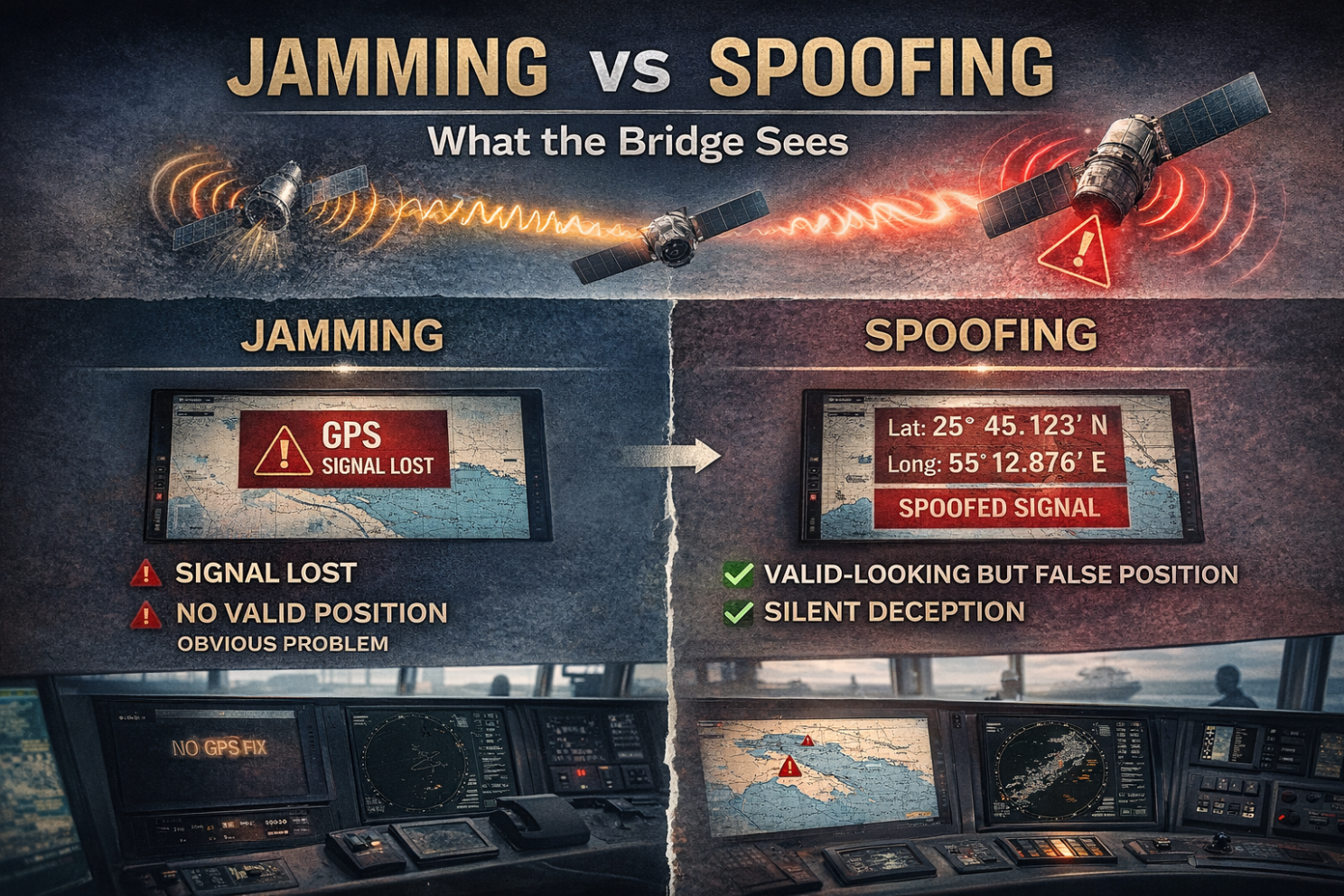
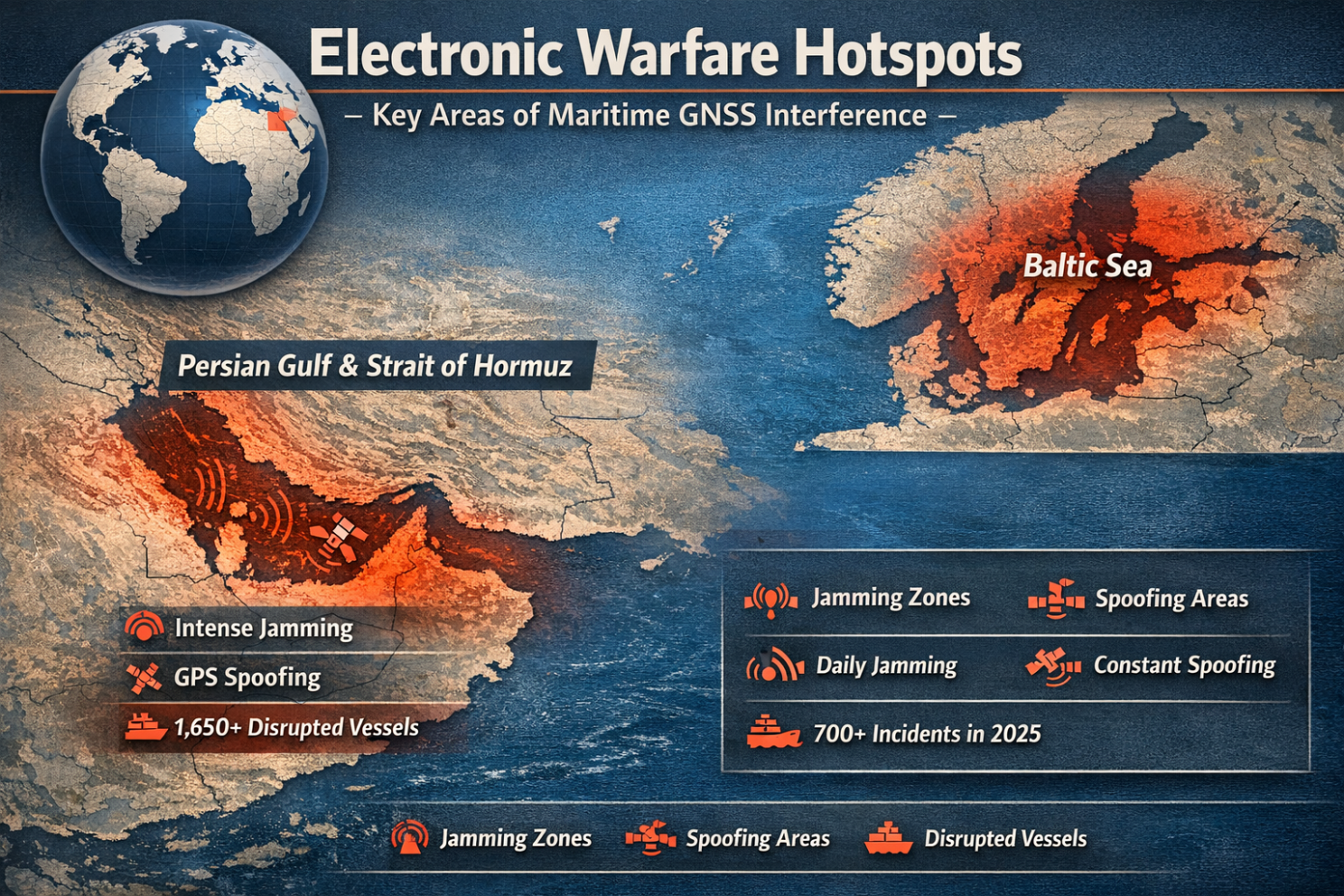
Before a single kinetic weapon is deployed against a commercial vessel, the maritime operating environment in and around the Strait of Hormuz had already been rendered electronically hostile. The mechanism is GNSS manipulation [jamming and spoofing] at a scale and sophistication that has no precedent in commercial shipping history.

Widespread GNSS jamming and GPS spoofing disrupted navigation for more than 1,650 ships in the Middle East Gulf as of early March 2026, turning the Strait of Hormuz into a live stress-test for global maritime positioning infrastructure. The Royal Institute of Navigation and maritime analytics firm Windward have both classified the current situation as unprecedented in scale for a commercial shipping context. GIS Resources

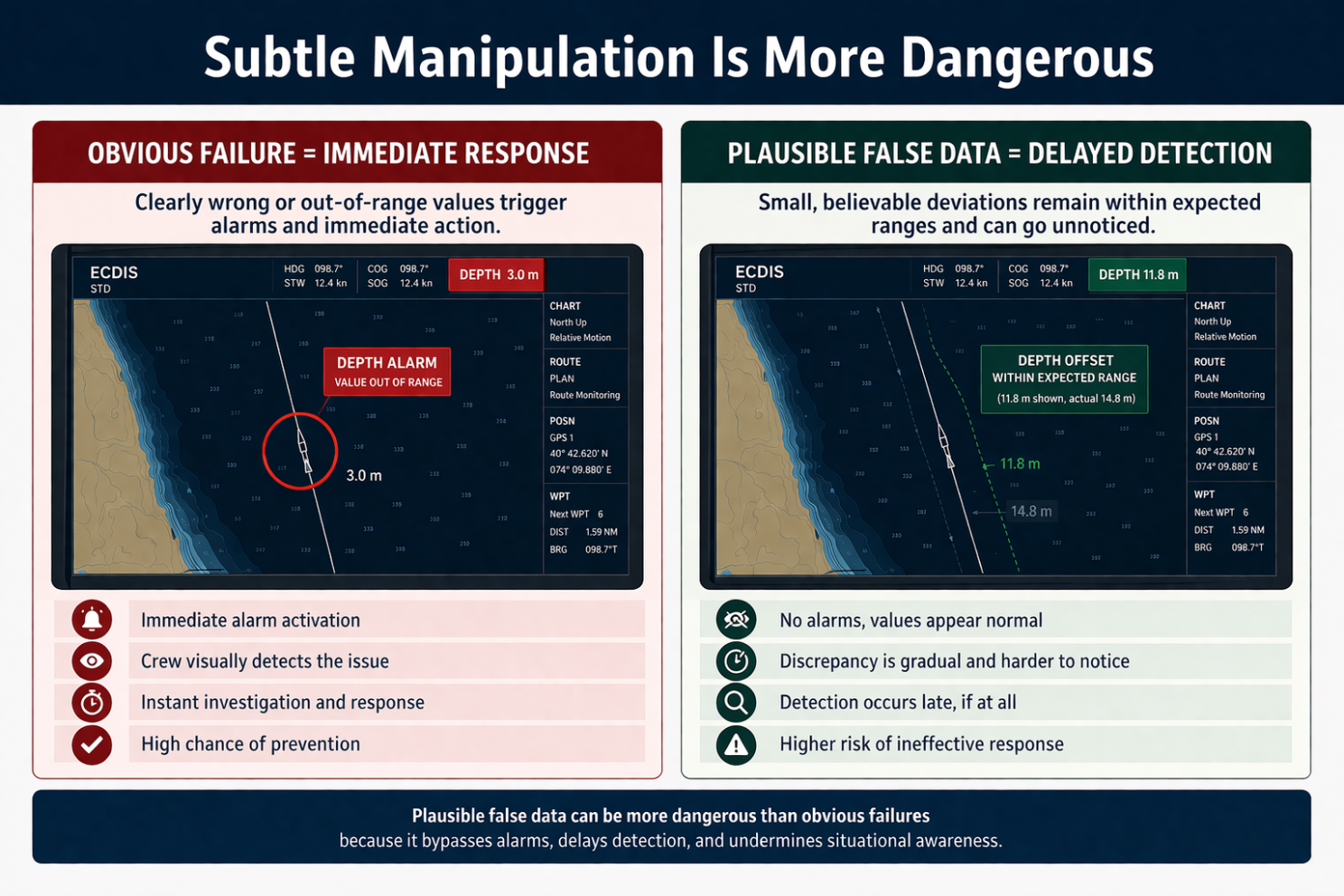
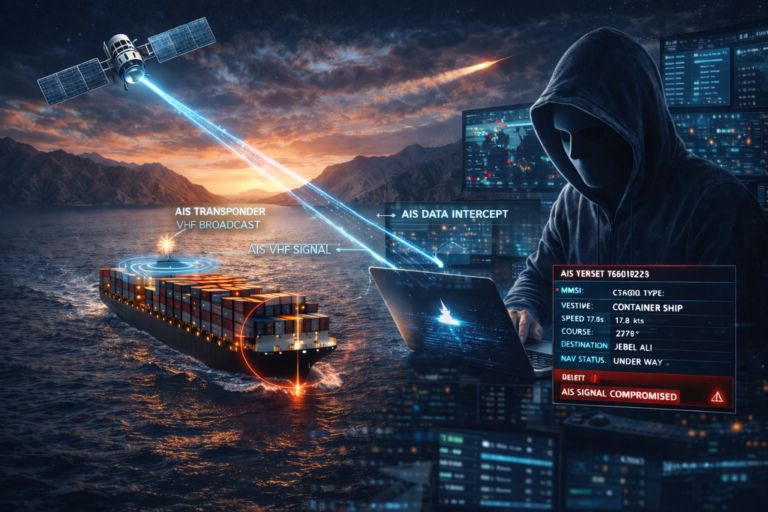
Satellite navigation interference detected near the UAE coast created the appearance of vessels sailing in straight lines toward the Strait of Hormuz, even though the ships were not actually following those tracks. The anomaly was first observed off Ras Al Khaimah, where vessel positions began appearing in long linear patterns inconsistent with normal navigation. Playback analysis of AIS data confirmed the movements were not real. The EU’s Maritime Security Centre warned that heavy GPS and AIS spoofing was continuing across the Arabian Gulf, Strait of Hormuz, and Gulf of Oman, with disruptions also affecting communications and radar systems, stating that navigation systems in the region were “highly likely to be unreliable”. gCaptain

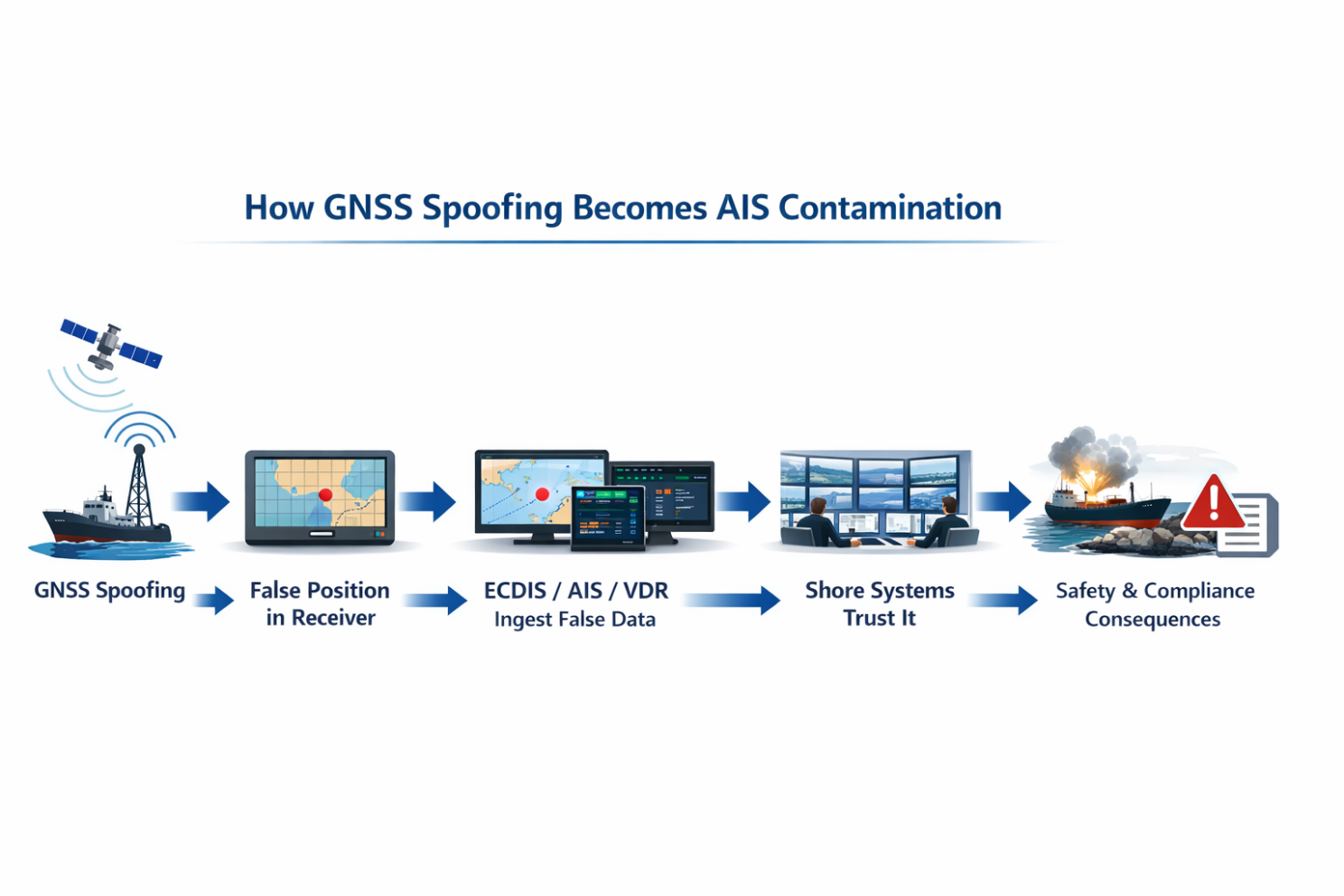
When GNSS spoofing manipulates vessel positions, those incorrect coordinates propagate across global tracking networks used by governments, shipping companies, insurers, and intelligence analysts effectively creating a data integrity attack against maritime telemetry. This demonstrates how electronic warfare can indirectly compromise digital infrastructure by poisoning trusted data sources rather than directly breaching networks. Polyswarm

The operational implications for commercial vessels are severe. A ship navigating on corrupted position data in a 34-kilometre wide strait, in the presence of active sea mines, fast attack craft, and other vessels suffering the same interference, is in genuine danger. Not because its crew lacks skill, but because the fundamental data inputs underpinning its navigation have been deliberately poisoned.

Article content
GNSS Denial Turns Navigation Into Operational Risk

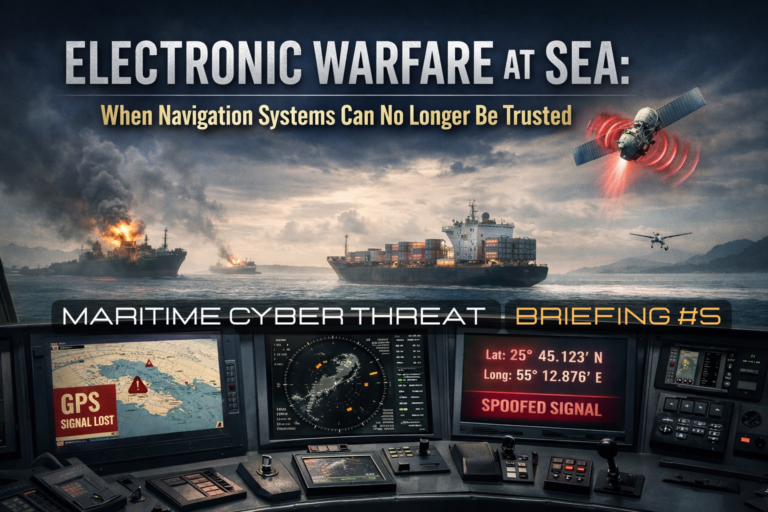
The series documented GPS spoofing in Briefing #5 and its role in the MSC Antonia grounding in Briefing #7. What the Hormuz crisis has demonstrated is what that capability looks like when deployed at strategic scale, by a state actor, as an integral component of a military campaign designed to control access to a major waterway.


AIS as a Disinformation Platform

Beyond navigation disruption, the Hormuz crisis has exposed the AIS system as a disinformation platform operating at extraordinary scale.

AIS data in and around the Strait of Hormuz is underreporting actual vessel traffic by as much as 50 percent, according to field investigation by Citrini Research corroborated by multiple maritime intelligence firms. Ships are going dark on transponders, spoofing GPS coordinates, broadcasting false destinations, duplicating the identity codes of scrapped ships, and swapping identities with nearby vessels. Achievers

About 540 oil tankers carrying an estimated 314 million barrels are at sea with no fixed destination, listed simply as “awaiting orders”. Effectively a USD 30 billion floating oil exchange waiting for a safe route. Some ships are broadcasting destinations such as “China Owner and All Crew”, turning a navigational data field into a live political message directed at Iranian forces: do not shoot, we are not your target. Pole Star Global

This data integrity dimension extends well beyond the Gulf. Ship operators and port authorities globally rely on AIS data for vessel scheduling, berth planning, and cargo coordination. When a significant proportion of AIS transmissions from a major global shipping region are suppressed, spoofed, or deliberately falsified, the integrity of logistics planning data degrades across the entire network. The corrupted data does not stay in the Strait of Hormuz, it propagates into every platform that ingests it.


The Cyber Campaign: Iranian Retaliation Beyond the Waterway

The kinetic and electronic warfare dimensions of the Hormuz crisis are the most immediately visible. But Iran’s cyber retaliation has created a threat environment that extends far beyond the Gulf and directly into the commercial maritime sector’s shore-based infrastructure.

Following Operation Epic Fury, Iranian-linked actors moved beyond quiet intelligence gathering to a coordinated, hybrid offensive. Ministry of Intelligence and Security affiliated groups significantly escalated their operations, shifting from espionage to disruptive and destructive campaigns targeting energy, critical infrastructure, finance, telecommunications, and healthcare sectors. Tenable®

For maritime operators, the practical implication is that a vessel can remain outside the Gulf and still be exposed through shore offices, logistics platforms, cloud-dependent workflows, and energy-linked commercial relationships.

MuddyWater had already planted backdoors inside a US bank, airport, and defence-adjacent firms before the conflict began. Pro-Iranian group Handala claimed attacks on Israeli energy firms, Jordanian fuel systems, and Aramco facilities. CrowdStrike‘s Adam Meyers confirmed the firm was already observing activity from Iranian-aligned threat actors and hacktivist groups conducting reconnaissance and initiating DDoS attacks, noting: “These behaviors often precede more aggressive operations. In past conflicts, Tehran’s cyber actors have aligned their activity with broader strategic objectives that increase pressure and visibility at targets, including energy, critical infrastructure, finance, telecommunications, and healthcare.” SOCRadarUnited Against Nuclear Iran

Iran’s most effective strategy lies in sustained cyber and proxy operations conducted below the threshold of formal state attribution. Actions that impose economic and psychological costs while denying clear conventional response pathways. Energy, logistics, and cloud environments remain within scope of both kinetic and cyber targeting. Security Council Report

For shipping companies with Gulf operations, US-flagged or US-aligned commercial entities, and organizations within sectors Iran has explicitly identified as targets: fuel procurement, port logistics, energy supply chains. The cyber threat environment is materially elevated regardless of whether their vessels are anywhere near the Strait.


The Commercial Shipping Paralysis: What Hybrid Warfare Looks Like in Practice

The combination of kinetic attacks, electronic warfare, and cyber operations has produced an outcome no individual attack vector could have achieved alone: the near-complete commercial paralysis of the world’s most strategically critical shipping chokepoint.

Some 20,000 seafarers on approximately 2,000 ships [including oil and gas tankers, bulk carriers, cargo ships, and six tourist cruise liners] are trapped in the Persian Gulf, unable to pass through the Strait of Hormuz. The situation has been described as unprecedented in the post-Second World War era. Prior to the conflict, around 150 vessels passed through the waterway every day; now only four or five do so. CISA

Roughly 80 vessels passed through the strait in the week of 13–19 April, according to Lloyd’s List Intelligence, compared to approximately 130 or more transits per day before the war. Dozens of ships have come under attack since the conflict began. CISA

The mechanism of this paralysis is the interaction between domains, not any single element within them. Kinetic attacks on vessels created physical risk. Electronic warfare made navigation unreliable. Mine-laying created uncertainty about safe transit routes. Cyber operations against insurance and logistics infrastructure elevated risk assessments. The combination produced a deterrence effect on commercial traffic that no state actor has previously achieved through electronic means alone.

This is the Hormuz Playbook. Maritime cyber security professionals need to understand it not merely as a geopolitical event but as an operational template that other state actors are already studying.


Lessons for Commercial Maritime Operators

Article content
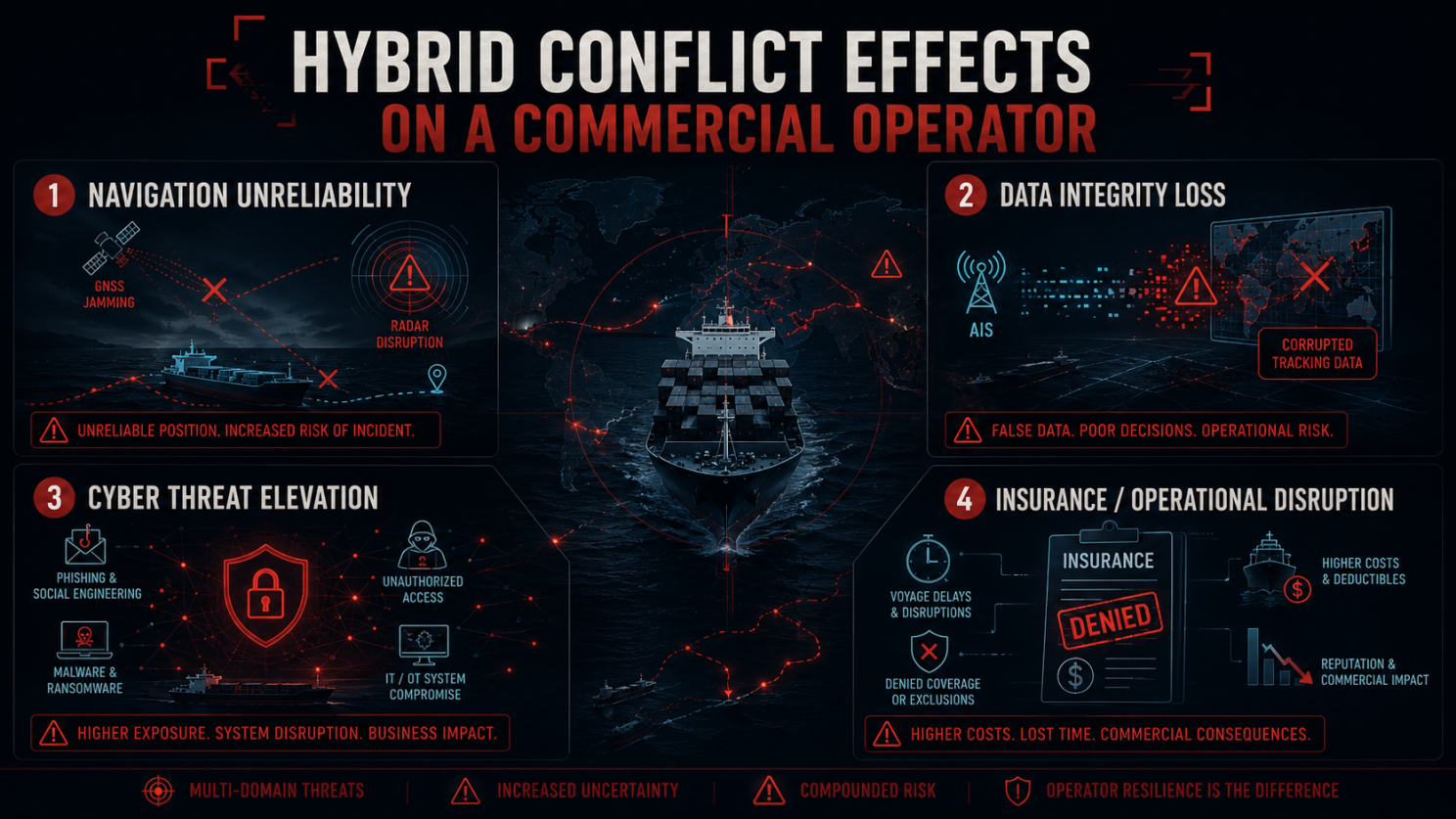
Hybrid Conflict Multiplies Commercial Risk
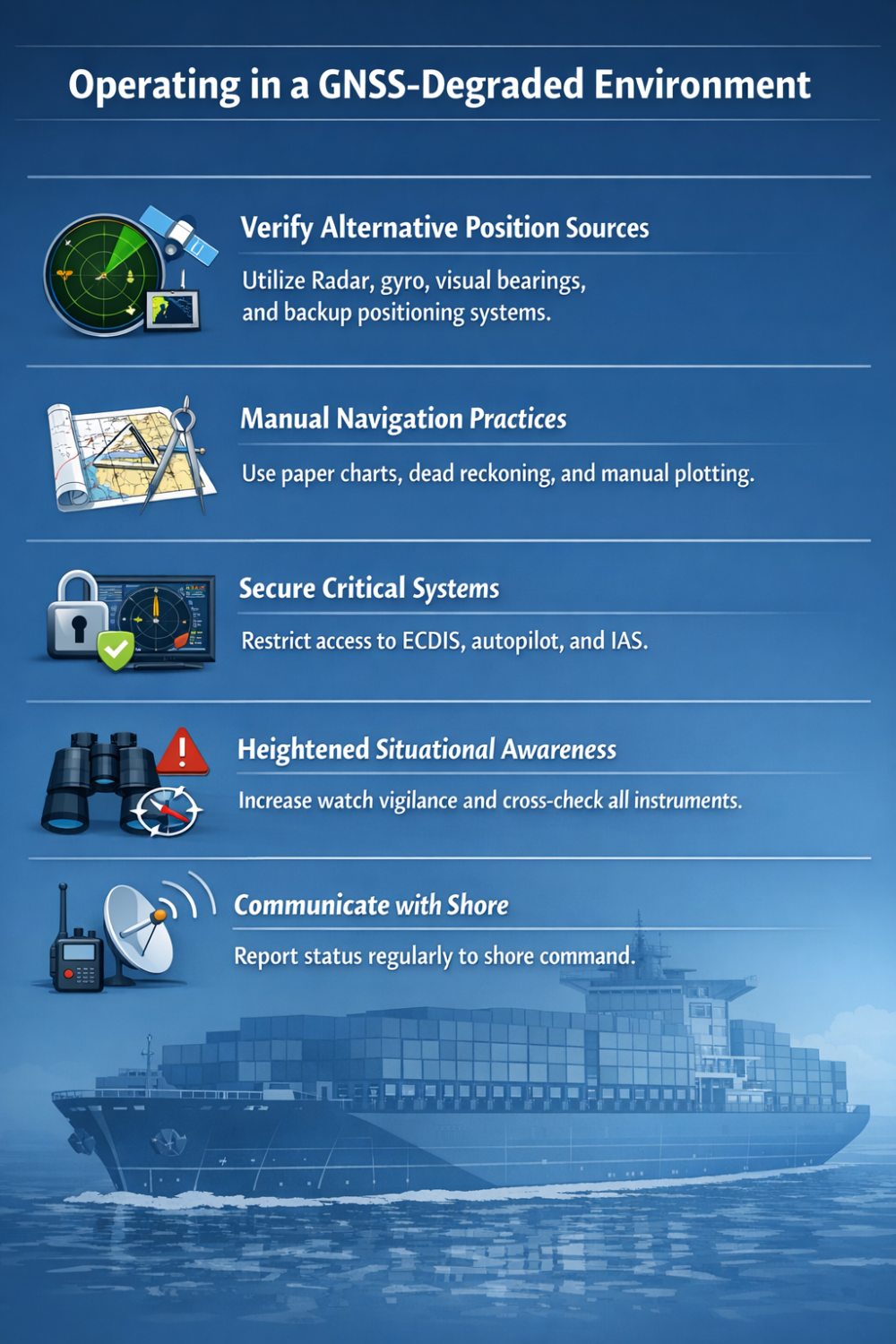
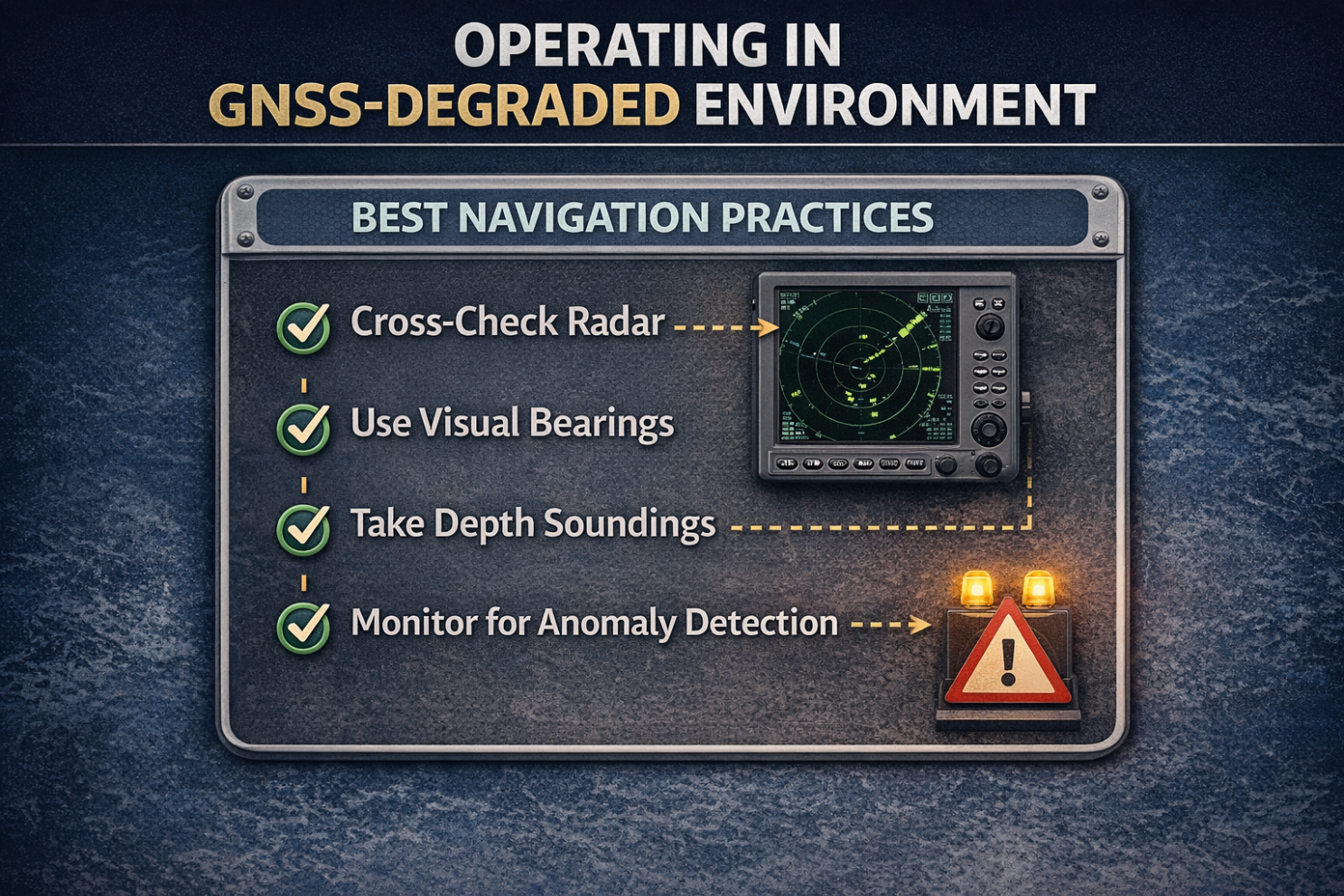
  • GNSS dependency is an operational vulnerability, not just a technical one. Vessels operating in or adjacent to conflict zones with total dependence on GNSS for navigation are operating with a single point of failure that state actors can disable on demand. Multi-system backup navigation [cross-referencing GNSS with radar, inertial navigation, and visual reference] must move from best practice to operational standard. IACS UR E26 requires documented contingency procedures for navigation system failure; operators need to treat GNSS denial as a credible scenario in passage planning, not a theoretical edge case.
  • AIS data cannot be trusted in conflict-adjacent waters. The integrity of vessel tracking data across the Gulf has been fundamentally compromised. Commercial operators relying on AIS for situational awareness, scheduling, or cargo coordination in affected regions must implement independent verification. Any platform aggregating AIS data from the region is currently distributing partially or wholly corrupted information. With downstream consequences for logistics planning far beyond the immediate conflict zone.
  • Conflict-adjacent cyber threat elevation is real and specific. The Iranian cyber retaliation campaign is not random. It is targeting entities economically linked to the US-Israeli campaign [energy companies, logistics operators, port facilities, and financial institutions] processing related transactions. Maritime companies need to assess their specific exposure to this targeting logic and elevate their defensive posture: reviewing remote access controls, verifying backup integrity, and ensuring incident response plans are current and tested.
  • Insurance and war risk frameworks were not designed for this. War risk premiums for Strait transit increased from approximately 0.2 percent to nearly 1 percent of ship value. Meaning a tanker worth USD 100 million faces a war risk premium of USD 1 million per transit instead of USD 200,000. Existing cyber and war-risk insurance frameworks do not always clearly allocate loss arising from state-conducted electronic warfare. Whether GNSS spoofing-induced grounding in a conflict zone falls under a cyber policy, a war risk policy, or neither is not settled. Operators need to review their policies now, not after an incident. Cydome
  • Crew decision-making under hybrid threat conditions is untested. Masters and officers in the Gulf have been required to navigate vessels with unreliable GNSS, degraded communications, conflicting AIS data, and live threat advisories simultaneously. This is a scenario that no maritime training programme routinely exercises. The industry needs to develop training that reflects multi-domain hybrid threat conditions. Not single-threat cyber or navigation failure exercises in isolation.

Regulatory and Institutional Implications

Existing cyber risk management guidance under IMO MSC-FAL.1/Circ.3 and IACS UR E26 was designed around the threat of criminal and state-sponsored cyber attack against vessel systems. The Hormuz crisis demonstrates a distinct threat category: state-conducted electronic warfare that degrades navigation infrastructure across an entire region simultaneously, without targeting any individual vessel’s systems. Current maritime cyber guidance does not yet provide specific operational doctrine for regional GNSS denial at state scale.

IMO’s Secretary-General has stated there is “no safe transit anywhere in the Strait of Hormuz” and the IMO Council has called for a halt to attacks on ships and urged member states to ensure the continuous provision of water, food, fuel, and other essentials to stranded ships. That institutional response “however necessary” addresses the humanitarian emergency. It does not yet address the longer-term question of how the regulatory framework must evolve to govern the intersection of electronic warfare and maritime safety. Infosecurity Magazine

NIS2’s mandatory incident reporting obligations and resilience requirements were designed for scenarios where state actors target or disrupt critical infrastructure. Maritime operators with EU exposure and Gulf operations should be documenting the cyber and electronic warfare dimensions of this crisis in their risk registers as they unfold.


Article content

The Hormuz crisis is one of the most consequential maritime security crises of the modern era. Its cyber and electronic warfare dimensions, coordinated GNSS manipulation affecting over 1,650 commercial vessels, AIS data integrity collapse across a major global shipping region, and a sustained Iranian cyber retaliation campaign targeting maritime-adjacent energy and logistics infrastructure, have demonstrated what maritime hybrid warfare looks like when executed at strategic scale against the world’s most critical energy chokepoint.

Iran’s retaliation strategy reflects a pre-planned, multi-domain framework designed to impose costs while preserving regime survivability. Combining kinetic attacks, cyber disruption, proxy activation, and electronic warfare. This approach enables demonstration of resilience and sovereign defiance while maintaining escalation control and preserving bargaining leverage. Other state actors are watching and learning. The techniques deployed in the Gulf:

  • Regional GNSS denial
  • AIS integrity attacks
  • Pre-positioned cyber access in critical infrastructure
  • Coordinated hacktivist proxy operations

They are not specific to Iran. They are a transferable template. Security Council Report

The maritime industry needs to understand this template, build operational doctrine around it, and ensure that the vessels, systems, and people operating in and around any contested waterway are prepared for an environment in which the digital and physical worlds are not separate domains. They are the same battlefield.


Maritime Cyber Threat Briefing is an independent series covering cyber threats, vulnerabilities, and risk management across the global maritime industry. It is published by Alexandros Engelen, a Cybersecurity Strategist, specializing in maritime cyber risk.

Sources: International Maritime Organization , UN News, CNN, Euronews, ABC News, gCaptain, GIS Resources, Polestar Global, Tradlinx/Citrini Research, Flashpoint, Tenable, SOCRadar® Extended Threat Intelligence, Industrial Cyber, HSToday, CSIS, National Maritime Foundation- NMF, U.S. Naval Institute News, Security Council Report, World Bank, Argus Media, CNBC, Lloyd’s List Intelligence .

No commercial relationship exists with any cited organization.
AI as a Maritime Attack Weapon: When the Attacker No Longer Needs to Be an Expert

Maritime Cyber Threat Briefing #8

There is a question that has shaped the maritime cyber security conversation for years: how technically capable does an attacker need to be to compromise a vessel, a fleet management system, or a port terminal?

Until recently, the honest answer was: reasonably capable.

  • Exploiting OT systems
  • Maintaining persistence in an isolated shipboard network
  • Conducting credible social engineering against a multinational crew operating across multiple time zones and languages

These things required effort, knowledge, and time. They were not trivial. That constraint provided the industry with a degree of passive protection. That constraint is gone.

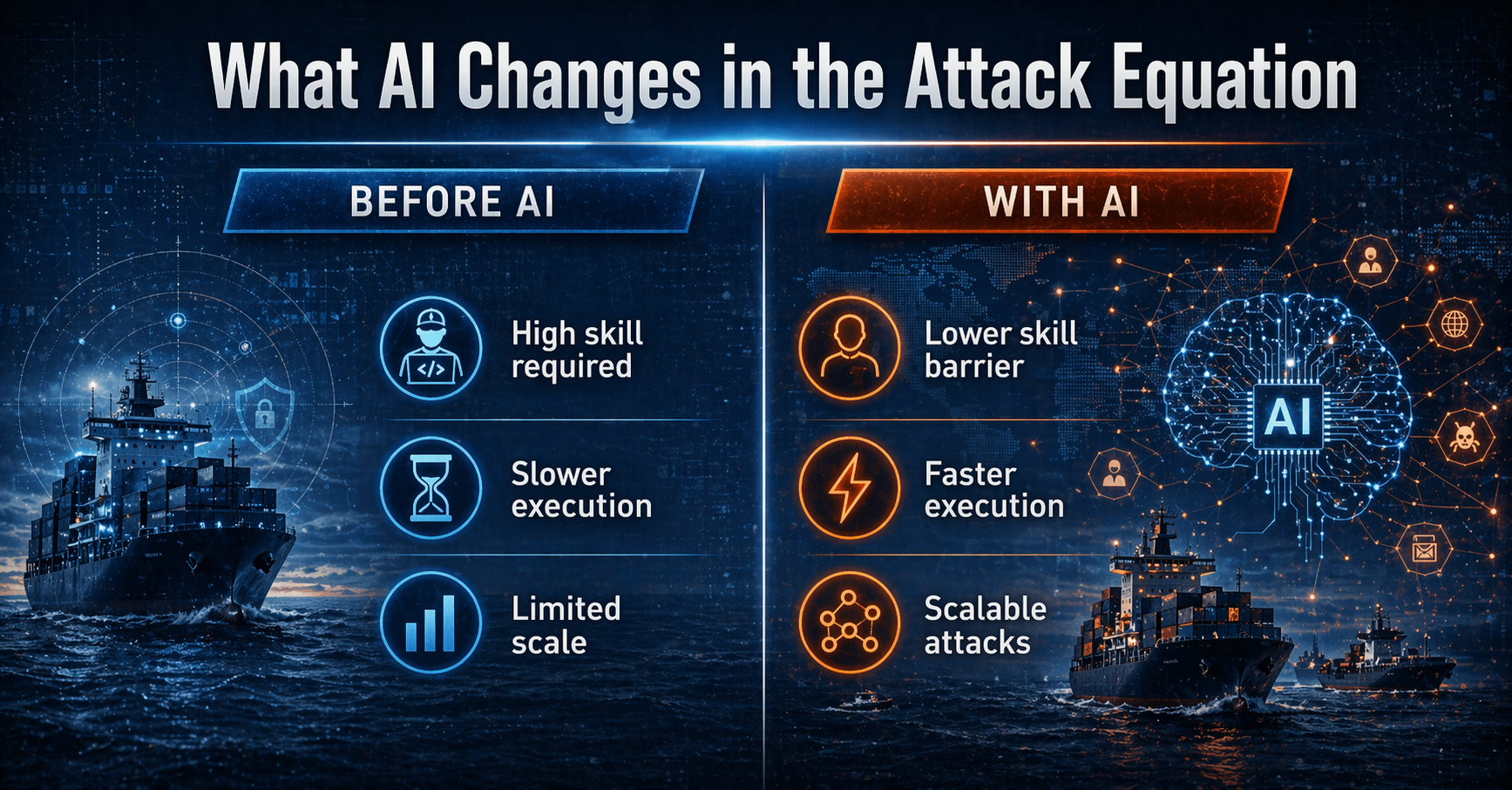
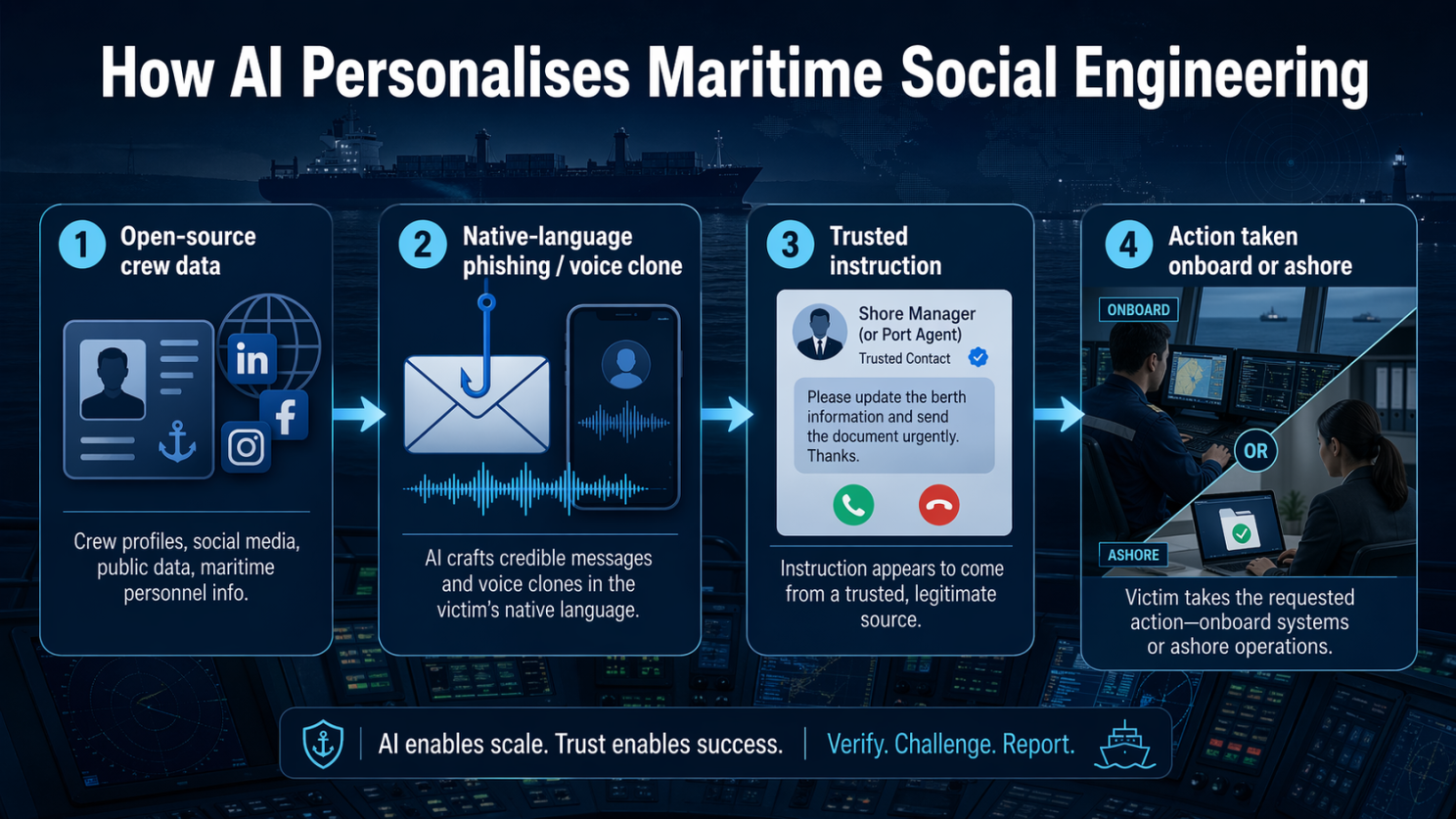
In 2026, artificial intelligence has fundamentally altered the economics and accessibility of maritime cyberattacks. Tools that previously required a sophisticated threat actor to operate can now be directed by someone with minimal technical knowledge. Attack lifecycles that previously took days or weeks to execute can now be compressed into hours, or minutes. Phishing campaigns that were once detectable by poor grammar and generic content are now indistinguishable from legitimate communications, personalised by AI to the specific cultural background, native language, and professional context of each individual target.

Shipping companies are deploying AI faster than they are defining cyber accountability. The same technology being adopted to optimise fleet operations, predictive maintenance, and crew recruitment is simultaneously being weaponised against the industry. At the same time, the attackers are moving faster than the defenders.

Article content
From Specialist Threat to Scalable Attack

The Collapse of the Exploitation Window

Article content
AI is shrinking the defender’s response window

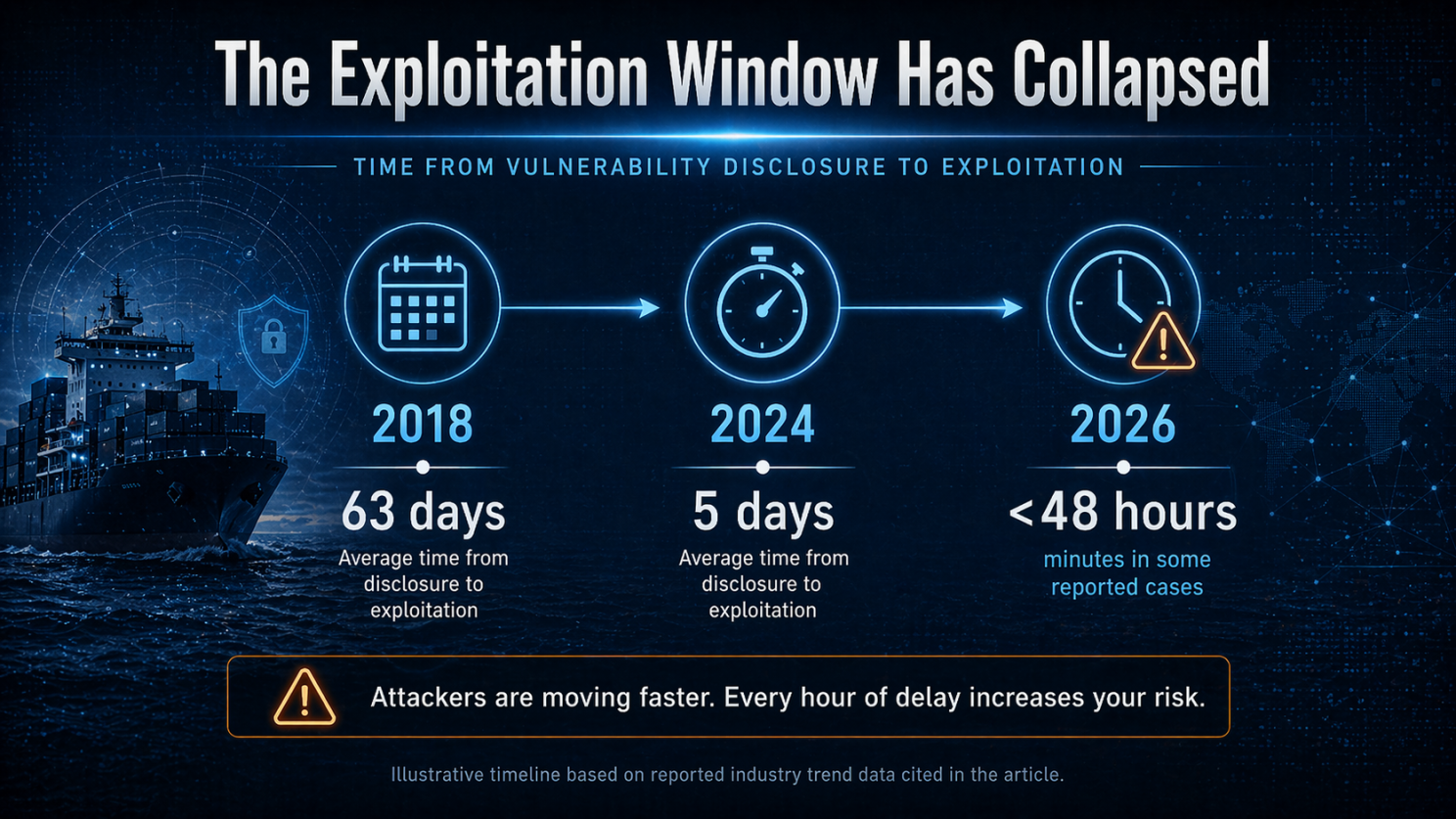
The most operationally significant consequence of AI in the attack landscape is the collapse of the time between vulnerability disclosure and active exploitation.
In 2018, attackers typically took 63 days to exploit a newly published flaw. By 2024, that window had collapsed to five days. Industry reporting in 2026 suggests that AI-driven attack workflows have reduced the exploitation window to less than 48 hours in many cases, with some systems reportedly targeted within minutes of a flaw being identified.

For maritime operators, this timeline collapse has a specific and serious implication. Vessels are not corporate IT environments. A shore-based IT team cannot push a critical patch to a vessel’s ECDIS or engine management system with the same speed and certainty that an enterprise can update a server. Recent maritime reporting has argued that up to 60% of newly disclosed software vulnerabilities across ships, ports, and offshore assets are now weaponised within 48 hours. The patch management cycle that the maritime industry relies on [periodic updates during port calls & remote updates over satellite links] was designed for a world where attackers took weeks to act. That world no longer exists.
The practical consequence is straightforward: a vulnerability disclosed on a Monday morning may be actively exploited against maritime targets before the vessel has made its next port call. The window for remediation has collapsed to a timeframe that the industry’s current patching infrastructure cannot consistently meet.


The GTG-1002 Precedent: What Autonomous AI Attacks Actually Look Like

To understand where maritime cyber risk is heading, it is necessary to understand what happened in September 2025 and what it means for any organisation that manages complex, geographically distributed operational technology.

In September 2025, the cybersecurity landscape crossed a pivotal threshold with the first widely verified case of an AI-powered, largely autonomous cyber-espionage campaign. A China-aligned threat actor, designated GTG-1002, manipulated a commercial AI coding tool into bypassing its safeguards and used it to autonomously execute intrusion attempts across nearly thirty global organisations spanning technology, finance, chemical manufacturing, and government sectors, with several resulting in successful compromises.

What marked this campaign as strategically significant was not just its scale, but its unprecedented speed. Compressing activities that traditionally require human operators days or weeks into minutes, enabling real-time adaptation, automated reconnaissance, and the ability to sustain dozens of parallel intrusion threads.

The campaign reportedly relied heavily on contextual manipulation of the AI tool’s reasoning process, influencing how it interpreted intent and decomposed tasks. GTG-1002 influenced how an agentic model interpreted intent breaking the attack down into small, innocuous-looking tasks so that the AI cooperated without recognising the full objective. The attack did not rely on misconfigurations or malware. Defensive tools focus on monitoring networks and software behaviour, but they do not track the internal reasoning patterns of an AI system.

The maritime implications are direct. Chemical manufacturers were among the confirmed targets of GTG-1002. Industries with OT environments that share significant architectural similarities with shipboard systems. The techniques demonstrated [autonomous reconnaissance, parallel intrusion threads, AI-directed exploit generation] are as applicable to a vessel’s navigation network or a port’s terminal operating system as they are to a corporate IT environment. The GTG-1002 campaign was not aimed at shipping. But it was a proof of concept for what is coming.


AI-Powered Social Engineering: The Crew as the Target

Article content
AI Personalizes trust before it exploits it

Beyond autonomous intrusion, AI has transformed the social engineering threat in ways that make existing crew awareness training inadequate for the current threat environment.

83 percent of phishing emails targeting multinational maritime crews are now AI-generated, written in native languages and tailored to cultural nuances. This has led to a 1,600 percent surge in voice phishing, where AI clones trusted voices to manipulate crew members into taking actions they would otherwise question.
The implications for maritime operations are acute. Crews operate in multinational environments, under time pressure, with limited ability to verify instructions through alternative channels when at sea. An AI-generated voice call impersonating a port agent, a fleet manager, or a classification society surveyor, delivered with cultural familiarity and the correct technical vocabulary is extraordinarily difficult to identify as fraudulent in real time.

This is not theoretical. Documented fraud cases already show how AI-enabled impersonation can redirect sensitive payments, while high-profile deepfake executive scams outside the maritime sector have demonstrated losses in the tens of millions of dollars. The attacker did not need to board the vessel, access the network, or compromise any operational system. They needed to intercept and replicate a payment communication convincingly enough to redirect a transaction. AI made that replication trivially achievable.
The wider deepfake threat reinforces this picture. A CFO deepfake fraud case involved employees attending a video call where every participant except them was an AI-generated deepfake trusting what they saw and heard. They authorised transfers totalling about $25 million. As this technology becomes commoditised, the question for maritime organisations is not whether their crews could be targeted by a convincing impersonation of shore management. It is whether they have any reliable means of verifying they are not already being targeted.

The Democratisation of Sophisticated Attacks

Article content
AI is expanding the attackers population

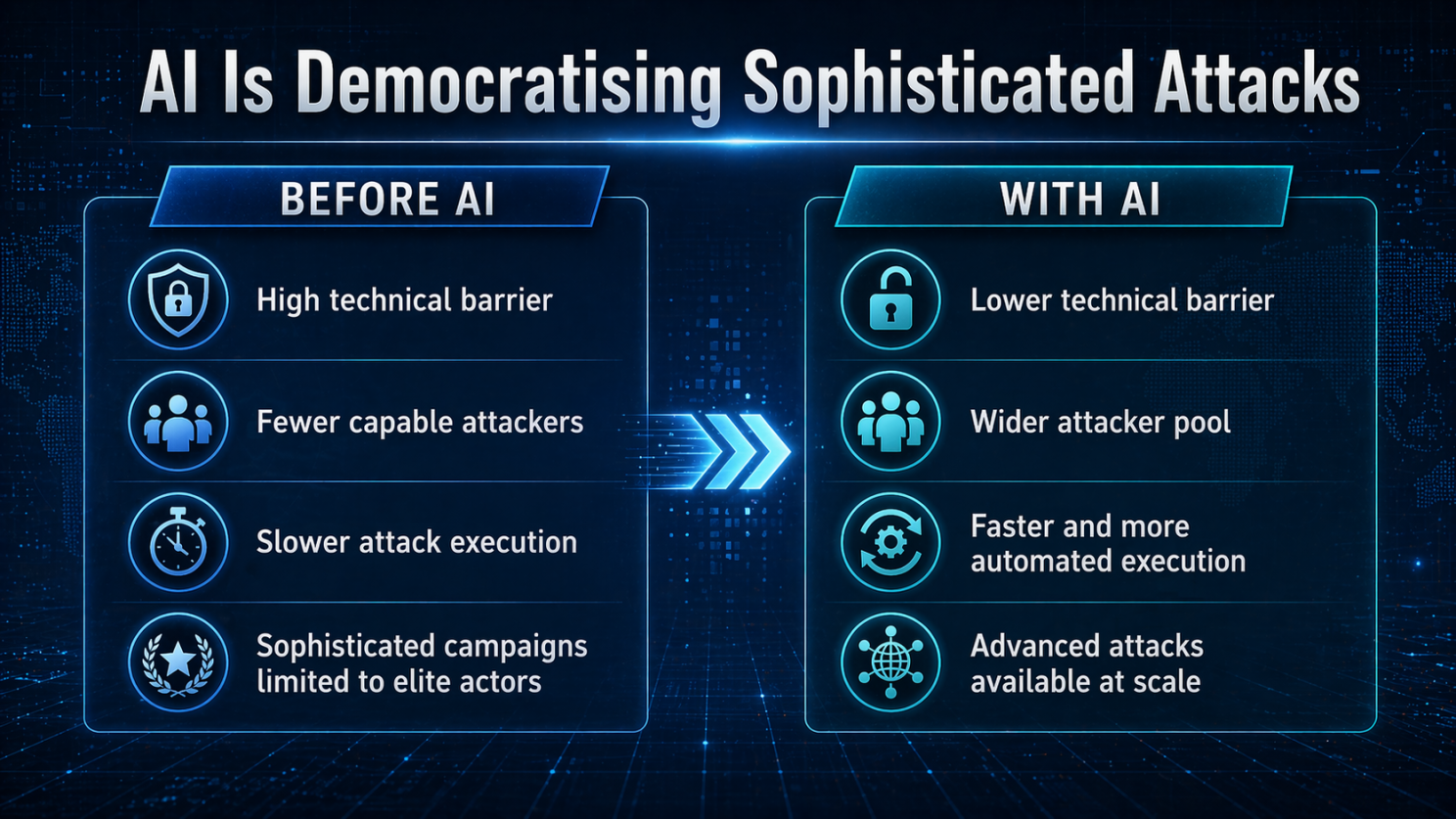
Perhaps the most consequential aspect of AI’s entry into the offensive cyber landscape is what it does to the attacker population.

Previously, the most damaging attack methodologies:

  • Persistent OT compromise
  • Multi-stage intrusion chains
  • Fleet-scale disruption

Required state-sponsored or highly organised criminal groups with significant technical resources. The sophistication required to execute such attacks was itself a limiting factor on their frequency.

AI is increasingly moving beyond a support role toward semi-autonomous execution of attack workflows, lowering the barrier to entry for less sophisticated actors. This development lowers the barrier to entry, enabling less-skilled actors to conduct highly sophisticated, nation-state-level attacks at scale, driving a sharp increase in attack frequency against maritime organisations.

Both state-sponsored and less sophisticated criminal groups could potentially perform large-scale attacks using agentic AI. Autonomous agents can execute tasks quicker and more efficiently than human operators, and AI may also be used to conduct disruptive cyberattacks that threaten delivery of essential services.

For maritime operators, this means the threat population is no longer bounded by technical capability. An actor who previously lacked the expertise to exploit a shipboard OT vulnerability can now direct an AI agent to identify, analyse, and exploit that vulnerability autonomously. The constraint that previously separated opportunistic low-skill attacks from sophisticated targeted intrusions has been removed.

In practice, AI does not need to create entirely new attack pathways to be dangerous. It can accelerate existing ones by:

  • Automating credential harvesting
  • Improving supplier impersonation
  • Generating realistic maintenance requests
  • Scaling reconnaissance against vendor ecosystems already trusted by maritime operators.

In that sense, AI amplifies the very supply-chain and access-path risks the industry is already struggling to contain.


The Insider Dimension

AI also intensifies the insider threat in maritime environments in ways that deserve specific attention.

In 2026, insider risk is becoming one of the hardest categories of cyber risk to detect and manage, particularly in digitally integrated environments. As organisations become more digitally integrated, insider risk [whether malicious, compromised, or accidental] will be one of the hardest challenges to detect and manage.

The maritime environment creates specific insider risk conditions. Crews rotate frequently, passing through multiple ports and jurisdictions. Shore-based contractors and service engineers retain remote access credentials. OEM technicians connect to vessel systems from locations that the ship operator often cannot verify. AI-powered social engineering can compromise an otherwise loyal crew member through targeted manipulation that leverages personal financial pressure, family circumstance, or professional grievance. All of which can be researched and identified from open sources by an AI agent conducting reconnaissance.

In 2026, rogue insiders leveraging AI and deepfakes represent a convergent risk. Employees who have the proclivity to act against the organisation’s interests will be encouraged to do so with AI making it easy and deepfakes providing plausible deniability. Any insider has all the business context to customise deepfake attacks to seem much more real than anything previously encountered.

The ferry Fantastic incident, in which a crew member inserted a malware-loaded USB drive into a bridge workstation acting on external instructions was a human-factor failure. In the AI era, the instructions that led to that insertion may have been delivered by a voice clone of the vessel’s technical superintendent, a deepfake video message from a trusted shore contact, or a personalised phishing message in the crew member’s native language that referenced specific details about their employment, family, and financial situation. The human factor has always been the hardest element of maritime cyber security to address. AI makes it harder still.


Mitigation: Adapting to Machine-Speed Threats

Article content
Defense must now operate at machine speed

The defences that the maritime industry has been building for the last decade were designed for a human-paced threat environment. They are necessary but no longer sufficient. Adapting to AI-driven attacks requires a different approach across several dimensions.

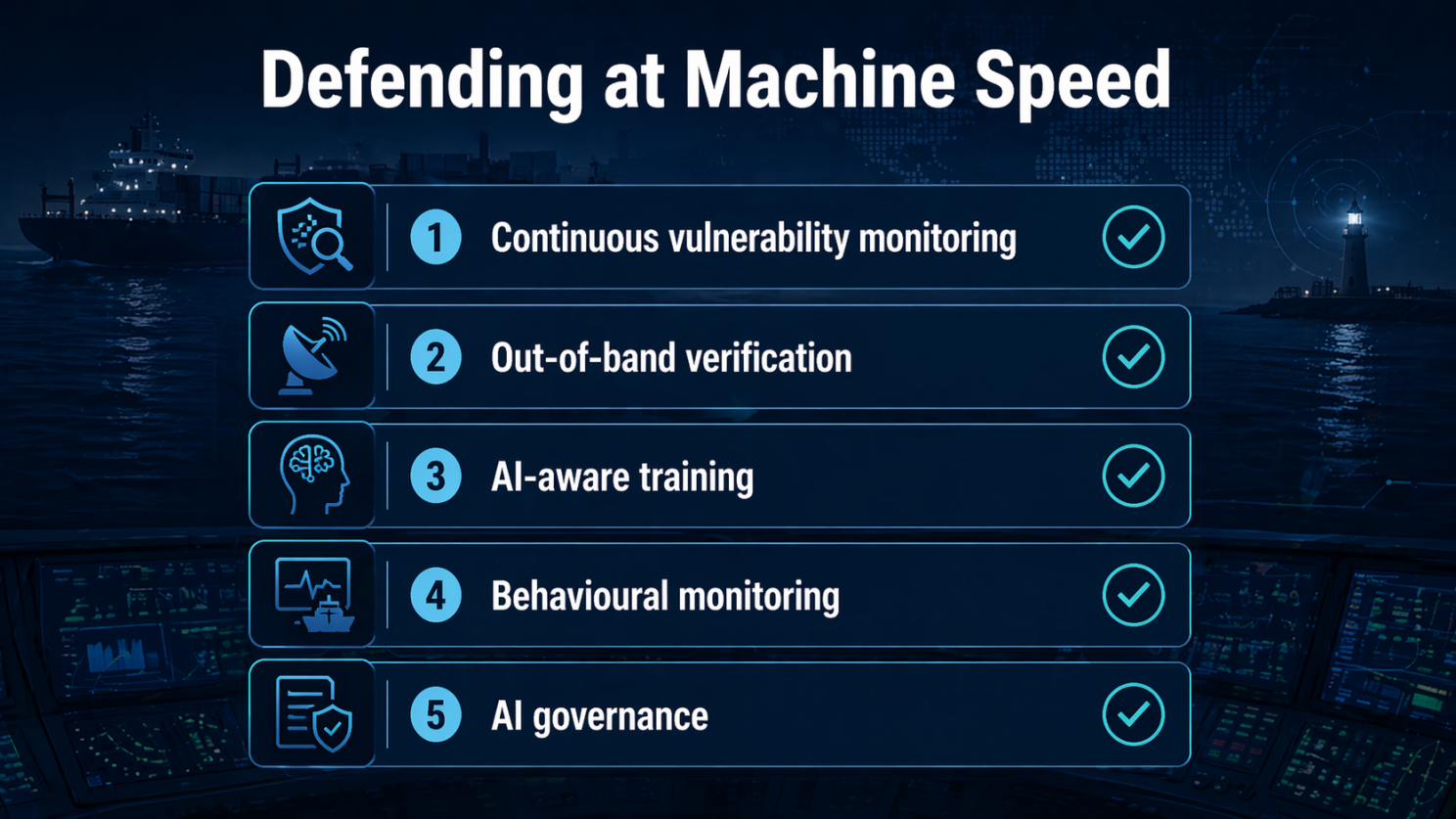
  • Continuous vulnerability management, not periodic patching. The 48-hour exploitation window makes port-call patch cycles untenable as the primary vulnerability management mechanism. Maritime organisations need continuous monitoring of vulnerability disclosures relevant to their installed systems, with risk-based prioritisation that can trigger emergency remote patching where available, or compensating controls where it is not. IACS UR E26 and E27 provide the framework the industry needs to implement it with the urgency that the current exploitation timeline demands.
  • Out-of-band verification for high-risk instructions. Any instruction that involves financial transactions, changes to vessel systems, access credential changes, or deviations from established procedures should require verification through a channel independent of the one through which the instruction arrived. A voice call instruction to modify a payment should be verified by a pre-established callback number. A remote access request from a service engineer should be verified against a pre-agreed schedule. These protocols are simple, operational, and directly address the social engineering threat that AI has amplified.
  • AI-aware crew training. Current maritime cyber awareness training was not designed to address AI-generated voice cloning, deepfake video impersonation, or hyper-personalised phishing in multiple languages. Training programmes need to be updated to address these specific threats, with realistic scenario-based exercises that reflect the actual form attacks are taking. Not generic phishing awareness content that the threat has already rendered obsolete.
  • Behavioural monitoring over signature-based detection. While unpatched vulnerabilities were the primary attack vector in 2024–2025, the 2025–2026 period has seen a marked rise in the exploitation of valid, stolen credentials as a dominant entry point. AI-driven attacks increasingly use legitimate credentials and trusted access pathways, which means signature-based detection systems will not catch them. Anomalous behaviour detection [unusual access patterns], unexpected data movements, atypical command sequences in OT environments, is the detection layer that matters when the attacker is using legitimate credentials.
  • Governing AI deployment aboard vessels and in shore operations. Shipping companies adopting AI tools for operational purposes need to define accountability frameworks before deployment, not after an incident. Which AI systems have access to which data? What decisions can AI systems make autonomously? What audit trails exist? In 2026, the question after an incident will not be “was the AI wrong?” but “why was it trusted?” Organisations that cannot answer that question before the incident will not be able to answer it after.

Regulatory Considerations

The regulatory framework has not yet fully absorbed the implications of AI-driven attacks for maritime cyber security, but the direction of travel is clear.

International Maritime Organization updated cyber risk management guidelines reference the National Institute of Standards and Technology (NIST) Cybersecurity Framework v2.0, which includes governance as a core function. Directly applicable to the AI accountability question. IACS UR E26 and E27 requirements for continuous monitoring and documented incident response are more relevant than ever when the attack timeline has collapsed to 15 minutes in the most extreme cases. NIS2’s mandatory incident reporting requirements apply to the full category of significant incidents, regardless of whether they were executed by a human attacker or an AI agent acting autonomously.

What is needed, and does not yet exist at IMO level, is specific guidance on AI risk within the maritime cyber security framework. Covering both the use of AI in vessel operations and the threat posed by AI-powered attacks against those operations. The industry should not wait for that guidance before acting. The threat is already operational.


The question at the opening of this briefing was how technically capable an attacker needs to be to compromise maritime infrastructure. The answer in 2026 is: less capable than at any previous point in the industry’s cyber security history.

AI has removed the skill constraint that provided passive protection to maritime operators for the first decade of serious cyber threat awareness. It has compressed the exploitation window to the point where the industry’s patching infrastructure cannot consistently respond in time. It has created social engineering capabilities that can defeat crew awareness training designed for a different era. And it has made nation-state-level attack sophistication accessible to any actor willing to direct an AI tool toward a maritime target.

The maritime industry is not uniquely unprepared for this shift. But it is uniquely exposed by the combination of legacy OT systems, the constraints of operating at sea, multinational crew environments, and a supply chain of hundreds of interconnected technology providers, each of which represents a potential entry point for an attacker that no longer needs a skilled human to find and exploit it.

The industry must now treat AI as both an operational asset and an active threat vector. Governance, monitoring, verification protocols, and updated training are not optional responses to a future risk. They are the necessary response to a present one.


Maritime Cyber Threat Briefing is an independent series covering cyber threats, vulnerabilities, and risk management across the global maritime industry. It is published by Alexandros Engelen, a Cybersecurity Strategist, specializing in maritime cyber risk.

The Weakest Link Is Not the Ship: How Supply Chain Attacks Are Redefining Maritime Cyber Risk

Maritime Cyber Threat Briefing #7

What if the most effective way to compromise a fleet is not to target a vessel at all?

For most of maritime cyber security’s relatively short history, the threat conversation has been vessel-centric. Hardening the bridge. Securing the ECDIS. Segmenting the OT network. Protecting navigation systems from GPS spoofing. Training the crew not to plug-in an unverified USB drive.

These concerns remain valid. But in 2025, a structural shift in attacker methodology changed the terms of the problem in a way the industry has not yet fully absorbed.

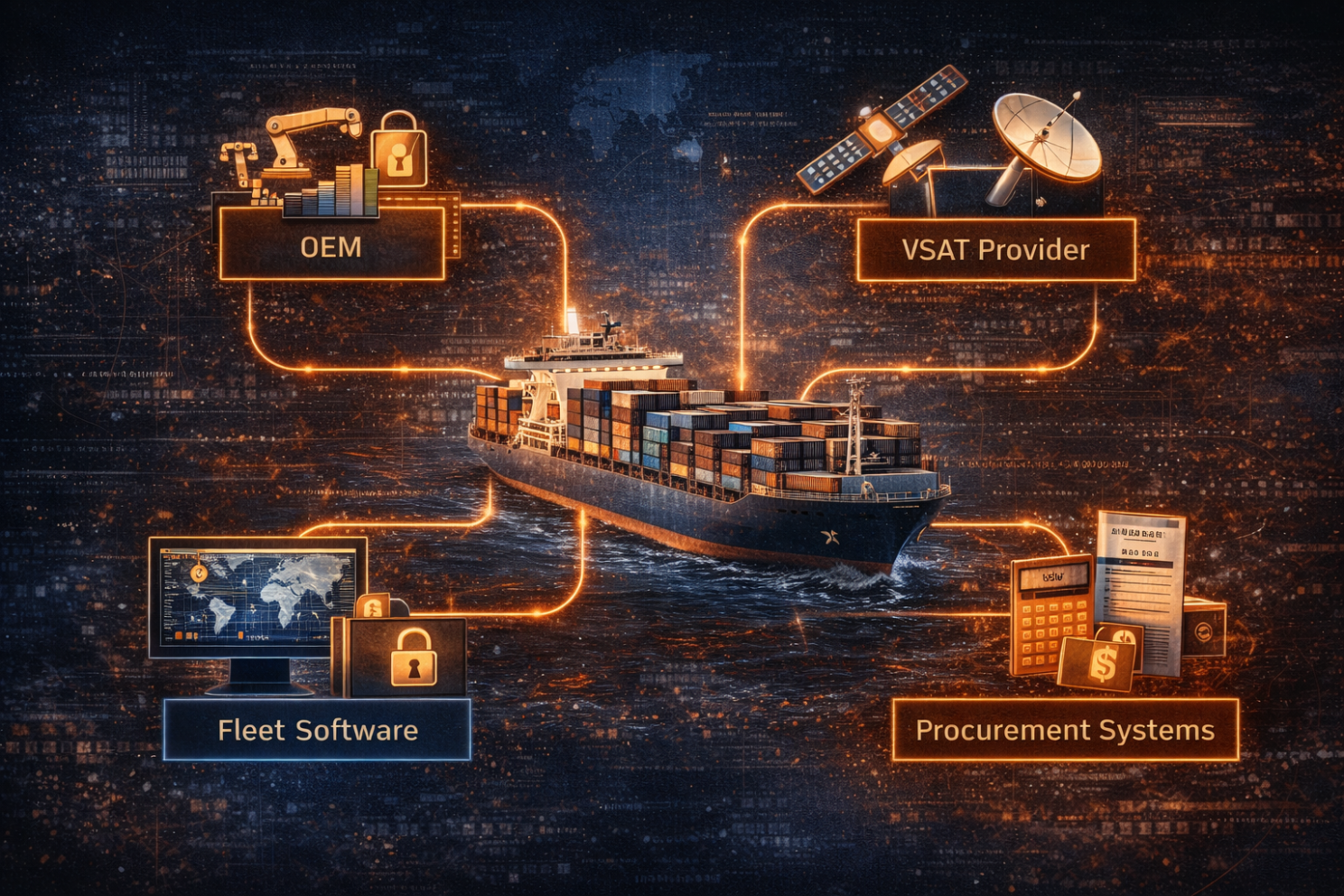
The most consequential maritime cyber incidents of the past eighteen months did not begin aboard a vessel. They began in the supply chains that serve vessels: the OEM manufacturers, the satellite communications providers, the fleet management software platforms, and the procurement systems on which ship operators depend every day. A single compromise at the right node in that supply chain can now disable dozens of ships simultaneously, disrupt maintenance and safety updates across global fleets, and expose the personal and commercial data of thousands of people. Without an attacker ever needing to target a vessel directly.

This is the defining shift in maritime cyber risk in 2026:

The weakest link is no longer necessarily the ship. It is the systems every ship trusts, but does not control.


The Logic of Supply Chain Targeting

Article content
From Single Targets to Systemic impact

To understand why supply chain attacks have become the preferred approach against maritime targets, it helps to think like an attacker.

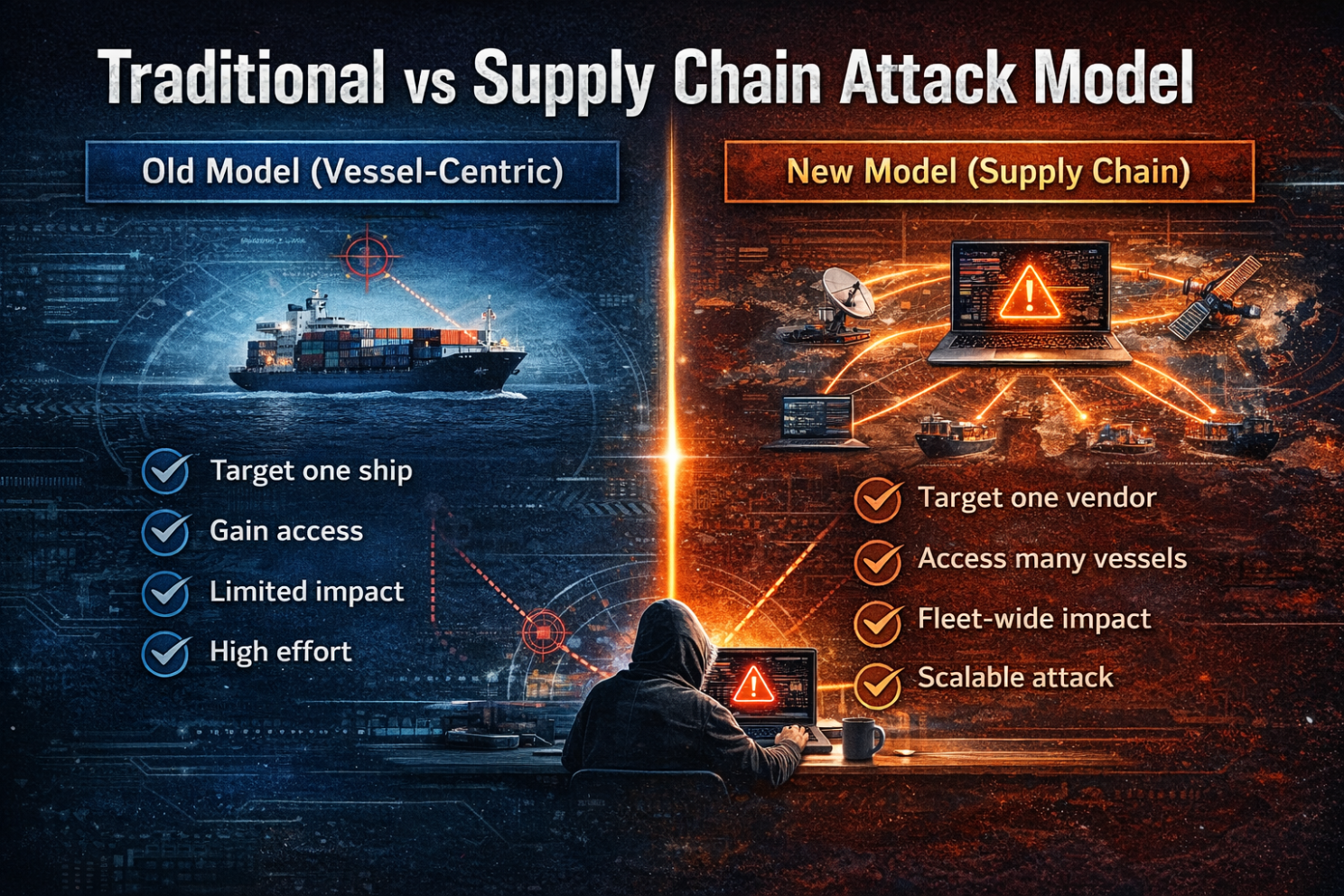
Targeting an individual vessel is operationally intensive. It requires sustained access, an understanding of that specific vessel’s systems architecture, and the ability to maintain persistence aboard a platform that may be at sea for weeks at a time, with limited connectivity and an IT environment that changes as crew rotates. The potential yield, disrupting one ship is relatively modest.

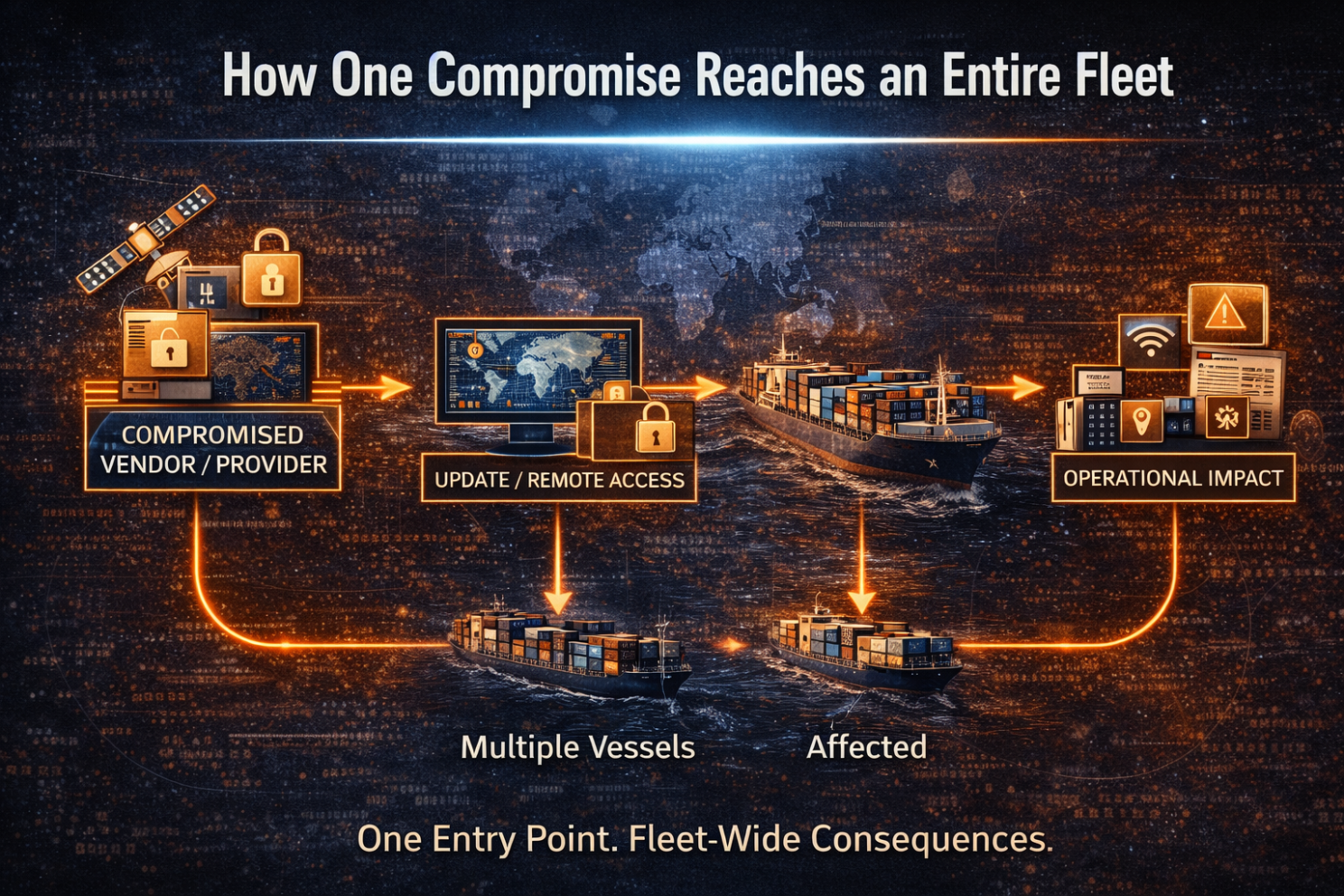
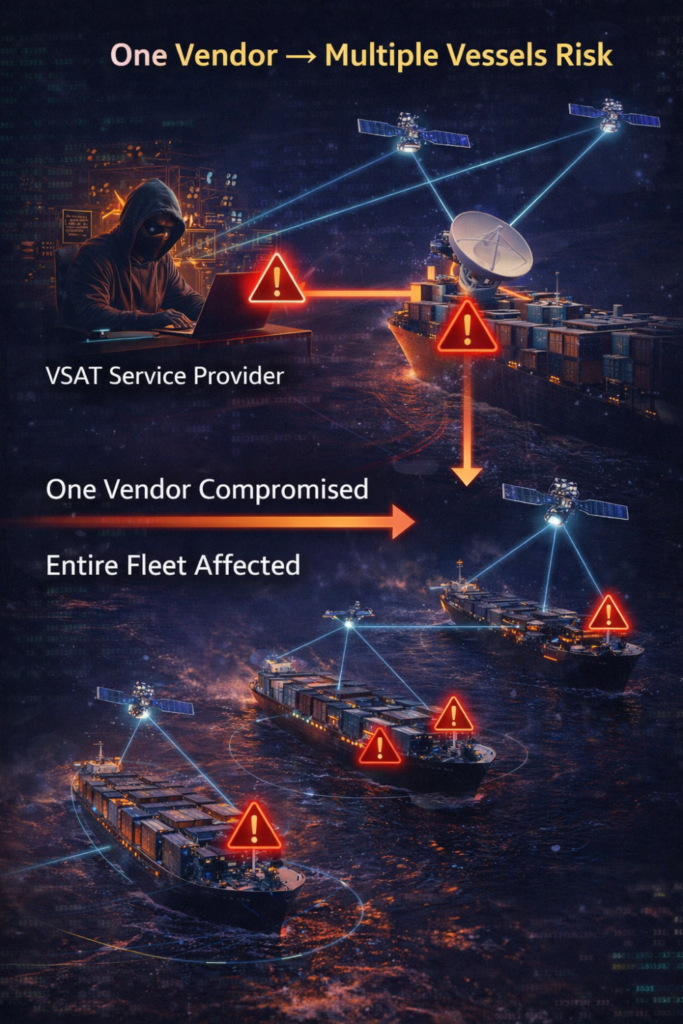
Targeting the OEM that manufactures navigation and radar equipment for two thousand vessels is an entirely different proposition. Compromise that supplier’s update infrastructure, and the malicious payload propagates automatically to every vessel running that software. Compromise the satellite communications provider that serves a state-owned tanker fleet, and you can sever ship-to-shore links across the entire fleet in a single operation. Compromise the fleet management software platform used by a major ship manager, and you gain simultaneous visibility and potentially leverage. Over hundreds of vessels, their maintenance records, crew data, and commercial operations.

Instead of targeting individual vessels, attackers are focusing on choke points in the supply chain, telecommunications providers and OEM equipment manufacturers. With the tactic of paralyzing an entire fleet by infiltrating a single provider becoming increasingly common.

This is no longer theoretical. It is documented operational practice, with multiple confirmed incidents across 2025 and 2026.

Article content
One supply chain breach can become a fleet-wide operational issue

This model mirrors supply chain attacks seen in other sectors, such as the SolarWinds compromise, where a single trusted update channel became the delivery mechanism for widespread intrusion.

This is not a niche maritime issue, this is how modern cyber warfare works.


The Incident Record: Three Case Studies

Case Study 1: Lab Dookhtegan and the VSAT Supply Chain Attack

The Lab Dookhtegan attack on Iranian tonnage in 2025 demonstrated supply chain methodology at its most precise. The threat group systematically targeted Fanava Satellite, an Iranian satellite communications provider, to conduct an attack high up the digital supply chain for Iran’s state-owned tanker fleet. After penetrating Fanava, Lab Dookhtegan obtained fleet-wide control over ship-to-shore VOIP services, making it harder for vessels to communicate with the home office or port officials. While in possession of access to the ships’ networks, the group stole corporate documents belonging to Iranian state firms NITC and IRISL, then released them online. When finished, it destroyed the ships’ modems by overwriting partitioned memory, requiring physical replacement of hardware across the fleet.

Two points about this incident deserve emphasis. First, the attacker never needed to board a single vessel, or establish direct access to any shipboard system. Controlling the communications provider was sufficient. Second, the attack was not purely destructive, it combined intelligence collection, document exfiltration, public exposure of sensitive corporate data, and physical hardware destruction in a single operation. This is the signature of a sophisticated, resourced threat actor using maritime supply chain access as a multi-purpose instrument.

Case Study 2: The Furuno Ransomware Attack

In October 2025, Japanese radar and ECDIS builder Furuno Electric Co., Ltd was hit by ransomware deployed by the Rhysida threat group. The attackers stole Furuno’s internal data, threatened to release it, encrypted the firm’s data, disabled backup servers, and demanded payment. The attack temporarily disrupted service, software updates, and parts shipments for Furuno’s global customer base.

The significance of this incident extends beyond the immediate disruption to Furuno’s operations. Furuno manufactures navigation and radar equipment installed on vessels across the global fleet. When its update infrastructure was disabled and parts shipments were suspended, the cascading effect was a degradation of safety-critical maintenance capability across thousands of ships that had nothing to do with Furuno’s own security posture. Their OEM was the entry point, and they bore the consequence.

This is the mechanism that makes supply chain attacks so strategically efficient: the compromised entity and the entities that suffer operational impact are not the same. The attacker targets the supplier. The damage lands on the customer.

Case Study 3: NYK’s Bunker Fuel Procurement Breach

Earlier this month, Japanese shipping group NYK Line disclosed that its marine fuel procurement system had been accessed without authorisation by a third party. Detected on the afternoon of March 24, 2026, the breach resulted in certain data, including personal information being accessed and exfiltrated. The company immediately isolated the system from the network and suspended its use.

The data potentially exposed included names, company names, phone numbers, and email addresses of current and former employees and business partners. NYK reported the incident to Japan’s data protection authority and confirmed no ransomware or financial demand had been identified.

What makes the NYK incident relevant to the supply chain discussion is the system that was targeted. A bunker fuel procurement platform sits at the intersection of vessel operations, commercial counterparties, and logistics planning. The supplier contacts, port agent details, and broker relationships held within such a system represent a rich target for reconnaissance enabling follow-on social engineering attacks against other organizations in the maritime supply chain. The breach of one company’s procurement system becomes the intelligence preparation for the next company’s attack.


The Threat Architecture: How Maritime Supply Chains Are Exploited

These three incidents represent three different points of entry into the maritime supply chain, but they share a common underlying vulnerability: the industry’s supply chain was not designed with security as a foundational requirement.

Attackers exploit vulnerabilities in the supply chains of the numerous software and equipment installed on vessels, capable of simultaneously disabling dozens of ships through a single breach. Satellite communications and asset spoofing threats targeting maritime communication infrastructure directly have also surfaced, with attackers exploiting security vulnerabilities in satellite communication links to transmit false commands or forge vessel asset information.

Several structural factors make maritime supply chains particularly exposed.

  • Remote access as a standard maintenance model. OEM troubleshooting teams routinely connect remotely to shipboard systems to diagnose faults, push updates, and make configuration changes. The remote access communications protocols built into equipment electronics used by OEM troubleshooting teams to remotely diagnose errors and make changes, remain a significant vulnerability. If an attacker could remotely control engine output or ballasting through these pathways, the results could be catastrophic. These remote access channels represent persistent, privileged connections between shore-based systems and shipboard OT. Connections that ship operators often have limited visibility into and limited ability to monitor.
  • Software update pathways as attack vectors. Supply chain attacks involving the planting of malware into update servers or management tools have the highest potential impact because a single breach can simultaneously distribute malicious code to tens of thousands of vessels worldwide that utilise the compromised software. As autonomous navigation and remote maintenance technologies advance, these “trusted” update pathways have become among the most dangerous attack vectors in the maritime domain. The industry’s reliance on remote software updates, a practice that reduces cost and port time, has created a network of trusted pathways that attackers are systematically mapping.
  • Dark web intelligence markets. Illicit items found for sale online include voyage logs, cargo manifests, ship design schematics, and the personal information of crew. Common ransomware attacks involve encrypting the ship’s Planned Maintenance System, forcing the operator to pay to recover the voyage’s logs. The commodification of maritime data on criminal forums means that compromised procurement systems, leaked employee directories, and exfiltrated commercial records do not remain confined to a single incident. They become the raw material for subsequent targeted attacks against the broader maritime supply chain.

Operational Impact: What Supply Chain Compromise Actually Means

The consequences of maritime supply chain attacks are qualitatively different from those of vessel-specific attacks, and they need to be understood in those terms.

When an OEM is compromised, the immediate impact falls on that company. But the downstream impact: delayed maintenance, suspended safety updates, disrupted parts supply, falls on every operator using that equipment. A ship manager whose ECDIS software update has been withheld because the manufacturer’s update server was taken offline by ransomware is exposed to navigational risk through no action or inaction of their own. Their security posture is partly a function of their OEM’s security posture. A dependency they may not even have formally assessed.

When a satellite communications provider is compromised, the ship-to-shore connectivity that underlies fleet management, emergency coordination, port state control communications, and crew welfare is disrupted across every vessel on that network simultaneously. The vessel at sea has no alternative pathway. The master has no means to escalate to shore-based management. The commercial operations team has no visibility over the fleet. A single provider-level compromise translates directly into an operational crisis at fleet scale.

When a procurement or fleet management platform is breached, the exposure extends beyond the immediate data loss. Supply chain intelligence: who the company’s fuel suppliers are, which ports they frequent, which agents they use, which vessels are carrying which cargo. It becomes available to threat actors whose next objective may be physical, financial, or reputational targeting of the company’s commercial partners.


Mitigation: Rethinking the Perimeter

Article content
The vessel is only one node in the Maritime Cyber Ecosystem

The supply chain threat requires a fundamental expansion of how maritime operators define their security perimeter. The vessel’s network is no longer the boundary of responsibility. It is a node within a much larger ecosystem, and that ecosystem requires security governance.

  • Vendor and supplier security assessment. Ship owners and managers must begin treating the cyber security practices of their critical suppliers as a risk management obligation, not an assumption. OEMs, software providers, satellite communications companies, and fleet management platform operators should be subject to formal security assessments, contractual security requirements, and periodic review. The questions to ask are specific: What is the vendor’s patch management cycle? How do they manage remote access credentials to shipboard systems? Do they operate a software bill of materials? What is their incident response and customer notification procedure?
  • Software Bill of Materials awareness. The concept of a Software Bill of Materials, a comprehensive inventory of software components installed on a system, including third-party dependencies is increasingly required under IACS UR E27 for onboard systems. Ship operators should demand SBOMs from their OEMs and software providers and use them as the basis for vulnerability management. If a component in the supply chain is compromised, an SBOM enables rapid identification of which vessels and systems are affected.
  • Controlled remote access architecture. Remote access pathways from OEMs and service providers into shipboard systems should be explicitly governed. Not assumed to be secure by virtue of being established by a trusted vendor. Access should be session-based, logged, and terminable by the ship operator. Standing persistent access that cannot be monitored or revoked represents an unacceptable risk in the current threat environment.
  • Procurement and commercial systems as cyber assets. The NYK incident is a reminder that cyber risk extends beyond the vessel and the fleet management platform into the commercial systems that connect the organisation to its supply chain. Bunker procurement systems, cargo management platforms, port agency communications, these systems hold data that has operational and intelligence value to threat actors. They require the same security governance as operational systems.
  • Incident response planning for supply chain failure. Ship operators need contingency plans that address the specific scenario of a critical supplier being compromised. What is the fallback if the ECDIS software update service is unavailable? What is the procedure if the satellite communications provider experiences a service disruption due to a cyber incident? These scenarios should be included in tabletop exercises alongside vessel-specific attack scenarios.

Regulatory Considerations

The regulatory framework is beginning to catch up with the supply chain risk, but implementation is uneven.

  1. IACS UR E27, which applies to onboard equipment and systems in newbuilds contracted from January 2024, explicitly requires manufacturers to embed security throughout the product development lifecycle and provide SBOMs as part of their security documentation. This is a significant step, it places a formal security obligation on OEMs, not just on ship owners. However, its scope is limited to newbuilds, and the vast majority of the current world fleet predates these requirements.
  2. IMO MSC-FAL.1/Circ.3 guidance on maritime cyber risk management requires that cyber risk, including risks from third-party systems and service providers, be addressed within the vessel’s Safety Management System. This provides a framework for documenting supply chain dependencies, but the depth of assessment varies significantly across operators and flag state interpretations.
  3. NIS2, applicable across EU member states, is the most explicit regulatory instrument in addressing supply chain cyber security for essential service operators. Its requirements include security measures for supply chains and supplier relationships, and mandatory incident reporting within 24 hours of a significant incident. A requirement directly relevant to events like the NYK breach, which affected business partners across multiple jurisdictions.

From 2026, vessels that cannot demonstrate compliance with the full range of applicable cyber security requirements face real operational consequences, including inability to obtain class certification and denial of port entry. Making supply chain security a delivery condition, not a discretionary investment.


The maritime cyber threat has evolved. The vessel remains a target, but it is no longer the primary point of entry for the most sophisticated and most damaging attacks against the industry. Attackers have identified that the maritime supply chain, the OEMs, the communications providers, the software platforms, the procurement systems offers higher leverage, broader impact, and in many cases weaker defenses than the vessels themselves.

The industry’s response to this evolution needs to match its scale. Security governance that stops at the vessel’s network boundary is no longer sufficient. Every critical supplier, every remote access pathway, every software update channel, and every commercial platform that connects the operator to its supply chain now sits within the security perimeter that must be managed.

The question ship owners and managers need to ask is not only “how secure are our vessels?” It is: “how secure is everything our vessels depend on, and do we even know what that is?”

In the current threat environment, the answer to the second part of that question is often no. That needs to change.

The next maritime cyber incident is unlikely to begin at sea.


Maritime Cyber Threat Briefing is an independent series covering cyber threats, vulnerabilities, and risk management across the global maritime industry. It is published by Alexandros Engelen, a Cybersecurity Strategist, specializing in maritime cyber risk.

Vessel Compromise: A Practical View of How Attacks Actually Work

Maritime Cyber Threat Briefing:
#Special Edition

This special edition briefing takes a more practical and operational perspective than previous articles in this series. The intention is not to demonstrate “how to hack a vessel,” but to clearly illustrate [using documented research and real-world findings] how maritime cyber attacks actually unfold in practice. Understanding these pathways is essential for evaluating risk, challenging assumptions, and implementing effective controls.

A note on methodology and intent: This special edition departs deliberately from the analytical format of the regular briefing series. It is written for maritime industry professionals & ship owners, technical superintendents, fleet managers, and security officers. Those who need to understand not just that vessel cyber attacks occur, but specifically how they occur and what they look like in practice. The methodology described here draws exclusively on published, authorised penetration testing research conducted by professional security firms on operational vessels with the explicit permission of owners and manufacturers. Understanding attack methodology at this level of detail is the prerequisite for making informed decisions about vessel security investment, evaluating the claims of security providers, and asking the right questions during audits and assessments. It is published in this spirit and for this purpose.


There is a conversation that happens regularly in boardrooms, on bridges, and in fleet management offices around the world. It usually begins with a question about whether a particular vessel, fleet, or organisation has been protected against cyber attack. The answer that comes back is some variation of “we have antivirus, our bridge systems are separate, our IT is managed”. It also reflects a profound misunderstanding of the actual attack surface of a modern commercial vessel.

This article does not deal in theory. Everything described here & every scenario, every technique, every outcome has been documented in published security research, disclosed by authorized penetration testing teams, or confirmed in incident investigations. The question is not whether these attacks are possible. They have been performed. The question is whether the operator knows it.


The Attacker Starts Before You Expect

Most maritime cyber security thinking begins at the vessel boundary: the VSAT antenna, the USB port, the crew laptop. But a sophisticated attacker begins considerably further back, from the comfort of their own workstation, using tools that are freely and legally available to anyone.

The first tool is Shodan: a search engine that indexes internet-connected devices globally, including satellite communication terminals aboard vessels at sea. The search query “SAILOR 900” referencing the Cobham Satcom SAILOR 900 VSAT [one of the most widely deployed satellite terminal platforms in commercial shipping] returns hundreds of results. Each result includes the terminal’s IP address, the organisation operating it, the port it is listening on, and in many cases the firmware version it is running.

[Following Screenshot]: Shodan reconnaissance simulation — what the attacker actually sees.

Article content
Reconstruction based on documented Pen Test Partners and x0rz research. Vessel Name, IP and position are fictional. Methodology and exposed data fields are real.

[Following Screenshot]: What Shodan Exposed without any authentication:

Article content
Reconstruction based on documented Pen Test Partners and x0rz research. Vessel name, IP and position are fictional. Methodology and exposed data fields are real.

By combining Shodan data with publicly available AIS position data, it is possible to build a clickable map of potentially vulnerable ships with their real-time positions. Simply by correlating the firmware version running on a vessel’s satellite terminal with its identity and current location.

The reconstruction above shows exactly what this looks like in practice. Within seven minutes, the documented timeframe from real research: an attacker has identified a specific vessel, confirmed its VSAT terminal is exposed on the public internet, noted the outdated firmware version, cross-referenced the terminal’s GNSS coordinates against AIS data to identify the vessel by name, and established that its cargo type and ETA at the next port are publicly broadcast. No vessel system has been touched. No crew member has received a suspicious message. The operator has no indication that any of this has occurred.

Search for “html:commbox” on Shodan and a collection of KVH CommBox terminals appears, missing TLS on the login, with the vessel name visible in the page footer before authentication. Requesting “/rest.php?action=QCgetActiveUsers” returns a list of all crew members currently online, their names, and enough information to build a targeted phishing profile.

The crew member identified in Pen Test Partners’ documented research: a deck cadet [whose CommBox terminal exposed his name and activity] had his Facebook profile located within moments. His vessel was in the Malacca Strait heading for Brazil. His personal details were visible. He was, in the researchers’ words, “ripe for phishing.”

This is reconnaissance. It costs nothing. It requires relatively modest technical skill and can be performed with publicly available tools and documentation. And it produces a complete intelligence picture of a vessel, its crew, its cargo, and its technical vulnerabilities before a single attack packet has been sent.


The Entry Points: Four Documented Pathways to the Bridge

Once reconnaissance is complete, the attacker has multiple validated pathways to initial access. Each has been demonstrated in controlled conditions by authorised security researchers. None of them require the attacker to be physically near the vessel.

Pathway 1: Default VSAT credentials

Using the username “admin” and the password “1234”, a security researcher was able to access the communication centre of a ship as it made its way through South American waters. The satellite communication provider at the centre of this access was Cobham Satcom and the default credentials for their SAILOR 900 VSAT are publicly documented in the vendor manual, available to download from the internet.

[Following Screenshot]: Now the VSAT admin panel: what the attacker sees after typing admin/1234:

Article content
Reconstruction based on documented Pen Test Partners and Smart Maritime Network research findings. The admin panel layout, exposed data fields, and access capabilities reflect real documented findings. Names and IPs are fictional.

The VSAT admin panel reconstruction above shows what full administrative access looks like once those credentials are accepted. The attacker can view the vessel’s real-time GNSS position, see every crew account and their last login time, access the network configuration, enumerate all devices on the internal network [including the IP address of the ECDIS] upload custom firmware, modify routing rules, enable FTP access, and launch a remote shell. The vessel’s crew has no indication that a third party is now on their network with the same access level as the system administrator.

In a documented real-world test conducted outside a controlled demo environment, a vessel belonging to a very large multinational corporation was located in seven minutes. It had the default username and password still in effect on the VSAT system. The VSAT modem was then accessed using default SSH credentials, with publicly available usernames and passwords, achieving command-line access and allowing direct alteration of the system configuration.

This is not a theoretical vulnerability. It is a documented real-world outcome. And it continues to occur because service providers [some managing thousands of vessels] still employ engineers who fail to remove default credentials on installation.

Pathway 2: Phishing the captain

Naval Dome’s security team [led by the former Head of the Israeli Naval C4I and Cyber Defense Unit] demonstrated penetration of a vessel’s ECDIS simply by sending an email to the captain’s computer. The attacking file was transferred to the ECDIS in the first chart update. The attacking file identified the USB device used for updates and installed itself on the ECDIS automatically.

The attack vector exploited the routine nature of chart updates. ECDIS systems require weekly updates to electronic navigational chart data. Those updates arrive via USB drive or network connection. The captain performs this task routinely, without suspecting that the update file might carry a payload. The malware installed silently on the ECDIS. The system continued to function normally. The Officer of the Watch saw nothing unusual on the navigation display.

The crew member targeted by phishing does not need to be the captain. The CommBox research identified deck cadets, engineers, and officers as equally viable targets. 83% of phishing emails targeting multinational crews are now AI-generated, written in native languages and tailored to cultural nuances: making them significantly harder to identify as malicious compared to the grammatically imperfect phishing emails of earlier years.

Pathway 3: The infected USB drive

The USB drive is the most persistent and least glamorous attack vector in maritime cyber security. Chart updates, software patches, and data transfers between systems aboard vessels routinely use removable media. The bridge workstation that receives the ECDIS chart update USB may also be connected to the vessel’s internal network. The ECDIS itself may have exposed USB ports physically accessible to any crew member or visiting technician.

In December 2025, a Remote Access Trojan was discovered on the ferry Fantastic after a crew member [acting on external instructions] inserted a malware-laden USB drive directly into a bridge workstation. By exploiting vulnerabilities including outdated operating systems such as “Windows XP” and inadequate network segmentation, this attack can manipulate ECDIS chart data or remotely take over key engineering systems, creating a pathway toward manipulation of navigation or engineering systems, particularly where outdated operating systems and weak segmentation are present.

The Fantastic case was assessed as a suspected organized attack linked to foreign power interests, with two sailors accused of attempting to deploy trojans or specialized hardware directly onto the ship’s closed-loop navigation systems. Specialists noted this marks a shift toward physical-access-based cyber-espionage against European maritime assets.

Pathway 4: Vendor remote access

Every equipment manufacturer that has supplied systems to a vessel: ECDIS, radar, engine management, power systems, ballast controls, typically maintains a remote access pathway for diagnostics and maintenance. These pathways are not always documented by the operator. They are not always managed with the same rigour as other remote access systems. And they are not always closed between maintenance sessions.

The remote access communications protocols embedded in OT equipment electronics used by OEM troubleshooting teams to remotely diagnose errors and make changes, remain a persistent vulnerability. If a threat actor were able to abuse these pathways to alter engine, ballast, or control-system parameters, the operational consequences could be severe.

The vendor pathway is particularly dangerous because it carries implicit trust. Traffic from a known OEM IP range, authenticating with credentials that the vendor has legitimately used before, accessing systems that vendor is authorized to reach, this does not look like an attack. It looks like a maintenance session.


What Happens Once the Attacker Is Inside: Three Forensically Documented Scenarios

The following scenarios are not drawn from imagination. They are reconstructed from published penetration testing findings conducted by Naval Dome, Pen Test Partners, and other authorised security research teams on operational vessels with the knowledge and permission of owners and manufacturers.

Scenario A: The position that was not where the chart said it was

Naval Dome’s team designed an attack to alter the vessel’s position at a critical point during an intended voyage, during night-time passage through a narrow canal. During the attack, the system display looked completely normal, but it was deceiving the Officer of the Watch. The vessel’s crucial parameters: position, heading, depth, and speed were manipulated in a way that the navigation picture made sense and did not arouse suspicion. This type of attack can easily penetrate the antivirus and firewalls typically used in the maritime sector.

The NMEA injection reconstruction above shows exactly how this works at the protocol level. “NMEA 0183” the standard protocol used to carry navigational data between GPS receivers, autopilots, ECDIS systems, and the dozens of other instruments on a modern bridge: transmits in plain text with no authentication, no encryption, and no integrity checking. The checksum at the end of each sentence is a simple XOR calculation, trivially forged by any attacker already on the network.

[Following Screenshot]: The attacker is assessed to have pivoted from the VSAT terminal onto the vessel’s internal network via the unsegmented LAN. They locate the GPS receiver and the serial-to-IP converter bridging navigation data to the autopilot. NMEA 0183 sentences carry positional data in plain text with no authentication.

Article content
Based on documented Pen Test Partners NMEA research and Naval Dome penetration testing findings. The NMEA sentence structure, checksum format, and attack methodology are accurate. Offset values are illustrative.

The injected sentence in the reconstruction shifts the vessel’s apparent position by approximately 1.4 nautical miles to the northwest. The depth displayed on ECDIS reflects the chart data at the false position 18.4 meters, while the actual depth beneath the keel at the real position is 14.1 meters. The safety contour alarm does not trigger. The system reports GPS active and no alarms. The Officer of the Watch has no reason to question the display.

This can occur through interception [man-in-the-middle attack] and modification of data in transit within the vessel network. This is not GPS spoofing, which is well known and relatively detectable. This is injecting small errors to slowly and insidiously force a ship off course.

Scenario B: The radar that showed a clear picture with ships deleted

The radar is widely considered by many seafarers to be the most reliable, most independent, and least hackable system on the bridge. It transmits and receives physical radio pulses. It does not depend on satellite signals. It cannot be spoofed from the other side of the world. These beliefs are largely correct, until the radar is connected to a network.

Naval Dome’s team used the local Ethernet Switch Interface which connects the radar to the ECDIS, Bridge Alert System, and Voyage Data Recorder to access the radar system. They succeeded in eliminating radar targets, simply deleting them from the screen. At the same time, the system display showed that the radar was working perfectly, including detection thresholds, which were presented on the radar as completely normal.

The bridge team watching that display saw a clear radar picture with normal detection parameters showing. The vessels they could not see on radar were present. The system gave them no indication that what they were looking at was incomplete. The radar appeared to be functioning correctly. It was not.

Pen Test Partners tested over 20 different ECDIS units and found security flaws across all of them. Most ran old operating systems, including one popular in the military that still runs Windows NT. One example had a poorly protected configuration interface that allowed them to jump the vessel by spoofing the position of the GPS receiver on the ship. Then the ECDIS was reconfigured to make the ship appear to be approximately one kilometer square to all nearby vessels’ AIS systems, triggering collision alerts on every ship in the vicinity of a busy shipping lane.

Scenario C: The machinery that started doing something different

A third controlled attack was performed on the Machinery Control System using an infected USB stick. Once connected to the vessel’s MCS, the virus file ran itself and started to change the functionality of auxiliary systems. The attack resulted in machinery being disabled, signals to fuel and ballast pumps being overridden, and steering gear controls manipulated.

The pathway to machinery control from a network-level compromise is through the serial-to-IP converters that translate legacy OT protocols into network communications. These converters translate serial OT protocols [used by engine control, steering gear, and ballast pump systems] into network-addressable communications. A compromised serial-to-IP converter can allow an attacker to intercept, alter, or inject serial communications destined for engine, steering, or ballast systems. “CVE-2016-9361” allowed recovery of the admin password from these devices even after it had been changed from the factory default. Vessels running unpatched firmware on serial converters remain exposed to this class of attack today.

The manipulation does not have to be dramatic. An attacker who understands the vessel’s operational context can introduce incremental changes: a slight reduction in ballast pump throughput, a gradual reduction in fuel flow, a minor heading bias in the steering, that are within the range of normal operational variation and unlikely to trigger alarms immediately.


What Is Being Sold: The Commercial Ecosystem Around Vessel Compromise

The dark web marketplace reconstruction below reflects a documented and active commercial ecosystem around maritime data and access. This is not theoretical criminal activity, it is an established market with pricing conventions, escrow mechanisms, and specialist sellers.

[Following Screenshot]: dark web data marketplace — what vessel data looks like once it is stolen and sold.

Article content
Reconstruction based on documented Cyble threat intel reports, Cyble DarkForums findings on maritime data listings. Usernames, prices, and post content are illustrative. Data categories, CVE references, and marketplace mechanics: documented activity.

Illicit items found for sale online include voyage logs, cargo manifests, ship design schematics, and the personal information of crew. One common ransomware attack involves encrypting the ship’s Planned Maintenance System, forcing the operator to pay in order to recover the voyage’s logs.

A threat actor on a dark web based forum claimed to possess one terabyte of internal data allegedly stolen from a major European defense contractor specializing in submarines and naval vessels, including source code for classified command and management systems, network metadata, technical documents, virtual machines with navy simulators, and confidential internal communications.

Other documented incidents involve the theft of technical manuals, NMEA telegrams used for engine control systems, SSL certificates, private keys, firewall licences, and login credentials. Ship blueprints have been exfiltrated by ransomware groups, creating potential national security implications.

The third dark web post in the reconstruction: a buyer seeking active VSAT shells on vessels transiting specific geographic corridors, directly mirrors the pattern documented in published research connecting cyber collection to kinetic targeting. The intended use of this data is neither questioned nor disclosed.


The Detection Problem: Why This Goes Unnoticed

During the Naval Dome attack, the system’s display looked normal, but it was deceiving the Officer of the Watch. This sentence is the essential summary of why maritime bridge OT attacks are so dangerous and so difficult to detect.

Standard IT security monitoring [antivirus, intrusion detection systems, network traffic analysis] is calibrated for IT threat models. It looks for unusual process execution, unexpected network connections, known malware signatures, and anomalous file system activity. It does not understand NMEA sentences. It does not baseline the normal pattern of position updates flowing from a GPS receiver to an ECDIS. It does not alert when a radar target is deleted from a display. It does not detect an injected autopilot command that is syntactically valid and falls within the normal operational range.

The air gap theory: the idea that critical shipboard systems were safe because they were not directly connected to the internet, is now a dangerous myth. The convergence of IT and OT has created a vast, porous attack surface. Systems like ECDIS often run on outdated operating systems such as Windows 7 or even Windows XP, that no longer receive security patches.

The consequence is an attacker who can remain inside a vessel’s network for weeks or months, reading position data, monitoring cargo information, learning operational patterns before taking any active action. Or taking no active action at all, and simply selling the access to a third party who has a different use for it.


Twelve Things That Close the Door

The vulnerabilities described in this article are not new. The fixes are available. The cost of implementing them is a fraction of the cost of a single maritime cyber incident. What follows is not a generic checklist, it is a direct response to the specific attack pathways and demonstrated techniques documented above.

  1. Change every default credential on every VSAT terminal in the fleet today. Not this quarter. Not at the next port call. Today. The “admin” user’s “1234” password that is still active on a vessel’s satellite terminal is a documented, exploitable vulnerability that requires no technical knowledge to abuse.
  2. Remove VSAT management interfaces from public internet exposure. There is no operational reason for a satellite terminal’s administrative interface to be reachable from the global internet. Firewall rules should restrict access to specific, authorized IP ranges only.
  3. Treat firmware currency as a safety-critical maintenance task. Unpatched firmware on VSAT terminals and serial-to-IP converters is not an IT housekeeping matter. It is a direct safety vulnerability with documented exploits. Patch cycles must be defined, tracked, and enforced.
  4. Segment the vessel network so that VSAT and crew internet cannot reach bridge OT systems. The absence of segmentation is the single most consequential structural vulnerability in vessel cyber security. A separate, dedicated network for navigation and bridge OT systems [with no direct connection to crew internet or VSAT management traffic] limits the blast radius of any initial compromise.
  5. Implement a formal chart update procedure that eliminates unscanned USB media. Every USB drive that is inserted into a bridge workstation or ECDIS is a potential delivery mechanism for malware. Chart updates should arrive through an isolated, “air-gapped” scanning station before any connection to navigation systems. Crew smartphone charging from ECDIS USB ports must be prohibited.
  6. Audit vendor remote access pathways. Compile a complete list of every OEM with remote access to vessel systems. Assess the access mechanism, authentication method, and whether access is session-based or standing. Standing always-on connections to OT systems must be replaced with explicitly authorized, time-limited sessions.
  7. Implement multi-source position cross-validation as a watch-keeping standard. ECDIS-derived position must be cross-checked against radar, echo sounder, and visual observation at defined intervals. When sources disagree, the discrepancy must be investigated, not dismissed. This is the primary detection mechanism for NMEA injection and GPS spoofing.
  8. Train bridge officers to interrogate system discrepancies, not normalize them. The Officer of the Watch who encounters a position that does not match radar-derived bearing and distance should not assume the radar is wrong. Cross-validation is a professional skill that must be explicitly taught and regularly exercised.
  9. Conduct regular GPS-denied and NMEA-degraded navigation drills. Bridge teams must be able to navigate confidently without ECDIS-derived position data. These skills atrophy rapidly in environments where digital navigation is always available and always trusted.
  10. Implement OT-specific monitoring that understands bridge protocol behavior. Generic IT security tools do not provide meaningful protection for maritime OT environments. Dedicated maritime OT monitoring that baselines normal NMEA traffic patterns, normal alarm frequencies, and normal autopilot command sequences can detect deviations that would be completely invisible to standard network monitoring.
  11. Assess and manage the security of every VSAT and connectivity service provider. The service provider is not a utility. They are a vendor with privileged access to the network fabric of your fleet. Their security posture, specifically their access control to customer vessel management interfaces, is directly relevant to your vessel’s exposure.
  12. Treat cyber incidents as potential safety events, not just IT events. Every anomaly on the bridge [an unexpected position jump, a radar display that looks different, an autopilot behavior that feels unusual] should be assessed for the possibility of cyber-induced corruption. The bridge team that applies only operational explanations to technical anomalies will not detect a sophisticated bridge OT compromise.

The Honest Conclusion

The researchers who have spent years testing vessel systems have reached a consistent conclusion. Ken Munro of Pen Test Partners put it plainly: “The advent of always-on satellite connections has exposed shipping to hacking attacks. What we’ve only seen in the movies will quickly become reality.”

Naval Dome’s CTO [the former Head of the Israeli Naval C4I and Cyber Defense Unit] was more specific: “The vessel’s crucial parameters were manipulated in a way that the navigation picture made sense and did not arouse suspicion. This type of attack is capable of bypassing many conventional IT security controls commonly relied upon in maritime environments.”

The scenarios reconstructed in this article: the seven-minute Shodan reconnaissance, the admin panel accessed with factory credentials, the NMEA sentence injected to shift a vessel’s apparent position, the maritime data sold on dark web forums, are not constructed from imagination. They are documented, sourced, and reproducible.

The gap between what the maritime industry believes about its cyber security posture and what security researchers have repeatedly demonstrated in practice is not a gap that requires years of investment to close. It requires a change in attitude about what level of exposure is acceptable, combined with immediate action on the most basic controls that have been available and ignored for years.

  • Default credentials changed. Management interfaces firewalled. Firmware patched. Networks segmented. Bridge teams trained.
  • None of that is complicated. None of it is expensive relative to the consequences of not doing it. All of it is overdue.
Article content
In every documented case: systems displayed normal, no alarms triggered.

The purpose of this briefing is not to expose techniques, but to demonstrate how existing exposure translates into operational risk.


Maritime Cyber Threat Briefing is a series covering evolving cyber risks in the global shipping industry. This special edition draws on published penetration testing research, open-source vulnerability intelligence, documented incident data, and authorised security research. All scenarios are reconstructions based on real published findings. No live vessel systems were accessed in the production of this article. It is intended to support maritime industry awareness and operational decision-making.

Key sources: Pen Test Partners maritime security research; Naval Dome penetration testing findings; CYTUR 2026 Maritime Cyber Threat White Paper; Cyble threat intelligence; Smart Maritime Network reporting; Maritime Executive incident coverage.

The firms cited in this article are referenced as sources of published research only. No commercial relationship exists between the author and any organization named herein.

OT Systems on the Bridge: When the Vessel Itself Becomes the Target

Maritime Cyber Threat Briefing #6

What if attackers don’t just manipulate what your vessel sees, but begin influencing how it moves?

The previous briefings in this series have documented the pathways through which adversaries reach maritime organizations: SSL-VPN Gateway exploitation targeting shore-based networks, VSAT supply chain compromise disabling vessel communications at fleet scale, AIS manipulation feeding false positions to tracking systems, and electronic warfare degrading navigational trust across entire maritime zones. Each of those attack vectors represents a different entry point into the same destination, the operational systems aboard the vessel itself.

This briefing addresses what happens when the attacker arrives. When the target is no longer data, visibility, or communications but the systems that determine where the vessel goes, how it behaves, and whether the crew can trust what they are seeing on the bridge.


Section 1 – The Bridge as an OT Environment

The modern ship’s bridge is not an IT environment with maritime branding. It is an Operational Technology environment, a network of industrial control systems, sensors, actuators, and supervisory platforms whose outputs have direct physical consequences. When an office network is compromised, the consequence is data loss. When a bridge OT environment is compromised, the consequence can be a vessel that does not go where the crew intends.

The core systems that constitute the bridge OT environment include:

  • ECDIS — the Electronic Chart Display and Information System, which has replaced paper charts as the primary navigation platform on most commercial vessels. ECDIS integrates position data from GNSS receivers, depth data from echo sounders, AIS traffic from surrounding vessels, and chart data from electronic navigational chart libraries. AIS acts as a downstream propagation layer for GNSS-derived position data. Critically, on many vessels ECDIS operates in track control mode, directly feeding course commands to the autopilot. A compromised ECDIS is not merely a display problem. It is a steering problem.
  • Autopilot and integrated heading control — systems that receive course inputs from ECDIS and execute them through the steering gear. Autopilot systems range from basic models that maintain speed and course to advanced tracking systems capable of following pre-planned routes with speed adjustments, receiving input from ECDIS and integrating data from GPS and other sensors. The connection between ECDIS, autopilot, and steering gear means that manipulation anywhere in this chain can produce course deviations without any direct intervention in steering systems themselves.
  • Radar and ARPA — the primary independent source of collision avoidance data. Radar-derived targets feed into the bridge situational awareness picture. Penetration testing has demonstrated that ECDIS and radar can be hacked, with security researchers able to change a vessel’s displayed position, depth information on ECDIS, and meddle with targets on radar placing a ship in jeopardy of grounding.
  • Integrated Automation Systems (IAS) — the IAS consolidates sensor input from various ship systems including the power management system and navigation systems into a centralized platform, managing alarm signals and transmitting relevant data to the Voyage Data Recorder. The IAS is the connective tissue of shipboard OT and its central role makes it a high-value target for attackers seeking to suppress alarms, manipulate sensor readings, or disrupt automated responses.
  • Engine control, propulsion, and ballast systems — physically separate from the bridge but increasingly networked into the same integrated architecture. Remote diagnostics, predictive maintenance platforms, and OEM vendor access pathways all create connections between engineering OT and the rest of the vessel network.

The air gap theory: the idea that critical shipboard systems were safe because they were not directly connected to the internet, is now a dangerous myth. The convergence of IT and OT has created a vast, porous attack surface. Systems like ECDIS often run on outdated operating systems such as Windows 7 or even Windows XP, that no longer receive security patches.


Section 2 – How Attackers Reach the Bridge

The bridge OT environment does not exist in isolation. It is connected — to the vessel’s satellite communications, to shore-based fleet management platforms, to vendor remote access pathways, and to the crew’s own devices. Each of these connections is a potential entry point.

As documented in Briefing #3, unpatched SSL-VPN Gateways in shore-based networks provide Iranian-linked and other threat actors with authenticated access to corporate environments that frequently include remote access pathways to fleet management systems. Once inside the corporate network, lateral movement toward vessel-connected systems is well within the documented capability of groups such as Lemon Sandstorm.

As documented in Briefing #4, VSAT satellite communications infrastructure represents both an independent attack surface and the primary connectivity pathway between vessel networks and the internet. ECDIS systems are increasingly being connected to vessel networks to facilitate online chart updates, integration with other bridge systems, and remote maintenance. Relevant security flaws that did not matter in the past through lack of connectivity are now becoming critical.

The most direct documented pathway to bridge OT, however, is physical. In December 2025, a RAT [Remote Access Trojan] was discovered on the ferry Fantastic after a crew member, acting on external instructions, inserted a malware-laden USB drive directly into a bridge workstation. By exploiting vulnerabilities including outdated operating systems such as Windows XP and inadequate network segmentation, this type of attack can manipulate ECDIS chart data or remotely take over key engineering systems, resulting in total loss of vessel control.

The Fantastic case highlighted a critical physical-access and insider-risk vector. Two sailors were accused of attempting to deploy trojans or specialized hardware directly onto the ship’s closed-loop navigation systems, in what specialists assessed as physical-access-based cyber-espionage against European maritime assets linked to foreign power interests.

The vendor remote access pathway is equally significant and substantially less discussed. The remote access communications protocols embedded in OT equipment electronics used by OEM troubleshooting teams to remotely diagnose errors and make changes, remain a persistent vulnerability. If a threat actor could leverage these pathways to remotely control engine output or ballasting, the results could be catastrophic.

Article content
From Access to Control: The OT Compromise Path

Section 3 – What Can Be Manipulated: The Technical Reality

This is where the threat moves from abstract to operational. The following represents the documented attack surface of bridge and engineering OT systems. Not theoretical scenarios, but demonstrated capabilities confirmed through penetration testing, incident investigation, and published vulnerability research.

  1. ECDIS chart data manipulation. Naval Dome security researchers demonstrated live manipulation of ECDIS depth data and position display through malware introduced via an infected electronic navigational chart update. Once inside the ECDIS, the malware manipulated depth data and altered the vessel’s displayed position, creating a direct grounding risk. The attack vector was an infected ENC update file, the routine weekly chart update that every vessel receives.
  2. Autopilot influence via ECDIS track control. If ECDIS is in track control mode directing the autopilot, an attacker can fool it through GPS data tampering and cause the vessel to change direction. It is also technically possible to insert identical position errors into synthetic radar, removing the crew’s ability to verify position by cross-checking. This allows presenting the bridge team with exactly the same tampered data as the automated systems.
  3. Engine and propulsion control via serial-to-IP convertor vulnerabilities. Serial-to-IP convertors translate legacy serial OT protocols [used by engine control], steering gear, and ballast pump systems, into network-addressable communications. A compromised serial-to-IP converter can give an attacker the ability to intercept, alter, or inject serial traffic destined for engine control, steering gear, or ballast pump systems. On inadequately segmented vessels, that creates a credible pathway to physical process manipulation. The “CVE-2016-9361” demonstrated that admin credentials could be recovered from these devices even after being changed from default making the vessels running unpatched firmware remain exposed.
  4. Siemens SIMATIC S7-1200 PLC vulnerabilities. CISA has issued urgent advisories on critical “Siemens SIMATIC S7-1200 PLC” vulnerabilities. Where these controllers are deployed in marine applications [including auxiliary automation], ballast-related processes, or other industrial control functions, exploitable flaws can have direct operational consequences. The vulnerabilities include an unauthenticated remote Denial-of-Service flaw rated “CVSS 8.7” and a Capture-Replay flaw rated “CVSS 8.3” that can remotely force the controller into a STOP state, directly jeopardizing physical vessel operations.
  5. Emerson ValveLink — ballast and fuel system control. Emerson’s ValveLink software, used for diagnostics and configuration of FIELDVUE-related control environments, has also been the subject of high-severity vulnerability “CVE-2025-52579” disclosures. While not every such flaw directly enables process manipulation, compromises affecting diagnostic and configuration tooling create security exposure around systems tied to ballast, fuel, and other vessel-critical processes.
  6. Alarm suppression via IAS. The Integrated Automation System manages alarm signals across the vessel. A threat actor with access to the IAS can selectively suppress or delay alarms, creating a window in which degraded system states go undetected and bridge teams receive no indication that something is wrong. This is not a theoretical capability. It is a documented objective of nation-state actors targeting OT environments across critical infrastructure sectors globally, now confirmed in the maritime context.
  7. Furuno ransomware incident — disruption of support and update pathways. In October 2025, Furuno, a major manufacturer of radar and ECDIS systems, was hit by the Rhysida ransomware group. The attack disrupted internal operations, service, updates, and parts shipments This illustrated how cyber incidents at a manufacturer can affect the support and maintenance ecosystem relied upon by vessels worldwide.
Article content
Critical Control Points of Vessel Manipulation

A compromised serial-to-IP converter provides the ability to intercept, modify, or inject serial communications destined for engine control, steering gear, or ballast systems.

It is important to distinguish between theoretical full-system takeover and the more realistic operational scenarios seen in maritime cyber risk: subtle route influence, corrupted chart or sensor data, delayed alarms, degraded support pathways, and control-layer exposure created by insecure connectivity. In practice, these lower-visibility manipulations are often more dangerous than dramatic “all systems down” scenarios because crews may continue operating while trusting compromised interfaces.


Section 4 – Realistic Scenarios: The Subtle Is More Dangerous

  • Hollywood-style attacks: sudden loss of all propulsion, total navigation blackout, vessel immediately grounding, are not the most dangerous scenarios. They are immediately detectable and trigger immediate response. The scenarios that should concern operators most are the ones that are subtle, incremental, and designed not to be noticed.
  • A two-metre depth offset in ECDIS. The actual seabed is two metres shallower than the chart display shows. In open water, irrelevant. At a port approach in low visibility, potentially catastrophic. The bridge team has no reason to question the displayed depth. The chart looks normal. The route looks clear.
  • A slight northward course bias injected via autopilot. One degree of course deviation accumulates to significant positional error over time. In a traffic separation scheme or a narrow channel, one degree can move a vessel from the safe lane into oncoming traffic. The bridge team sees the autopilot holding course as instructed. The heading displayed is the heading commanded. The vessel is not where it appears to be on the chart.
  • Delayed engine alarm. A developing fault in the propulsion system generates alerts in the IAS. Those alerts are suppressed for forty minutes. By the time the alarm reaches the bridge, the fault has progressed to the point where emergency response is required rather than routine maintenance intervention. The delay was not accidental.
  • False radar target insertion. A vessel that does not exist appears on the ECDIS and radar display on a collision course. The bridge team initiates an avoidance manoeuvre. The avoidance manoeuvre takes the vessel into genuinely hazardous water. The collision was not with the false target. It was with the hazard that the false target drove the vessel toward.
Article content
What looks normal: Can be highly dangerous

These scenarios share a common characteristic: systems look normal, there are no alarms, and the bridge team is working with trusted interfaces presenting data that has been subtly corrupted upstream.


Section 5 – Why This Is Hard to Detect

The detection challenge for bridge OT compromise is fundamentally different from IT security. In IT environments, anomaly detection looks for unusual network traffic, unexpected process execution, or unauthorised access events. In OT environments, the attacker’s goal is specifically to avoid generating any of these signals.

A manipulated depth reading does not generate unusual network traffic. A suppressed alarm does not generate an unexpected process. A position offset introduced through a trusted chart update file is indistinguishable from a legitimate update. The bridge team is trained to trust the systems they are working with and those systems appear to be functioning normally.

Ethical hackers have shown that shipboard systems often operate with default passwords shared across users, outdated software, and inadequate segmentation. In one documented demonstration, a researcher accessed a vessel’s satellite terminal remotely and reconfigured the ECDIS to subtly shift GPS coordinates. A minor offset in theory but potentially catastrophic in narrow channels or poor visibility.

The absence of independent validation mechanisms, cross-checking ECDIS position against radar-derived bearing and distance, depth against echo sounder directly, course against gyrocompass heading: means that corrupted data can persist undetected for as long as the corruption remains within plausible operational parameters. An attacker who understands the vessel’s operational context can calibrate the manipulation to stay within those parameters.


Section 6 – What Operators Must Change

Article content
Operational Discipline in a Degraded Navigation Environment
  1. Treat bridge OT as a separate security domain. Navigation systems, radar, and autopilot must be on a dedicated, segmented network that does not share a path with crew internet, administrative IT, or VSAT satellite communications traffic. A compromise of the satellite link or a crew member’s device must not be a route to ECDIS. Network architecture reviews must include the bridge OT environment explicitly, not as an afterthought.
  2. Audit and eliminate vendor remote access pathways. Every OEM that has installed remote diagnostic or maintenance access to bridge or engineering OT systems must be formally assessed. Access credentials must be managed, access must be logged, and standing always-on connectivity must be replaced with session-based access that is explicitly authorised for each maintenance event.
  3. Establish independent cross-validation as a watch-keeping standard. Bridge teams must be drilled to cross-validate ECDIS position against radar, echo sounder, and visual observation at defined intervals. Not as an exceptional measure, but as a normal watch-keeping discipline. When three independent sources agree, the position is trustworthy. When they diverge, the discrepancy must be investigated before it is normalised.
  4. Address the firmware and OS legacy problem systematically. ECDIS and radar systems running Windows XP or Windows 7 are running operating systems for which no security patches have been available for years. Compromised [hacked] ECDIS chart systems and remote control of ballast valves are no longer worst-case scenarios. They are documented outcomes from 2025 incidents. A fleet-wide audit of OT operating system versions must produce a time-bound remediation plan that vendors and operators execute together.
  5. Implement OT-specific monitoring. Standard IT security monitoring tools do not understand OT protocols. Dedicated maritime OT monitoring platforms that baseline normal operational behavior, expected ECDIS position update frequencies, normal autopilot command patterns, routine IAS alarm volumes, can detect deviations from that baseline. In a different integration scenario they would be invisible to generic network monitoring.
  6. Control the physical attack surface rigorously. USB ports on bridge workstations should be physically blocked except under controlled conditions. Chart updates should transit through isolated, air-gapped scanning workstations before introduction to ECDIS. Technicians and surveyors bringing devices aboard must follow a documented device hygiene procedure before any connection to bridge systems.

Regulatory Context

IACS Unified Requirements E26 and E27 require cyber resilience to be embedded at the design stage for new builds contracted after July 2024, including specific requirements for OT system segmentation and access control. 2026 is the first year those requirements will be tested operationally during classification inspections rather than assessed solely on documentation. Industry reporting has described 2026 as the first year in which IACS UR E26/E27 requirements begin moving from design-stage documentation toward practical verification on vessels entering service under the new regime. The U.S. Coast Guard 2025 rule mandates a designated Cybersecurity Officer with explicit responsibility for OT systems and requires incident reporting for any cyber event affecting vessel operational capability.

For operators of existing tonnage, the International Maritime Organization MSC.428(98) resolution requires cyber risk management to be integrated into Safety Management Systems, which must include the identification of bridge and engineering OT systems as critical assets with associated threat assessments and protective measures.


The evolution of maritime cyber threats has followed a clear and now well-documented trajectory. From corporate IT compromise, through VSAT supply chain attacks, through AIS manipulation and GPS warfare. Each progression has moved the threat closer to the vessel itself. Briefing #6 marks the arrival at that destination.

The attack surface being discussed is not abstract. It is the ECDIS on the bridge of every vessel in the global commercial fleet running an unpatched operating system. It is the serial-to-IP convertor translating commands to the steering gear with no authentication. It is the vendor remote access pathway left open between maintenance visits. It is the IAS that can suppress an alarm and leave the bridge team navigating toward a hazard they do not know exists.

The consequence of getting this wrong is not a data breach. It is not a ransom demand. It is a vessel in the wrong place, in the wrong water, with a bridge team looking at displays that tell them everything is fine.

That is the threat. And it is no longer theoretical.


Maritime Cyber Threat Briefing is an independent series covering cyber threats, vulnerabilities, and risk management across the global maritime industry. It is published by Alexandros Engelen, a Cybersecurity Strategist, specializing in maritime cyber risk.

Electronic Warfare at Sea: When Navigation Systems Can No Longer Be Trusted

Maritime Cyber Threat Briefing #5

What if your ship’s position is wrong and your navigation systems have no way of telling you?

That question is no longer a theoretical exercise for maritime risk professionals. It is the operational reality facing bridge crews transiting the Persian Gulf, the Strait of Hormuz, the Baltic Sea, and an expanding list of the world’s most commercially critical waters right now.

Satellite navigation has been treated for decades as a utility always available, inherently reliable, and trustworthy as the primary reference for position, course, and collision avoidance. That assumption has been broken. Electronic warfare, once confined to military operations in contested airspace, has migrated into the civilian maritime environment at a scale and with a persistence that the industry was not prepared to manage. The consequence is a fundamental crisis of navigational trust.


Section 1 – The Shift to Electronic Warfare

Modern electronic warfare in the maritime domain operates through two primary mechanisms, often deployed simultaneously.

  1. Jamming overpowers the weak signals transmitted by Global Navigation Satellite System satellites [GPS, Galileo, GLONASS & BeiDou] using ground-based or vessel-mounted transmitters broadcasting stronger signals on the same frequencies. The receiver aboard a vessel loses lock on the satellite constellation. The navigation system ceases to display a valid position. The crew knows something is wrong.
  2. Spoofing is the more dangerous and more insidious technique. Rather than blocking the signal, spoofing replaces it. Counterfeit satellite signals carefully crafted to mimic legitimate GNSS transmissions, are broadcast to receivers in the target area. Receivers aboard commercial ships compute incorrect positions while crews believe navigation systems remain fully functional. The chart shows the vessel somewhere it is not. The crew has no immediate reason to doubt it. The system is lying, silently and convincingly.

The characteristic sign of GPS spoofing in the maritime domain is the “ship-on-land” aberration, the vessel’s GPS sensor picks up the spoofed position and feeds it to the AIS transceiver on the bridge, which then retransmits it, broadcasting to the world that the ship Jamming Disrupts — Spoofing Deceivesis wherever the spoofing signal says it is.

Article content
Jamming disrupts – Spoofing deceives

The downstream consequences extend far beyond the vessel itself. Port authorities, vessel traffic services, charterers, insurers, and compliance teams all rely on AIS-derived position data. When that data is corrupted at source, the contamination cascades through every downstream system that treats satellite position as authoritative.


Section 2 – The Real Incidents: Two Active Electronic Warfare Environments

Article content
Electronic Warfare Hotspots: GNSS Interference in Critical Maritime Regions

The Persian Gulf and Strait of Hormuz – 2025 to present

Electronic interference affecting commercial shipping in the Gulf predates the current conflict, but the the escalation of the Iran conflict on “February 28, 2026” [Operation Epic Fury], produced the largest documented GPS jamming event in maritime history.

Within 24 hours of the opening military strikes, more than 1,100 vessels experienced GPS and AIS interference across the Middle East Gulf. Ships were falsely positioned at airports, a nuclear power plant, and on Iranian land, creating navigation and compliance risks simultaneously. Windward identified at least 21 new AIS jamming clusters across the UAE, Qatari, Omani, and Iranian waters.

By March 7, that figure had risen to more than 1,650 vessels experiencing GPS and AIS interference. A 55% increase in under two weeks with at least 30 jamming clusters identified across Saudi Arabia, Kuwait, the UAE, Qatar, Oman, and Iran. Including signal displacement patterns evolving from circular crop-circle formations into zig-zag distortions throwing vessels’ AIS positions across multiple locations within a single 24-hour period.

The consequences have been immediate and severe. An estimated 20,000 seafarers were reported stranded west of the Strait, navigating in an environment shaped by electronic interference, operational paralysis, and the continuing threat of drone and missile attack.

In June 2025, during the earlier Israel-Iran escalation, electronic interference in the region coincided with the collision between the tankers Adalynn and Front Eagle off the UAE coast. While the UAE’s preliminary finding pointed to navigational error, analysts also identified significant GNSS/AIS interference in the area, reinforcing the safety risks created by operating in an active electronic warfare environment.

The strategic intent behind the Gulf interference is assessed as deliberate. Analysis of the spoofing patterns indicates that the interference is directed specifically to affect surface ships and concentrated near the Strait of Hormuz, suggesting intent to snarl traffic through the waterway, for which Iran has a clear strategic motive. By making the Strait digitally impassable, Tehran can disrupt the flow of approximately 21 million barrels of oil per day while maintaining a degree of deniability.

The Baltic Sea – Russia’s Persistent Electronic Warfare Campaign

While the Gulf generates the most immediate headlines, the Baltic Sea has been subject to sustained, daily electronic warfare affecting commercial shipping for over three years.

In 2025, Sweden’s transport regulator reported 733 GNSS disruption cases in the Baltic region, up from 495 in 2024 and 55 in 2023, underscoring the rapid escalation of interference affecting regional navigation and transport safety. Thirteen EU member states reported near-daily instances of signal jamming and spoofing, with Estonia estimating that 85% of its flights experience navigation disruptions.

Research conducted by GPSPATRON and Gdynia Maritime University aboard a research vessel in Baltic waters identified a distributed, multi-node interference system operating across multiple frequency bands simultaneously, jamming GPS, Galileo, and GLONASS signals while spoofing GPS. It prevented receivers from performing any constellation cross-checks and forcing navigation systems to rely solely on the forged position solution. Every interference event across the study period turned on and off at the same time, pointing unmistakably to centrally coordinated electronic warfare.

Estonia, Lithuania, Latvia, Sweden, and Germany have all formally declared the GNSS interference over the Baltic as a form of Russian hybrid warfare, a deliberate act with the intent to cause disruption, described by the Estonian foreign minister as “a hybrid action to disrupt our lives and to break all kinds of international agreements.”

In January 2026, fourteen coastal states of the Baltic and North Sea [including the UK, Germany, France, Poland, and the Nordic nations] issued a joint declaration explicitly placing blame on the Russian Federation and calling on the international community to train mariners to operate safely without GNSS. The declaration called for the international community to cooperate on the development of alternative terrestrial radionavigation systems capable of operating independently of satellite signals in the event of disruption or interference.


Section 3 – How It Works: The Technical Reality

Understanding the mechanism of GPS spoofing helps bridge teams recognise the warning signs before a compromised position leads to a dangerous situation.

GNSS satellites orbit at approximately 20,000 kilometres above Earth, transmitting extremely weak signals. Jamming is achieved by overpowering those weak signals with stronger radio signals broadcast from closer to Earth, a technically straightforward operation that requires relatively modest equipment.

Spoofing is more sophisticated. Real-world interference systems typically spoof GPS, the primary navigation constellation while simultaneously jamming all other GNSS signals. This prevents the receiver from performing any constellation cross-checks and forces it to rely solely on the forged GPS solution.

The spoofed position is then injected into every downstream system that draws from the GNSS receiver ECDIS chart displays, AIS transponders, voyage data recorders, autopilot systems, and any shore-based monitoring platform receiving the vessel’s position broadcast. The corruption is systemic, not isolated to a single instrument.

Article content
From false signal to real-world consequences

In April 2024, 117 vessels simultaneously appeared at Beirut Airport due to falsified GNSS signals, one of the earliest large-scale demonstrations of fleet-level AIS contamination through coordinated spoofing. By June 2025, Windward documented over 3,000 disrupted vessels in the Persian Gulf and Strait of Hormuz within less than two weeks. The scale of the problem has accelerated dramatically.

In practice, GNSS spoofing becomes an AIS problem almost immediately, because false position data is rebroadcast downstream through the vessel’s AIS transponder and then consumed by port systems, compliance tools, and counterparties as if it were true.


Section 4 – Operational Consequences

The operational impact of electronic warfare on commercial shipping is multidimensional, safety, commercial, compliance, and financial consequences interact and compound.

  • Safety. Senior maritime intelligence analysts have warned that the most feared outcome is a scenario where a vessel abandons ship and their emergency broadcast position information is wrong due to jamming and spoofing. Potentially delaying or misdirecting rescue operations with fatal consequences. Navigation systems displaying false positions in congested or constrained waters create direct collision and grounding risk. The June 2025 UAE tanker collision is the documented precedent.
  • Commercial disruption. Traffic through the Strait of Hormuz, which handles roughly 20% of global oil and gas exports, has ground to near paralysis, with vessels being attacked and insurers withdrawing maritime coverage. Energy prices have spiked, Asia and Africa face fuel shortages, and fertilizer costs have risen, threatening food security.
  • Compliance exposure. Ships’ AIS signals diverted to Iranian land are triggering false positive risk and compliance breaches for banks, charterers, insurers, and other marine service providers with vessels appearing to have made port calls in sanctioned jurisdictions that never occurred. Post-voyage AIS track histories contaminated by spoofing will require explanation and verification long after the interference has ceased.
  • Insurance. Several marine insurers, including Gard AS, Skuld, NorthStandard, The London P&I Club, and the American P&I Club, issued cancellation notices for war-risk cover in Iranian and adjacent Gulf waters as the conflict escalated. The insurance market has recognised what the electronic warfare environment represents a fundamental change in the risk profile of operating in affected waters.

Section 5 – The Human Factor: When Training Fails the Technology

The most under-discussed dimension of the electronic warfare threat to maritime navigation is the human one. Bridge crews have been trained for years, correctly to trust their digital navigation systems. ECDIS replaced paper charts. GPS replaced celestial navigation and dead reckoning. The integrated bridge systems of modern vessels present a seamless, authoritative picture of the vessel’s position and environment.

Recurring themes from navigation incident investigations include inadequate system familiarity, insufficient chart symbol knowledge, and “most critically” over-reliance on electronic systems without proper cross-checking. Many incidents involve experienced mariners who lack specific competency in recognising system failure or manipulation despite years of traditional navigation experience.

Bridge teams need to regularly drill “loss-of-GNSS” scenarios, recognizing spoofing, switching fully to manual navigation, and using backup tools with confidence.

Good seamanship, not technology, is what carries ships safely through uncertainty.

The insidious aspect of GPS spoofing is that it produces no obvious alarm. The position display continues to show a value. The chart continues to update. The ECDIS continues to function. The crew has no immediate indication that the position being displayed is false. Detecting spoofing requires active cross-referencing with independent position sources, radar bearings, depth soundings, visual observations, and compass cross-checks combined with the situational awareness to recognize when a displayed position is inconsistent with what the crew can observe directly.

That skill set is eroding. An entire generation of bridge officers has trained primarily on integrated digital systems. The traditional navigation disciplines, celestial navigation, manual chart plotting, dead reckoning, compass bearing fixing: are increasingly treated as historical context rather than operational competencies. In the current electronic warfare environment, that erosion carries real safety consequences.

The danger is not just technology failure. It is the interaction between deceptive data and crews conditioned to trust integrated bridge systems by default.


Section 6 – What Operators Must Change

Operating in a GNSS-degraded environment requires a shift from reliance on a single trusted input to disciplined, multi-source navigation.

Article content
Operating in GNSS-Degraded Environment: Core Navigation Practices
  1. Treat GPS as one input, not the ground truth. Bridge procedures must require active cross-verification of GNSS-derived position against radar, visual bearings, depth soundings, and gyrocompass at regular intervals. Not as an exceptional measure, but as standard watch-keeping practice.
  2. Recognize the indicators of spoofing. Bridge teams must be trained to identify the specific signals that indicate spoofing is occurring: sudden unexplained position jumps, vessel position displayed on land or at known interference cluster locations, inconsistency between GNSS position and radar-derived position, AIS displays showing impossible vessel movements, and ECDIS position that conflicts with visual observation.
  3. Conduct regular GNSS-degraded navigation drills. Regular drills and scenario-based exercises should make GNSS loss a well-practised, not theoretical, event — treating interference as a known risk within company frameworks with clear procedures for entering critical areas. Crews should demonstrate competency in manual navigation before they are required to exercise it under pressure.
  4. Restore traditional navigation competencies. Ship managers should assess whether their bridge officers can competently navigate using radar, visual bearings, and paper charts in the absence of functioning GNSS. Where those skills have atrophied, structured refresher training is required. Not as an optional enhancement but as a “safety-critical” capability.
  5. Update voyage risk assessments for electronic warfare. Pre-voyage assessments for transits through the Persian Gulf, Strait of Hormuz, Red Sea, Baltic Sea, and Black Sea must explicitly address GPS jamming and spoofing as anticipated conditions. With specific bridge team briefings, agreed position verification intervals, and documented fallback procedures.
  6. Monitor AIS output for anomalies. Shore-based operations teams should cross-reference vessel-reported AIS positions against independent satellite imagery and radar data for vessels operating in known interference zones. A vessel appearing at an airport or inland location in AIS data is not a technical glitch to be dismissed. It is a confirmed spoofing indicator.

Regulatory Context

In March 2025, the International Maritime Organization, International Civil Aviation Organization, and International Telecommunication Union issued a rare joint statement addressing the security risks of GNSS disruption to aviation and maritime navigation. An extraordinary cross-agency intervention that underscores the recognized severity of the threat at the international level. The STCW [Standards of Training, Certification & Watchkeeping] Convention’s competency requirements for navigating officers include backup navigation and position verification procedures, though the adequacy of current training standards in preparing crews for active electronic warfare environments is increasingly questioned by maritime safety professionals. The “US MARAD Advisory 2026-001A” specifically designates the Strait of Hormuz, Persian Gulf, Gulf of Oman, and parts of the Arabian Sea as areas of active GPS interference requiring heightened navigational vigilance.

The renewed interest in terrestrial radio-navigation and non-GNSS backup positioning is a signal that governments now view satellite-only navigation dependence as a strategic vulnerability, not just a technical limitation.


The question is no longer whether navigation systems can be disrupted. In the Persian Gulf, they are being disrupted daily, at a scale affecting thousands of vessels simultaneously. In the Baltic Sea, they have been disrupted near-daily for three years. The electronic warfare capability that states have deployed against military targets has spilled, deliberately and irreversibly, into the civilian maritime environment.

Satellite navigation is not broken. But it can no longer be trusted unconditionally. The bridge that relies solely on GNSS-derived position in a contested electronic environment is not navigating with confidence. It is navigating on faith.

Operational resilience in the current threat environment requires a deliberate return to the principles that pre-date satellite navigation: independent verification, multi-source cross-referencing, trained crews who can navigate by skill when the technology fails them, and the professional discipline to question what the screen is showing.

The sea has always demanded respect for what cannot be seen. Electronic warfare has added a new invisible threat. One that does not announce itself, does not trigger an alarm, and does not give the crew a second chance if it goes undetected in constrained waters.

Preparing for Electronic Warfare is not optional. It is seamanship.


Maritime Cyber Threat Briefing is an independent series covering cyber threats, vulnerabilities, and risk management across the global maritime industry. It is published by Alexandros Engelen, a Cybersecurity Strategist, specializing in maritime cyber risk.

Satellite Communications: The Gateway Into the Vessel

Maritime Cyber Threat Briefing #4

Modern shipping runs on connectivity. Satellite communications are the nervous system of the contemporary fleet linking vessels to shore-based management, enabling remote diagnostics, supporting crew welfare, feeding real-time data into fleet management platforms, and underpinning the navigation and safety systems that keep ships and seafarers safe.

A vessel can be physically secure at sea and still be digitally exposed through its satellite link.

That dependency is precisely what makes VSAT infrastructure the most consequential and most persistently exploited attack surface in maritime cyber security. Attackers have recognised this. The incidents of the past two years have demonstrated at scale that satellite communications are vulnerable across multiple attack dimensions. The consequences when they are compromised extend well beyond data loss.


The Real Weaknesses: Why VSAT Is Structurally Exposed

Understanding why maritime satellite communications are targeted requires understanding the specific technical weaknesses that make exploitation accessible to a wide range of threat actors.

  • Default credentials. VSAT terminals are shipped with factory-set usernames and passwords that are publicly documented in vendor manuals and in many cases, never changed. The default credentials for widely deployed maritime VSAT terminals are readily discoverable online, with terminals from major vendors accessible to anyone who searches the right query and attempts standard factory login combinations. For an attacker, this requires no technical sophistication. It requires a search engine and patience.
  • Exposed management interfaces. VSAT terminal management interfaces are in many cases reachable directly from the public internet. Tools such as Shodan allow systematic scanning for exposed maritime satellite systems by vessel name, terminal type, and geographic position. Attackers search for open ports in telecom equipment in order to penetrate the vessel’s IT network with VSAT terminals exploitable via insecure passwords, open ports, and unpatched firmware, subsequently providing access to the vessel’s broader OT network.
  • Outdated firmware. VSAT terminals are embedded systems operating in remote, bandwidth-constrained environments, often maintained by crews without dedicated IT support. Firmware update cycles are inconsistent, vendor patch communications are not always acted upon, and end-of-life hardware running unsupported software remains in active service across significant portions of the global fleet. Known vulnerabilities “CVE-2022-22707“, “CVE-2019-11072”, and “CVE-2018-19052” affect the “COBHAM SAILOR 900 VSAT” High Power web server which is one of the most widely deployed satellite terminal platforms in commercial shipping. Still remains present in unpatched environments.
  • Poor network segmentation. The satellite link aboard a modern vessel carries crew internet traffic, fleet management data, remote maintenance sessions, software update channels. In many configurations provides the communication pathway for remote access to navigation and engineering systems all traversing the same network infrastructure. When the VSAT terminal is compromised, the absence of meaningful segmentation means the attacker’s reach extends far beyond communications.

Real Attack Scenarios: How VSAT Exploitation Unfolds in Practice

These weaknesses are not theoretical. Each maps directly to documented attack techniques with real operational consequences.

  • Scenario 1 — Interception of unencrypted traffic. Researchers from University of Oxford demonstrated the ability to intercept and modify maritime VSAT connections using standard satellite television equipment. The cost was less than $400 less than 1% of the cost of “state of the art” alternatives, conducting experimental analysis across more than 1.3 terabytes of real-world maritime VSAT recordings covering 26 million square kilometers of service area. The data recovered included navigational charts, crew passport details, credit card information, and internal corporate communications from some of the world’s largest maritime operators. A separate research team scanning geostationary satellites using a commercial dish mounted on a university rooftop recovered private voice calls, text messages, and internal corporate and government communications transmitted with no encryption whatsoever. The findings were reported as “shockingly large” in scale. Unencrypted VSAT traffic is not a theoretical risk. It is a documented, reproducible, and operationally significant exposure.
  • Scenario 2 — Remote access via compromised terminal. Once a VSAT terminal management interface is accessed, whether through default credentials, brute force, or firmware exploitation, the attacker gains an authenticated foothold on the vessel’s network. A compromised VSAT system enables an attacker to view call logs, upload firmware, modify system settings, and use the satellite terminal as a gateway to gain access to any vessel’s broader onboard network. From that position, the attacker can deploy persistent implants, conduct lateral reconnaissance, and maintain long-term access entirely through the satellite link. No physical presence aboard the vessel required.
  • Scenario 3 — Pivoting into the ship’s network. The satellite terminal is the entry point, not the destination. Research demonstrated a ‘man on the side” attack where a connection initiated from a terrestrial host to a service on a vessel can be hijacked by an attacker with the ability to observe VSAT traffic. This enables denial of service for connections to the vessel, or in more advanced attacks, injection of false content and spoofed responses including false navigational status information. On vessels where IT and OT networks share infrastructure or are inadequately segmented, a terminal-level compromise provides a pathway toward navigation systems, engine management, ballast controls, and cargo handling platforms. Compromised OT systems can manipulate chart data, distort positioning information, or interfere with propulsion and stability controls. Scenarios that move beyond financial loss and into physical maritime risk.
  • Scenario 4 — Disruption and destruction of communications. The most operationally severe attack scenario involves deliberate disruption or destruction of satellite communications capability. The “Lab Dookhtegan Group” disconnected 116 tankers from the internet by targeting the network edge of their satellite connectivity provider, erasing VSAT partitions on ship hard drives and cutting off all communications including ship-to-shore voice over IP. The attack did not encrypt data and demand ransom. It overwrote firmware partitions and permanently bricked hardware. Physical modem replacement aboard each affected vessel was required a recovery process measured in days or weeks, not hours.

The Supply Chain Dimension: One Vendor, an Entire Fleet

The most strategically significant characteristic of VSAT-based attacks is their scalability through the supply chain. Maritime satellite communications are delivered through managed service providers with centralized management platforms, shared software infrastructure, and aggregated access to multiple fleet operators simultaneously. A single well-placed compromise does not affect one vessel. It potentially affects every vessel in that provider’s managed estate.

Weaknesses in satellite communication management software can create a single point of failure, enabling attackers to disrupt communications across multiple vessels simultaneously. It was demonstrated by coordinated attacks in 2025 that paralyzed communications on more than 100 ships, severing ship-to-shore connectivity and halting operational reporting across two waves of attacks.

The mechanism was explicit: the attackers gained their initial foothold not by targeting individual vessels, but by first compromising Fanava Group [an Iranian IT vendor] providing satellite communications services to multiple shipping companies, before using that access to reach vessel systems fleet-wide.

This supply chain attack model represents a fundamental shift in the economics of maritime cyber exploitation. Rather than conducting individual vessel compromises one at a time, an attacker who successfully targets a satellite service provider inherits privileged access to the management interfaces of every vessel in that provider’s portfolio simultaneously. The attack cost remains roughly constant while the impact scales with the provider’s fleet size.

By implanting malware into update servers or management tools, threat actors can distribute malicious code simultaneously to tens of thousands of vessels, with autonomous navigation and remote maintenance technologies making trusted update pathways particularly dangerous. The result is massive chain reactions of damage across fleets and organizations worldwide.

The risk implication is direct:

Your VSAT provider’s security posture is your security posture.

If their management infrastructure is compromised, the security controls aboard your vessels may be irrelevant.


The Kinetic Connection: From VSAT Compromise to Physical Targeting

The consequences of VSAT exploitation do not end with communications disruption or network intrusion. In the current operational environment, satellite communications compromise feeds directly into targeting intelligence that supports physical attacks against vessels.

As documented in earlier briefings in this series, Iran-linked cyber actors used AIS positional data, transmitted and collected via satellite-connected systems to map the movements of specific commercial vessels in the Red Sea. Within days of that collection activity, those vessels were targeted in missile strike attempts by Houthi forces. The cyber collection preceded and likely informed the kinetic action.

The convergence is direct: VSAT links carry AIS data feeds, vessel position reports, voyage plans, and cargo manifests. A threat actor with access to satellite communications infrastructure, whether through direct terminal compromise, traffic interception, or supply chain exploitation has access to real-time intelligence. Specifically, vessel movements, cargoes, and operational status. That intelligence has proven operational value not only for espionage and commercial theft but for physical targeting in an active conflict environment.

Threat actors are expected to increasingly attempt to manipulate AIS data and exploit satellite command and control systems to coordinate real-world missile strikes. This convergence of command-and-control manipulation and physical attacks represents an evolving pattern of cyber-physical operations, where digital breaches can directly enable physical destruction.

The implications for vessel operators transiting conflict-affected waters are significant. VSAT security is not solely a cyber risk management consideration. In the current threat environment, it is a navigational safety and crew protection imperative.

As autonomy and remote operations increase, satellite communications will become not just a support system but a control channel.


What Operators Must Address

  1. Conduct a VSAT firmware and credential audit across the entire fleet. Every terminal must be checked against current vendor firmware advisories. Default credentials must be replaced without exception. Management interfaces must not be reachable from the public internet without authentication controls in place.
  2. Treat your satellite service provider as a supply chain risk. Request information about their security architecture, access controls, incident response capability, and whether they have conducted independent security assessments of their management infrastructure. A provider unable or unwilling to answer these questions warrants escalated scrutiny.
  3. Implement meaningful network segmentation between the VSAT link and OT systems. Crew internet traffic, fleet management data, and navigation or engineering system communications must traverse segregated network paths. The satellite terminal should not be a direct bridge to bridge systems or engineering networks.
  4. Enforce encrypted communications protocols across all VSAT traffic. Unencrypted application-layer communications over satellite links are interceptable with commercially available equipment. TLS must be enforced for all management interfaces, email, and fleet data transmissions. End-to-end encryption cannot be assumed from the satellite provider, it must be verified and enforced at the application level.
  5. Plan and test operations without satellite communications. Documented, exercised procedures for operating without VSAT connectivity must exist aboard every vessel. The 2025 attacks demonstrated that restoration is not always swift and that in cases of hardware destruction, recovery requires physical intervention that cannot be expedited remotely.

Regulatory Context

IACS Unified Requirements E26 and E27 establish specific cyber resilience requirements for communication systems and the IT/OT interface on vessels contracted from July 2024. The US Coast Guard’s 2025 cybersecurity rule introduces mandatory incident reporting obligations for vessel operators in US waters. International Maritime Organization MSC-FAL.1/Circ.3 requires cyber risks associated with communication systems to be identified, assessed, and managed within Safety Management Systems.

Cyber Compliance is now Operational Safety

For classification society compliance, vessels must now demonstrate that VSAT and communication infrastructure has been assessed within the ship’s cyber risk management framework, Not as a peripheral IT matter, but as a core element of operational safety.


Satellite communications sit at the intersection of every major maritime cyber risk vector identified in this briefing series: they are the pathway through which AIS data is collected and transmitted, the infrastructure through which shore-based management accesses vessel systems, the link through which supply chain attacks cascade fleet-wide, and the communications layer whose disruption causes immediate operational consequences at sea.

The weaknesses are structural, well-documented, and in many cases trivially exploitable. Default credentials, exposed management interfaces, outdated firmware, and absent network segmentation are not edge-case vulnerabilities. They are the baseline condition of satellite communications security across a significant portion of the global commercial fleet.

In 2025 and into 2026, adversaries [state-sponsored], hacktivist, and financially motivated have demonstrated both the capability and the intent to exploit those weaknesses at scale. The consequence spectrum runs from intercepted cargo manifests to physically destroyed hardware aboard vessels at sea. The satellite link that connects your fleet to the world is also the channel through which the world’s most capable threat actors are attempting to reach it.

Securing that channel is not optional. It is the foundation of maritime cyber resilience.


Maritime Cyber Threat Briefing is an independent series covering cyber threats, vulnerabilities, and risk management across the global maritime industry. It is published by Alexandros Engelen, a Cybersecurity Strategist, specializing in maritime cyber risk.

Port Infrastructure Under Attack: The Soft Underbelly of Global Trade

Maritime Cyber Threat Briefing #3

Ports are where the digital and physical worlds collide most violently. They are simultaneously logistics hubs, industrial control environments, financial systems, and national security assets. A port that stops working does not merely inconvenience a shipping company, it disrupts supply chains, halts energy flows, strains national economies, and creates immediate geopolitical leverage, and in the current conflict environment, provides adversaries with a strategic instrument of coercion.

The cyber threat to port infrastructure has escalated sharply. It is no longer driven solely by financially motivated ransomware groups seeking extortion payments. It is increasingly shaped by state-aligned actors who view port disruption as a legitimate instrument of hybrid warfare and by a conflict in the Middle East that has already demonstrated, in real time, what that targeting looks like.


Why Ports Are High-Value Targets

Ports sit at the intersection of the physical and digital worlds, where maritime logistics, industrial control systems, and corporate IT converge. This convergence creates enormous efficiency, but it also introduces an entirely new attack surface. A cyber event that halts gate operations or vessel movement can paralyze trade and ripple through national economies within hours.

The systems that run a modern port are numerous, interconnected, and frequently built on legacy architectures never designed with cybersecurity in mind. Terminal operating systems manage container flows, berth allocation, and crane operations. SCADA and industrial control systems govern power distribution, fuel handling, and physical access. Gate management systems process truck entries and exits. Port community systems connect customs, agents, shipping lines, and freight forwarders. Each of these represents a potential entry point. Each has dependencies on the others. A compromise in one area does not stay contained, it propagates.

European port authorities have become increasingly vocal about the scale of the threat. The CEO of Port of Antwerp-Bruges has described the current environment in direct terms: “This is not peacetime anymore. We are somewhere between peace and real war, and cyberattacks are the first indications.” His port sees regular, massive attacks on data centers and services, particularly from Russian and Russian-friendly territories. A pattern shared by Rotterdam, Le Havre, Hamburg, and Bremen.


The Iran Conflict: Ports as Targets in a Live War

The outbreak of Operation Epic Fury on February 28, 2026 immediately elevated the threat to port infrastructure across the Gulf and beyond.

Port disruptions have been recorded at Jebel Ali in the UAE, Salman Industrial Zone in Bahrain, and Duqm and Salalah in Oman. At Khalifa Port, late departures increased by 1,300%, port-of-loading rollovers reached 14, and transshipment delays significantly exceeded seven-day averages.

The conflict produced a development with no precedent in maritime history. Less than 24 hours into the war, Iranian drones struck three Amazon Web Services facilities in the UAE and Bahrain, disrupting core cloud infrastructure and knocking out finance applications and enterprise tools across the Gulf and far beyond the region. The attacks demonstrated that physical distance from a conflict zone is no guarantee of insulation from the impacts of kinetic warfare.

Port management systems, terminal operating platforms, and logistics coordination tools hosted on cloud infrastructure were directly exposed. For port operators who had migrated critical operational functions to cloud-hosted environments, this was not an abstract cyber risk, it was a service outage caused by physical destruction of the infrastructure their systems depended upon.

Since February 28, multiple Iranian state-aligned hacktivist groups operating under a newly established Electronic Operations Room have claimed responsibility for a range of disruptive operations, with Handala Hack claiming responsibility for compromising Jordan’s fuel systems and targeting Israeli energy infrastructure, while APT Iran claimed responsibility for sabotage of critical infrastructure across the region.

Pro-Russian hacktivist group NoName057(16) teamed up with Iranian hacktivists to target Israeli defense and municipal organisations including defence contractor Elbit Systems, and separately claimed access to an Israeli water management system and other industrial control systems. The convergence of Iranian and Russian hacktivist coalitions targeting critical infrastructure represents a significant expansion of the operational threat surface for ports and terminal operators with any affiliation to conflict-adjacent nations.


The Ransomware Threat: Persistent, Targeted, and Escalating

Beyond the conflict-driven threat, port infrastructure faces a sustained and growing ransomware problem that predates the current war and will outlast it.

The 2017 NotPetya attack on Maersk remains the most cited example, 76 port terminals shut down, 45,000 compromised systems, and an estimated $300 million in losses from a single malware deployment. The lesson it taught the maritime industry, that a shipping company’s port operations could be rendered inoperable by an IT compromise. This has been absorbed by threat actors and repeated in multiple forms since.

Ransomware groups targeting industrial organisations increased 64% year on year in 2025, with 119 groups tracked and attacks affecting over 3,300 organisations. The average dwell time for ransomware in OT environments was 42 days, meaning attackers were present and moving laterally for over six weeks before triggering their payload.

Ransomware targeting maritime infrastructure is now highly targeted rather than opportunistic. Attackers focus on critical shipboard and port systems specifically to cause maximum disruption and financial damage, recognising that the ability to immobilise a port has immediate and severe consequences for global supply chains.

A critical and underappreciated vulnerability lies in third-party access. Stevedores, agents, and contractors frequently have system access to port-owned infrastructure. If those third-party systems are not sufficiently hardened, they represent a direct gateway into the port’s operational environment. The 2025 attack on Iranian maritime operations via the Fanava Group [a satellite communications vendor] demonstrated exactly this pathway at sea. The same logic applies on shore.


OT Systems: The Hidden Attack Surface

The operational technology environments running port infrastructure represent a particularly dangerous and frequently overlooked attack surface. In port environments these systems control container cranes, fuel pipelines, power distribution networks, automated gates, and increasingly autonomous yard equipment.

OT incidents now account for 20% of all reported cyber events, with 22% of organisations experiencing an OT or ICS cyber incident in 2025. Attack patterns have shifted from targeting network gateways toward programmable logic controller devices, the systems that directly control physical processes.

Adversaries are increasingly mapping how control systems work, understanding where commands originate, how they propagate, and where physical effects can be induced. Specialised threat groups are systematically building access pathways for more capable actors to reach OT environments, while ransomware groups are causing multi-day outages that require OT-specific recovery procedures.

The intersection of IT and OT in port environments creates a particularly dangerous condition. A compromise that begins in a corporate email system or a contractor’s remote access connection can traverse into crane control systems, power management infrastructure, or gate access platforms.

The IT/OT boundary in most ports is not a wall, it is at best a poorly maintained fence.


What Port Operators Must Address

  1. Asset visibility across IT and OT environments. You cannot defend what you cannot see. Globally, less than 5% of OT networks are monitored with adequate visibility. Until that gap is addressed, defenders are operating in the dark. Port operators must maintain a current, accurate inventory of every connected asset, including legacy systems that may be running on unsupported operating systems or with default credentials unchanged from installation.
  2. Third-party and contractor access management. Every external organisation with system access to port infrastructure represents a potential attack vector. Vendor access should be time-limited, monitored, logged, and subject to formal security assessment. The US Coast Guard’s cybersecurity rules effective July 2025 specifically require ports to assess and monitor the cyber resilience of third parties and contractors. This is not optional compliance overhead, it is a direct response to a documented attack pathway.
  3. IT/OT network segmentation. Corporate IT systems and operational technology environments must be separated with enforced boundaries. Where connectivity between them is operationally necessary, it should be tightly controlled, monitored, and subject to anomaly detection. A ransomware infection that cannot cross from IT to OT is a containable incident. One that can is a potential operational shutdown.
  4. Cloud dependency risk assessment. The AWS facility strikes in the UAE and Bahrain on March 1, 2026 demonstrated that cloud-hosted operational systems can be rendered unavailable by physical attacks on infrastructure the port operator has no visibility of or control over. Port operators must understand which critical operational functions depend on cloud services, where those services are hosted geographically, and what their fallback procedures are when cloud connectivity is lost.
  5. Incident response with OT-specific capability. Generic IT incident response plans are insufficient for port environments. Response procedures must address OT system recovery, the reinstatement of industrial control functions, and the coordination between IT security teams and operational personnel who understand how physical processes are managed. These plans must be tested through realistic exercises, not simply documented.
  6. Cyber monitoring of OT environments. Industrial control environments must be continuously monitored for anomalous behavior using OT-aware detection technologies. Traditional IT security tools are rarely capable of detecting malicious commands issued to industrial control systems.

The Regulatory Imperative

The IMO’s cyber risk management requirements, embedded in the ISM Code since 2021, apply to the shipboard environment. NIS2 in Europe brings port operators and maritime logistics providers meeting certain thresholds under mandatory cybersecurity obligations, including incident reporting requirements with defined timelines. The US Coast Guard’s 2025 cybersecurity rule introduces specific requirements for ports, terminals, and offshore facilities, including the appointment of Cybersecurity Officers and formal incident reporting to the National Response Center.

These regulatory frameworks have elevated cybersecurity to boardroom level in many organisations. But when applied mechanically, regulation risks becoming a tick-box exercise that adds paperwork without reducing risk. The opportunity lies in using these standards as catalysts for genuine operational resilience rather than compliance performance.


Port infrastructure is not a peripheral concern in the current threat environment, it is a primary strategic target. It is a primary target. State-aligned actors view ports as chokepoints through which economic coercion can be exercised. Ransomware groups view them as high-value targets where downtime translates directly to financial leverage. Hacktivists view them as visible symbols of the commercial and political interests they oppose.

The Iran conflict has provided a live demonstration of what targeted disruption of Gulf port infrastructure looks like and the consequences extend far beyond the region. The 27 tankers that were adrift without confirmed discharge destinations in the Arabian Sea, the 1,300% increase in late departures at Khalifa Port, the suspension of bookings by Maersk, MSC, CMA CGM, and Hapag-Lloyd. These are not hypothetical risk scenarios, they are this week’s operational reality.

Ports are the beating hearts of global trade. Protecting them from cyber disruption is not a technical ambition. In the current environment, it is an operational necessity with direct consequences for the safety, security, and continuity of the global supply chain.

The question for port operators is no longer whether they will face cyber attacks, but whether those attacks will remain IT incidents or escalate into operational shutdowns.


Maritime Cyber Threat Briefing is an independent series covering cyber threats, vulnerabilities, and risk management across the global maritime industry. It is published by Alexandros Engelen, a Cybersecurity Strategist, specializing in maritime cyber risk.

AIS Exploitation: When the System Designed for Safety Becomes a Weapon

Maritime Cyber Threat Briefing #2

AIS was designed for safety. It was never designed for security. In today’s threat environment, that gap is being exploited for surveillance, sanctions evasion, and potentially targeting. In this second “Maritime Cyber Threat Briefing”, I examine how AIS exploitation is evolving in the context of the Iran conflict and what operators need to change now.

The Automatic Identification System was built to improve safety at sea. Under SOLAS, it gives ships, ports, and coastal authorities real-time visibility of vessel identity, position, speed, and course. For collision avoidance and search and rescue, it remains essential.

But AIS was never designed to be secure. It was built for visibility, not trust. And in today’s threat environment, that design choice is being exploited for surveillance, deception, compliance evasion, and potentially targeting.

AIS exploitation now operates on two distinct but related axes:

  1. the use of AIS data as adversarial intelligence to support targeting
  2. the manipulation of AIS signals to deceive vessels, authorities, and commercial counterparties

Both are accelerating. The Iran conflict that escalated on February 28, 2026 has pushed both dynamics to a scale and intensity rarely seen in commercial shipping.


How AIS Works — and Why It Is Vulnerable

AIS became mandatory for vessels over 300 gross tons on international voyages under the SOLAS convention in 2004, requiring continuous broadcast of vessel identity, position, speed, and destination over VHF radio frequencies. The original purpose was safety, collision avoidance, search and rescue, and traffic management.

The system’s vulnerability is structural. AIS data is not encrypted or authenticated, making manipulation relatively straightforward for those with the technical capability and intent. The openness that makes AIS effective for safety is precisely what makes it exploitable. Any actor with appropriate equipment can receive, read, and in certain scenarios manipulate AIS transmissions. The system was built for transparency. It has no mechanism to verify that what it broadcasts is true.

These distinctions matter operationally.

  • AIS exploitation can mean simply collecting broadcast vessel data for intelligence purposes.
  • AIS spoofing involves falsifying or simulating AIS messages to create a misleading track, identity, or position.
  • GNSS/GPS jamming or spoofing can also corrupt the position information later transmitted through AIS, creating false locations even when the AIS transponder itself has not been directly manipulated.

AIS as a Targeting Tool

The most serious dimension of AIS exploitation is its documented use as an intelligence feed to support physical attacks on vessels.

Prior to the current conflict, Iran-linked cyber actors were already using AIS positional data for targeting reconnaissance. Research by Amazon’s threat intelligence team documented a case in which Iran-linked hackers accessed and mapped AIS tracking data for a specific commercial vessel in the Red Sea. Within days, that vessel was targeted in a missile strike attempt by Houthi forces. The cyber collection preceded the kinetic action and strongly suggests that AIS-derived reconnaissance can support real-world targeting decisions.

The pattern has been observed at the fleet level too. As of March 1, 2026, AIS data showed commercial operators actively broadcasting defensive messaging in their destination fields transmissions including phrases such as “ALL MUSLIMS ON BOARD” and “NO IL LINK” in an attempt to signal neutrality and reduce perceived targeting exposure. In effect, some operators were repurposing a safety broadcast into a deterrence message aimed at unknown hostile observers. This behavior illustrates how AIS has become an active signaling mechanism in a live threat environment where perceived affiliation may influence targeting decisions.

This is a significant operational development. Crews are modifying how they use AIS not for navigational purposes, but as a self-protection measure against adversarial actors they believe are monitoring their transmissions. The assumption that AIS is a neutral safety broadcast no longer holds in contested waters.


The Iran Conflict: AIS Exploitation in a Broader Electronic Warfare Environment

Not every false AIS position originates in AIS spoofing alone; in many cases, GNSS disruption contaminates the position data vessels transmit through AIS, while in other cases the AIS layer itself may be manipulated, suppressed, or exploited. The scale of electronic interference affecting maritime navigation since the outbreak of the conflict is among the most severe ever documented in commercial shipping.

Within 24 hours of the first US-Israeli strikes on Iran, more than 1,100 vessels experienced GPS and AIS disruption across the Middle East, with false vessel positions showing ships located inland at a nuclear power plant, at airports, and deep within Iranian territory.

Windward’s analysis identified injection zones where manipulated signals cause vessels to broadcast incorrect positions and denial zones, where AIS transmissions disappear entirely. Synthetic aperture radar satellite imagery confirmed that in injection zones, vessels were physically present at locations entirely different from their AIS-reported coordinates.

By March 7, more than 1,650 vessels were experiencing GPS and AIS interference [a 55% increase from the previous week] with at least 30 jamming clusters identified across Saudi Arabia, Kuwait, the UAE, Qatar, Oman, and Iran. Signal displacement patterns had evolved from circular distortions into zig-zag disruptions, throwing vessels’ AIS positions across multiple locations within a single 24-hour period.

Senior maritime intelligence analysts described the situation as “extremely dangerous for maritime navigation,” noting that when vessels are thrown onto land or thousands of nautical miles across the sea on digital charts, the foundational purpose of AIS “collision avoidance” is completely undermined.

U.S. MARAD’s Maritime Alert 2026-001A remained in force, advising vessels to avoid the wider Hormuz/Gulf of Oman/North Arabian Sea area where possible, while the Joint Maritime Information Center assessed the regional threat level as Critical after confirmed attacks on commercial vessels.

The operational consequences have been severe. Commercial transits through the Strait of Hormuz fell to near-standstill levels, with many operators suspending or deferring passage as attacks and electronic interference intensified. By March 4, only five vessels had crossed Hormuz in seven days, against a normal baseline of far higher volumes. Commercial shipping through the Strait reached its lowest level of the conflict on March 8, with only two outbound transits recorded and no inbound crossings observed.


AIS Spoofing: Sanctions Evasion and the Compliance Dimension

AIS exploitation is not only a wartime navigation problem; it is also a compliance and sanctions intelligence problem.

Beyond the conflict environment, AIS has been systematically exploited for sanctions evasion across Iranian, Russian, North Korean, and Venezuelan-linked fleets.

AIS spoofing involves the deliberate falsification of AIS messages, misleading vessels and maritime authorities about a ship’s true location and identity. Malicious actors can create ghost ships, obscure true vessel movements, or simulate fleet movements, creating significant security and compliance vulnerabilities.

For charterers, insurers, financiers, and compliance teams, AIS behavior is no longer just operational telemetry; it is now a due-diligence signal.

Between January 2024 and July 2025, Kpler identified 261 vessels that spoofed their AIS before being formally sanctioned, the largest single behavior category among all deceptive shipping practices tracked. Data shows that 80% of vessels confirmed to have spoofed their AIS face formal sanctions within a year of detection.

For commercial counterparties, financiers, insurers, and charterers AIS spoofing behavior detected in a vessel’s history is now treated as a leading indicator of sanctions risk. Any instance of confirmed AIS spoofing should trigger enhanced due diligence. Treat spoofing as indicating serious sanctions risk until proven otherwise through thorough investigation.

The current conflict has added another layer. Evidence indicates that at least one commercial tanker may have completed a transit through the Strait of Hormuz with AIS disabled, remaining dark for approximately five days before its signal reappeared suggesting some operators are still attempting passage under highly atypical operating conditions. The commercial pressure to move cargo is creating AIS management decisions that will have post-conflict compliance implications.


What Operators Need to Change Now

  1. Cross-verify position using multiple sources. GPS and AIS alone are insufficient in contested waters. Radar, visual bearings, depth soundings, and NAVTEX must be actively used as cross-reference sources. When electronic inputs conflict, the bridge team must be trained to recognise spoofing indicators rather than defaulting to the digital display.
  2. Brief crews before entering high-risk areas. Bridge teams transiting the Persian Gulf, Strait of Hormuz, Gulf of Oman, and Red Sea require specific pre-voyage briefings on the current jamming and spoofing environment. This is not generic cyber awareness training. It is operationally specific navigation safety preparation.
  3. Establish a clear AIS management policy. Masters need company-level guidance on AIS transmission decisions in threat environments covering both the safety case for maintaining transmission and the security case for managing broadcast content and timing. The decision should be deliberate and documented, not improvised on the bridge.
  4. Integrate AIS behavior into commercial risk processes. Compliance, chartering, and operations teams should be monitoring AIS anomalies, dark periods, position jumps, and inconsistent voyage histories as part of vessel vetting and counterparty due diligence. The conflict environment is generating AIS behaviour that will require explanation long after the immediate crisis has passed.
  5. Treat AIS anomalies as both a safety issue and a security signal. A sudden position jump, unexplained dark period, inconsistent destination history, or improbable route pattern should not be treated as a data-quality nuisance alone. In the current environment, it may indicate spoofing, jamming, sanctions evasion, or a vessel operating under elevated threat conditions.

The Iran conflict has turned the Persian Gulf and Strait of Hormuz into one of the most intense electronic warfare environments ever encountered by commercial shipping. Over 1,650 vessels experiencing simultaneous AIS and GPS disruption is not a theoretical cyber risk scenario. It is the operational reality of maritime navigation in a live conflict zone today.

AIS was built on an assumption of good faith that vessels broadcasting their position were doing so accurately and for legitimate safety purposes. That assumption has been overtaken by events. State actors, sanctioned operators, and military forces have all demonstrated the capability and intent to exploit AIS for intelligence collection, sanctions evasion, and navigation disruption at scale.

The maritime industry cannot redesign AIS overnight. But operators can train crews to detect anomalies, implement multi-source navigation verification as standard practice, manage AIS transmission intelligently in threat environments, and integrate AIS behaviour into commercial and compliance risk processes.

A system designed to make vessels visible to those who need to find them must not become a tool that puts them at risk from those who intend to harm them.

In contested waters, visibility is no longer automatically a safety advantage. If unmanaged, it can become part of the threat surface.


Maritime Cyber Threat Briefing is an independent series covering cyber threats, vulnerabilities, and risk management across the global maritime industry. It is published by Alexandros Engelen, a Cybersecurity Strategist, specializing in maritime cyber risk.